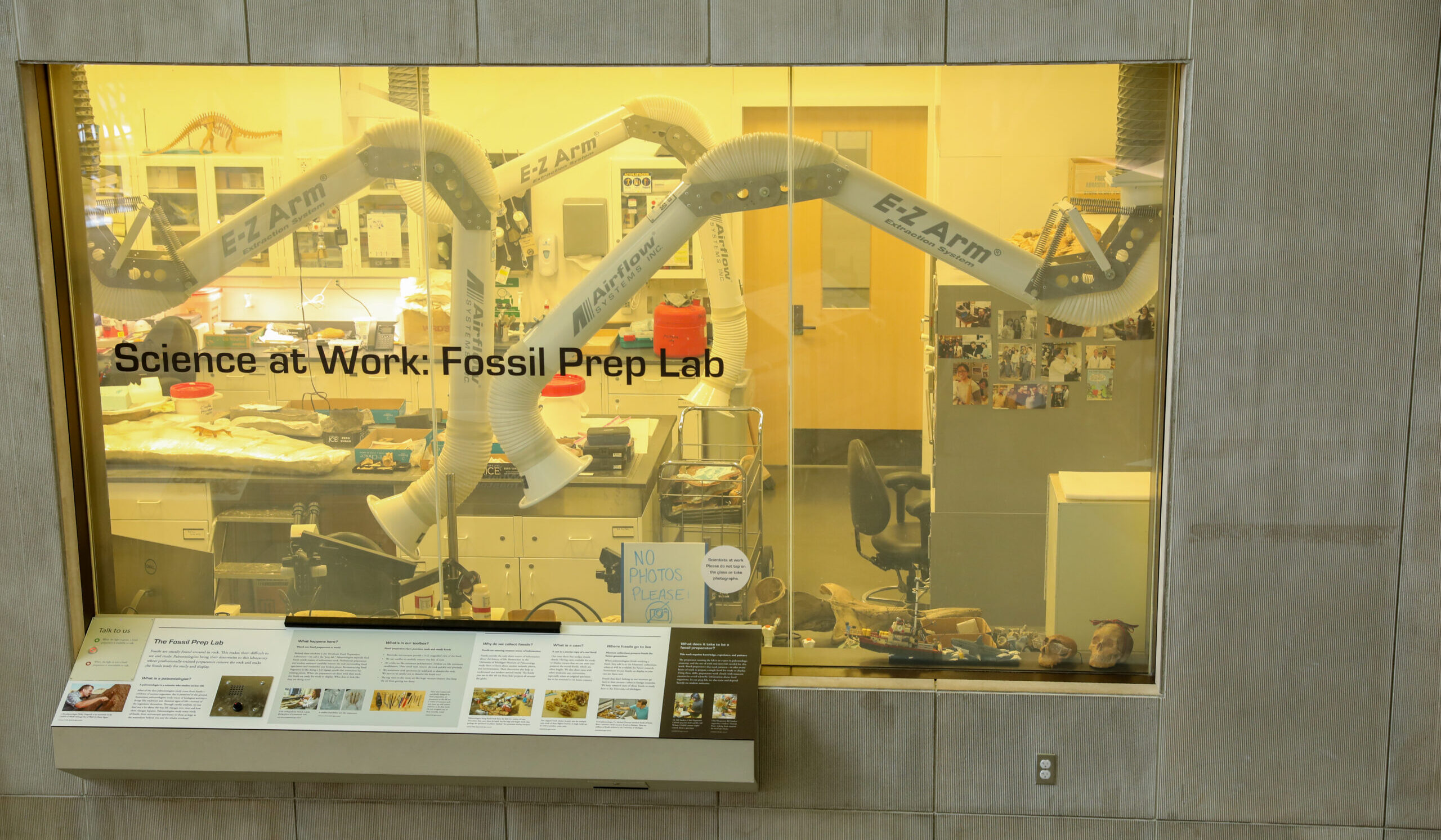
Inside the Fossil Prep Lab at the U-M Museum of Natural History (UMMNH), Chief Vertebrate Preparator Bill Sanders eagerly engages a group of young visitors peering curiously through the windows from the museum lobby.
Though separated by a large pane of glass, Sanders is able to communicate with them via headset and a two-way intercom system while he works.
“The way the lab is set up is very purposeful to encourage interaction with the public,” Sanders explains. “We’ve tried to arrange our workstations around the windows so that people can see what we’re doing, so they can see us at work, and they feel more of a connection with us.”
The Museum of Paleontology’s Vertebrate Fossil Preparation Lab is one of three fossil labs at the University of Michigan.
Supporting field- and collections-based research, the prep lab plays an integral role in supporting the scientific and educational mission of the U-M Museum of Paleontology, which is home to a world-renowned collection of nearly four million fossil objects and among the largest fossil archives in the country.
“We go to the field, we bring the fossils back, and we work with real fossils,” Sanders says. “We’re not just doing all theoretical work, but actually studying the fossils themselves.”
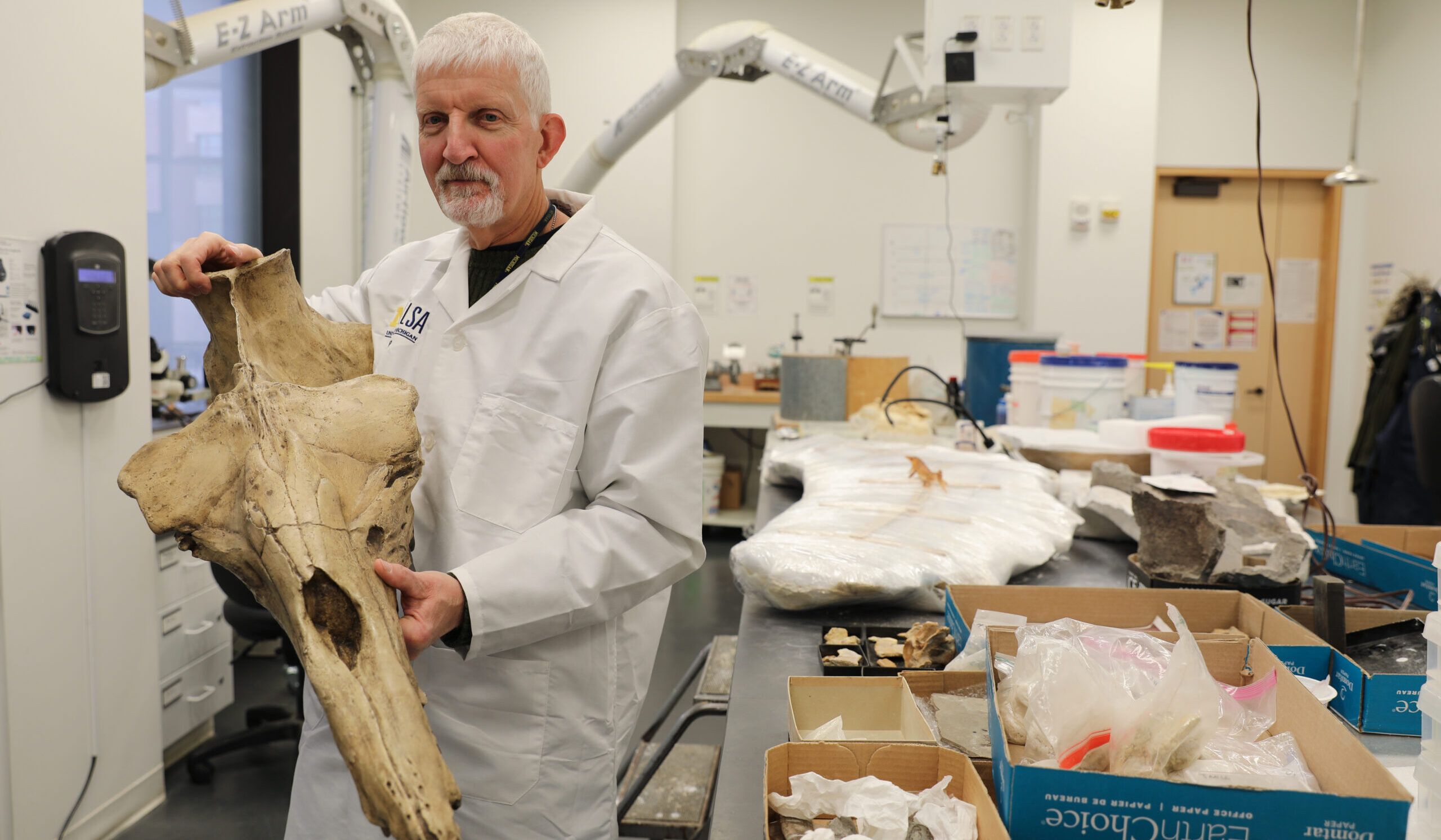
Standing with an indistinguishable replica of a prehistoric whale skull lifted high above his head, Sanders motions toward two Basilosaurus isis skeletons towering above them in the museum’s atrium.
“The animals that you see up overhead — those big whales — they’re from Egypt and they’re about 38 million years old,” he tells the group. “We spent years excavating them out of the field, brought them back to the lab, took them out of the rock, and then a bunch of students worked with me to make molds and casts like this [skull].”
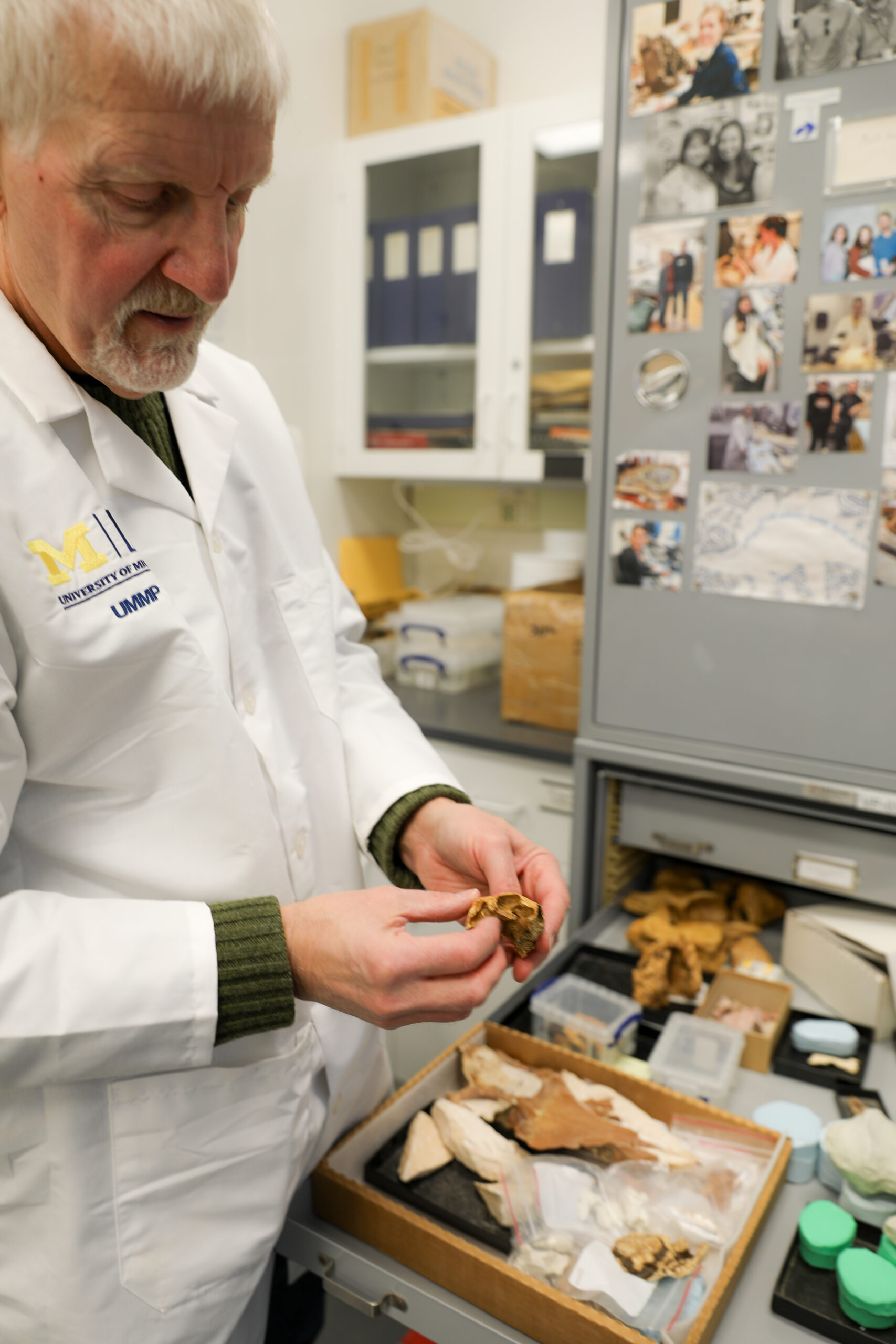
Each workstation is equipped with a microscope, air scribe, pin vises, and various precision tools — some of which Sanders says you might find at your dentist’s office — to help him and his small team of student assistants remove the sedimentary rock from fossils of all sizes, and prepare them for future study and curation.
Sanders is the only preparator here, but the presence of former students who worked in the lab can be felt through the collage of photos displayed on the wall and cabinet just beyond the lab’s window.
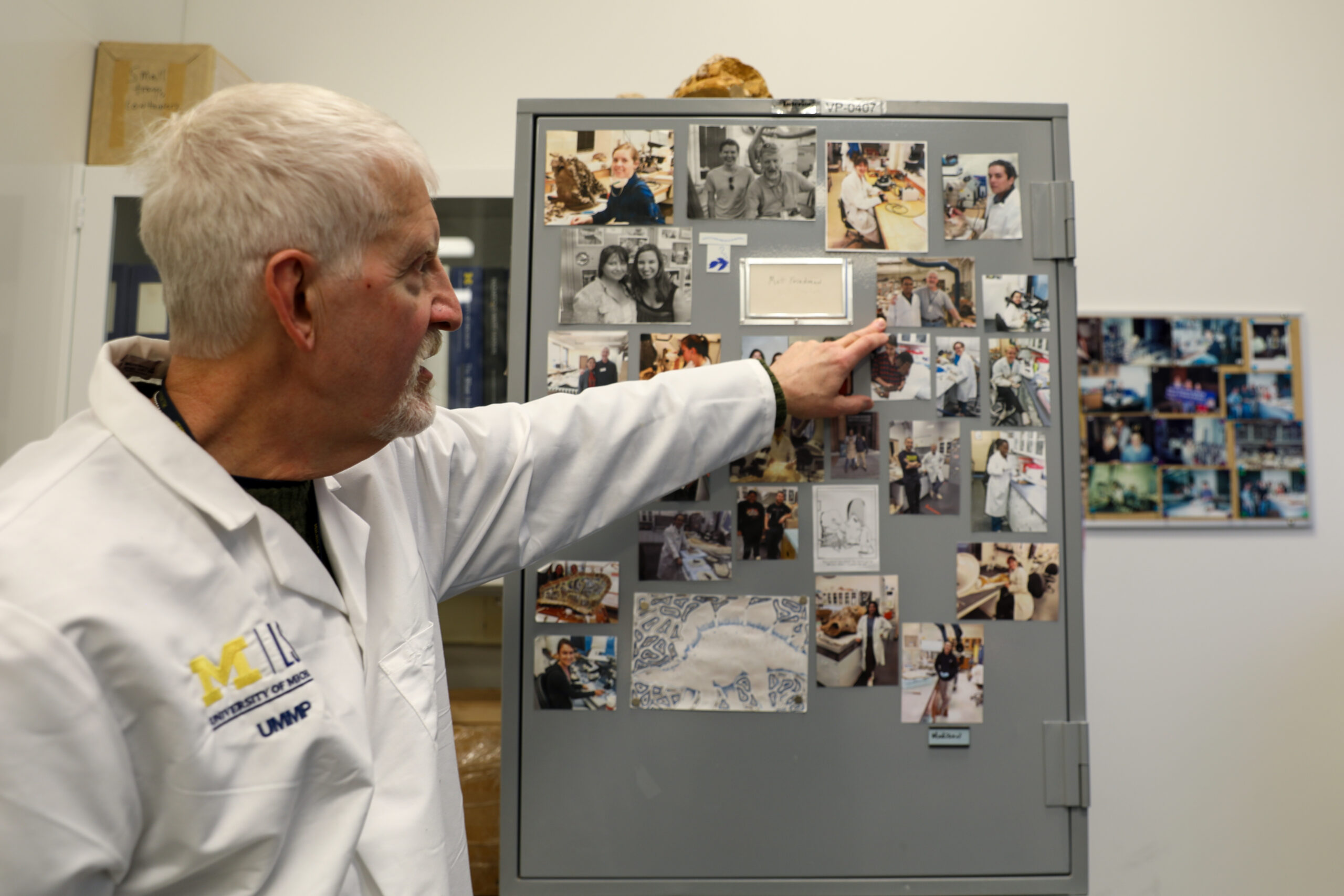
“Many of them go on to have careers in paleontology, in anthropology, or in biology, and some of them become professional preparators and conservators as well,” he says. “It’s a good place for students to interact with faculty, graduate students, with research scientists like myself, post-docs, and visiting researchers in a more informal way.”

In addition to their fossil prep work, Sanders and his team spends much of their time making molds and casts of fossils for research, display, and historic preservation — especially in cases where the fossils don’t belong to the University or if the original fossils are at risk of being damaged or destroyed.
“That’s a serious concern when many of the fossils you get come from developing countries that sometimes are politically unstable,” Sanders says. “Very few institutions do very much casting anymore. We’re one of the few places that still know how to do this.”
With every new student assistant who walks into the lab — or museum visitor eager to learn more about fossil preparation — Sanders says he sees a new opportunity to instill a passion for this meticulous work that tells us so much about the world around us.
“The diversity of life on Earth is amazing, especially when you add the component of time,” Sanders says. “Fossils are like the messengers of the past, and they can tell you all about them if you learn how to speak their language.”
Jenny Sherman is a writer and copy editor for Michigan Alum.