Learning Mindful Leadership
•
Illustrations by Kotryna Zukauskaite.
Yena Kwon, ’25, used to think there was one type of leader.
“My perception of a leader was someone who always had the loudest voice, who was charismatic, stood in front of the room,” she says. “But I quickly realized that isn’t really who I am.”
While getting her bachelor’s of business administration at the University of Michigan’s Ross School of Business, Kwon continued to see this monolithic idea of a leader. But when she found the Barger Leadership Institute, she was able to explore and shape her own leadership style, with the support of peer, staff, and faculty mentors.
“A big question for me, stepping into the University my first semester, was ‘How do I be a leader while still embracing my soft-sided, introverted self?’” Kwon remembers. “Getting that mentorship and support from a manager who I can trust and look up to really helped me develop my own leadership style.”

Kwon spent four years honing her leadership identity in U-M’s Barger Leadership Institute, where undergraduate students are engaging in immersive and interdisciplinary leadership experiences. The institute believes “leadership is a set of learnable characteristics, habits, and actions designed to connect and foster meaningful change.” Using techniques developed over more than a decade of mindfulness research by director Ramaswami Mahalingam, students like Kwon find support as they explore what it means to be “a leader they would want to follow.”
“Students think leaders are born — that’s a misconception,” Mahalingam says. “Leaders grow and they learn. It’s a process. That’s the first thing I work with students to really understand.”
A Solid Foundation
Founded in 2007 by Rick Price, U-M psychology professor and the founding director of the Organizational Studies Program — and named after a founding donor and U-M alum David Barger, the founder of JetBlue Airways — the Barger Leadership Institute (BLI) is housed within the College of Literature, Science, and the Arts and serves undergraduate students from across campus.
With more than 900 members, BLI offers students a variety of low-commitment opportunities for engagement, before progressing to one of many pathways for deeper involvement — experiences that prepare them to become leaders at the University, in professional settings, and in their communities.

Students begin with at least one learning experience that exposes them to BLI’s leadership concepts. There are several courses which students can take that help them define their personal leadership style through activities and experiences that explore their values, abilities, and visions. BLI also offers leadership retreats such as the Mindful Leader Retreat, which is newly hosted at Camp Michigania, the Alumni Association’s family camp.
The learning experiences prepare interested students for BLI’s fellowships in applied leadership, leadership teaching, and global peace, where undergrads can earn grant funding, lead leadership courses, complete a professional leadership certificate, and even study abroad.
“We want to create leaders who care about people and communities, which is the Michigan way,” Mahalingam says.
Mahalingam worked with the BLI staff to restructure the institute’s programming to its current state when he became the director in 2019. It was then that he implemented one of the program’s most influential changes: the “Mindful Mindset.”
Drawing from Buddhism, critical intersectionality theory, and a social justice perspective, the Mindful Mindset is a framework with seven features — compassion, sympathetic joy, critical intersectional awareness, negative capability, cultural humility, wonder, and generosity — through which leaders can view the world, make values-driven decisions and, ultimately, be more holistic leaders.
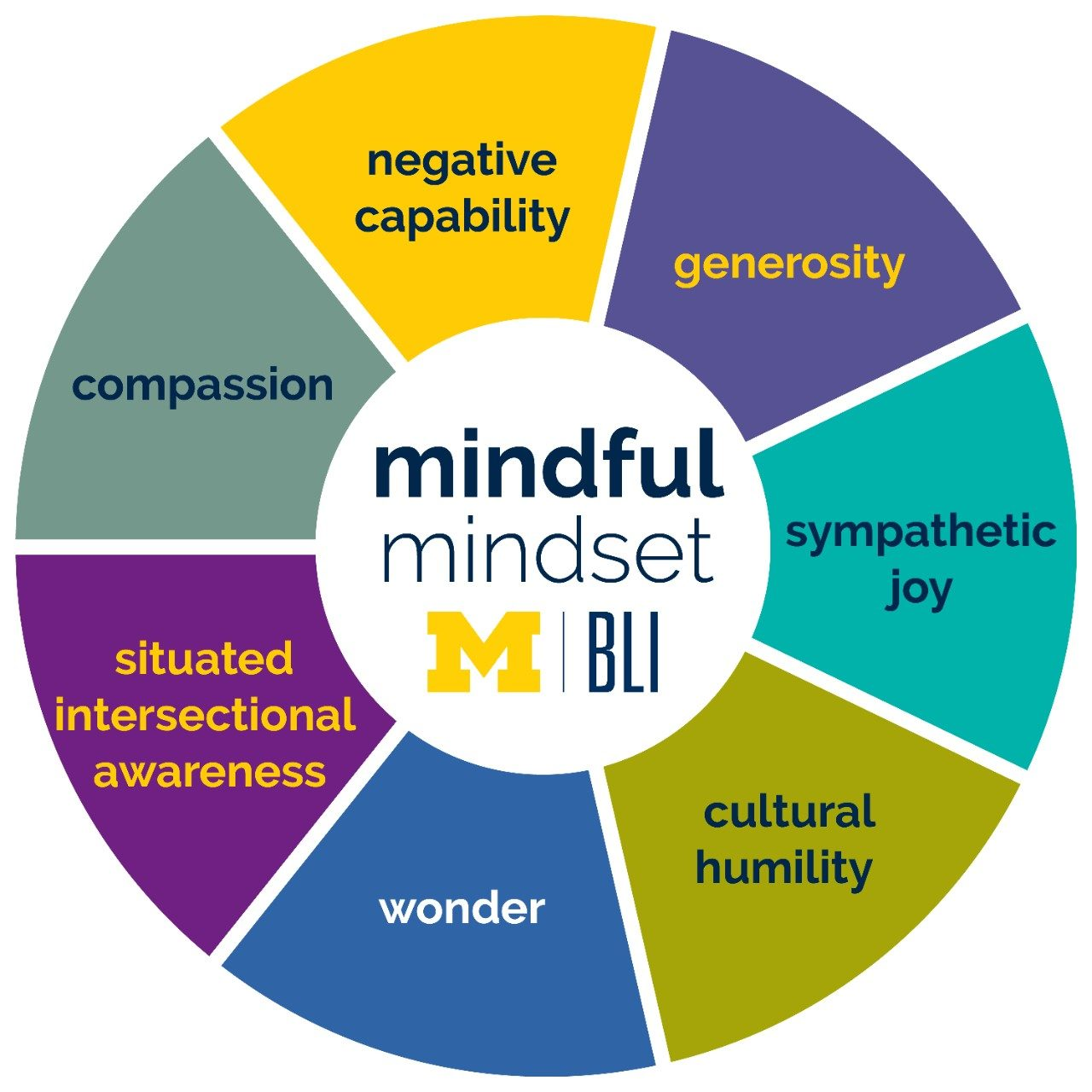
“In mindfulness programs, typically what happens is a lot of training, but without explicitly telling students what the values are — the ethical framework is always implicit. Most of the time, we have to really help students to really think about it in concrete terms,” he says. The Mindful Mindset, which Mahalingam integrated into all BLI programming, helps them do just that.
Mary Schlitt, ’01, MPA’17, became the associate director of the program in 2017, and says Mahalingam’s changes improved student impact by “leaps and bounds.”
“We are providing students with the tools to be more empathetic, compassionate leaders — folks who listen, who are present, who step back and take a critical lens to their own self and their values before they step into that leader role,” she says. “I think the Mindful Mindset has a lot of components of that. … We already start with great students, and any little nudge or expansion of the way they approach their work or the world gives them a greater advantage.”
Debunking Mindfulness
One of the misconceptions Mahalingam encounters most frequently is the idea that mindfulness is about meditation, and little else.
“If you’re mindful, it’s not about how long you’re going to meditate — which is important, you can do that. But if I meditate and I don’t treat my employees or my co-workers with respect, then there is no point being mindful at all,” he says.
While meditation is one action a person can take to practice mindfulness, others include journaling, art, exercise, and community discussion. These practices help individuals reflect on their values, mindset, and impact — and that ability to reflect and adapt is what being a mindful leader is about.
Mahalingam describes the institute as “high-contact,” with staff, faculty, and student leaders frequently engaging with each other, often on meaningful and intimate levels, as they use personal narratives to explore failure, humility, and growth in uncomfortability. Mahalingam interacts with students in class, at events, through individual assignment journals, and often because the students simply enjoy spending time with each other in the institute’s physical space in Weiser Hall on Central Campus.
“Many students actually spend more time in our space than in their major’s departments. We provided a safe space for them where they explore and we challenge them supportively. We created an environment where we try our best to really practice what we preach,” he says.

BLI provides a safe environment for students to reflect and explore, but the program’s leaders also emphasize the importance of “tough conversations” during students’ development — one of the program’s mantras is “feedback is love.”
“We say feedback is love, but it can not feel like love sometimes,” Schlitt says. “But it’s delivered with, always, reasoning and rationale.”
As a student, Kwon published an essay about team-building and effective communication. She says these lessons still affect how she views feedback.
“Through my four years at the BLI, I learned that feedback is truly love. If you use the right communication style with the right intention and the right framework, it can really help people grow. Now it’s kind of my love language, as corny as it sounds,” she says. “I think it’s key to healthy relationships regardless of whether you’re co-workers, family, or friends.”
Mentoring Future Leaders
Students from every U-M school have been part of BLI, but Schlitt says many students come to them from the hard sciences.
“They’re looking for their leadership identity, and they’re looking for someone that helps them discover that in an environment that’s comfortable with, I would say, ‘radical experimentation,’” she says, referring to BLI’s contemplative mindfulness practices.
BLI’s training is deliberately broad, and designed to be applied to any professional industry, from nonprofits to corporate finance. Rather than prescribing a single leadership style, through courses, fellowships, and meaningful engagement, the institute is emphasizing self-awareness, dignity, and compassion, with tools students can adapt as their personal and professional circumstances evolve.
“We provide a very foundational training that is broad enough that they can create their own path, their own trajectory, and appropriately use [these tools] at different moments in life, with a lot of awareness, respect, dignity for others, and compassion,” Mahalingam says. “I tell them, ‘I’m giving you a Swiss Army knife. How you’re going to use it depends on you.’”
Katherine Fiorillo is the senior editor of Michigan Alum.