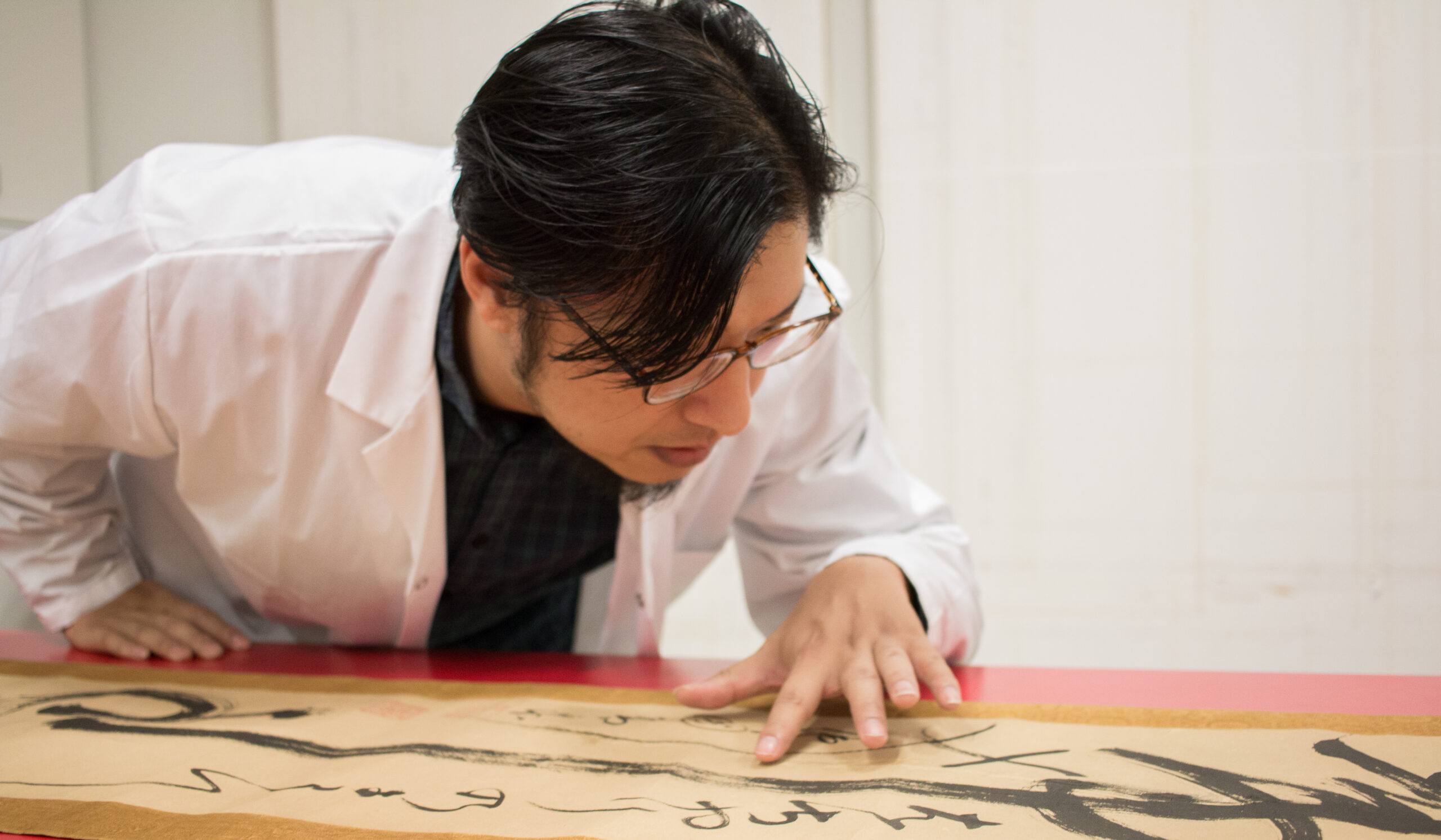
For nearly 40 years, conservators at the Robert B. Jacobs Asian Art Conservation Laboratory inside the University of Michigan Museum of Art (UMMA) have delicately and masterfully breathed new life into precious Asian artworks and other culturally significant relics in disrepair.
Qian He, Starr Conservator of Asian Art for UMMA, is the latest to serve in that procession and is now in his 10th year leading the lab’s operations — a job he refers to as a “lifelong calling.”
“Asian art is a pinnacle of human creativity and the soul of UMMA’s holdings,” He says. “By preserving these masterpieces, we provide the University with an eternal educational resource. Our mission is to radiate this excellence from Michigan to the world, ensuring that humanity’s greatest spiritual legacies endure physically for all time.”
Founded in 1987 with funding from the Starr Foundation, the Conservation Lab provides specialized in-house conservation, mounting, and remounting services to UMMA’s impressive collection of nearly 400 Chinese and Japanese paintings and more than 7,000 prints and drawings — a number that continues to grow year over year.
The lab also accepts works sourced from major art museums and private collectors around the world, and remains the only academic facility of its kind in the country that blends traditional East Asian conservation techniques with modern scientific restoration methods.
“We use natural materials like starch paste, Xuan paper, and silk, ensuring that every intervention is entirely reversible,” He says. “Unlike the Western pursuit of a ‘permanent fix,’ our tradition acknowledges that a work will need care every few centuries.”
As a fourth-generation art conservator, He says his work at the lab is deeply rooted in cross-generational knowledge of orthodox Chinese restoration techniques, affording the Museum and greater U-M community invaluable and unique insights into the precise time-honored skill of Chinese and East Asian art conservation.
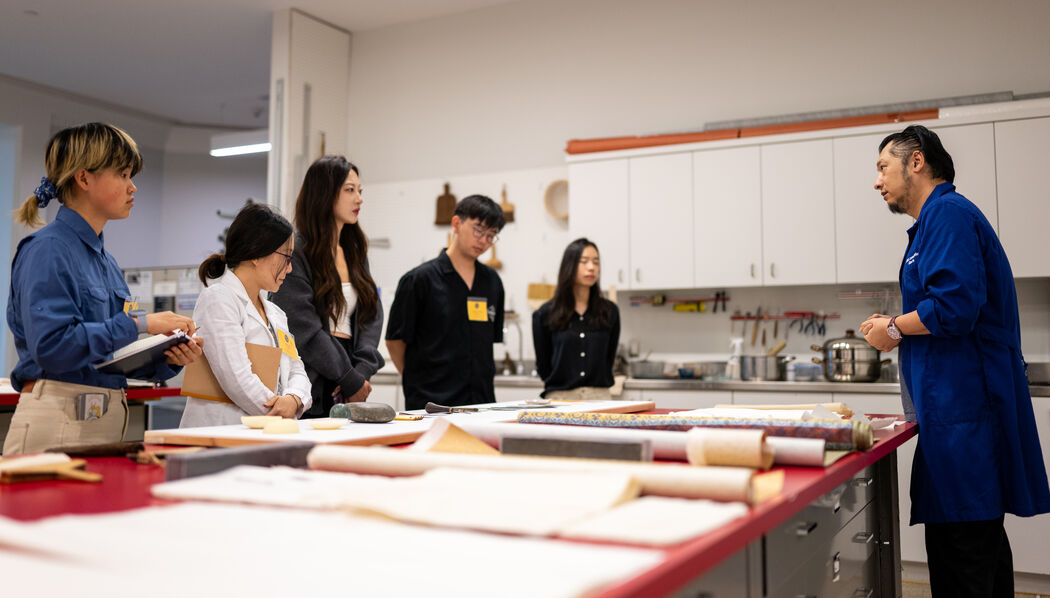
Because each art piece requires a customized treatment plan depending on the style, reason for deterioration, and age of the work — some pieces being many centuries old — He says he must prioritize the physical integrity of the artwork over high turnover.
“On average, we complete about 10 routine restoration projects each year,” he says. “However, for highly significant projects or exceptionally large-scale artworks, it is not uncommon for a single piece to require up to two years of dedicated conservation work.”
The process begins with an initial examination, followed by cleaning and consolidation of the artwork, a structural assessment and dismantling of the piece, completion of the core restoration work, and finally, its reassembly and protection.
“The time required depends entirely on the artifact’s condition and structural needs,” he says. “For an average painting, the actual hands-on manual labor typically amounts to 40 to 50 hours. However, the overall project timeline is usually stretched out to two to three months to properly accommodate the necessary resting, drying, and acclimatization periods between the different treatment phases.”
Following a recent $2 million endowment from a U-M alum in support of a permanent curator position for Asian art at UMMA, the lab’s integral role in preserving the museum’s important artworks and artifacts will only continue to grow alongside the collection.
“I am obsessed with the material immortality of these treasures,” He says. “I love the process of building this into a world-class research institution that will eventually radiate its standards and influence across the nation and the globe.”
Though the lab is typically viewable to the public, it’s expected to remain inaccessible through fall 2026 as renovations to the historic marble floors in Alumni Memorial Hall are completed.
Jenny Sherman is a writer and copy editor for Michigan Alum.