What It Means To Be Human
•
Photos by Cydney Scott Photography
When Grant Williams was leaving the Church of Jesus Christ of Latter-Day Saints, he was left questioning whether or not he could still be an honorable person if he became an atheist. He picked up a copy of “Good Without God: What a Billion Nonreligious People Do Believe,” a 2009 New York Times bestseller, and realized the author, Greg Epstein, ’99, MA’04, was a chaplain on his own campus at Harvard University.
But Epstein isn’t a religious chaplain — he’s a humanist one, a professionally trained member of the clergy who supports the ethical and communal lives of nonreligious people. For more than 20 years, he’s been helping students find meaning and purpose beyond religion.
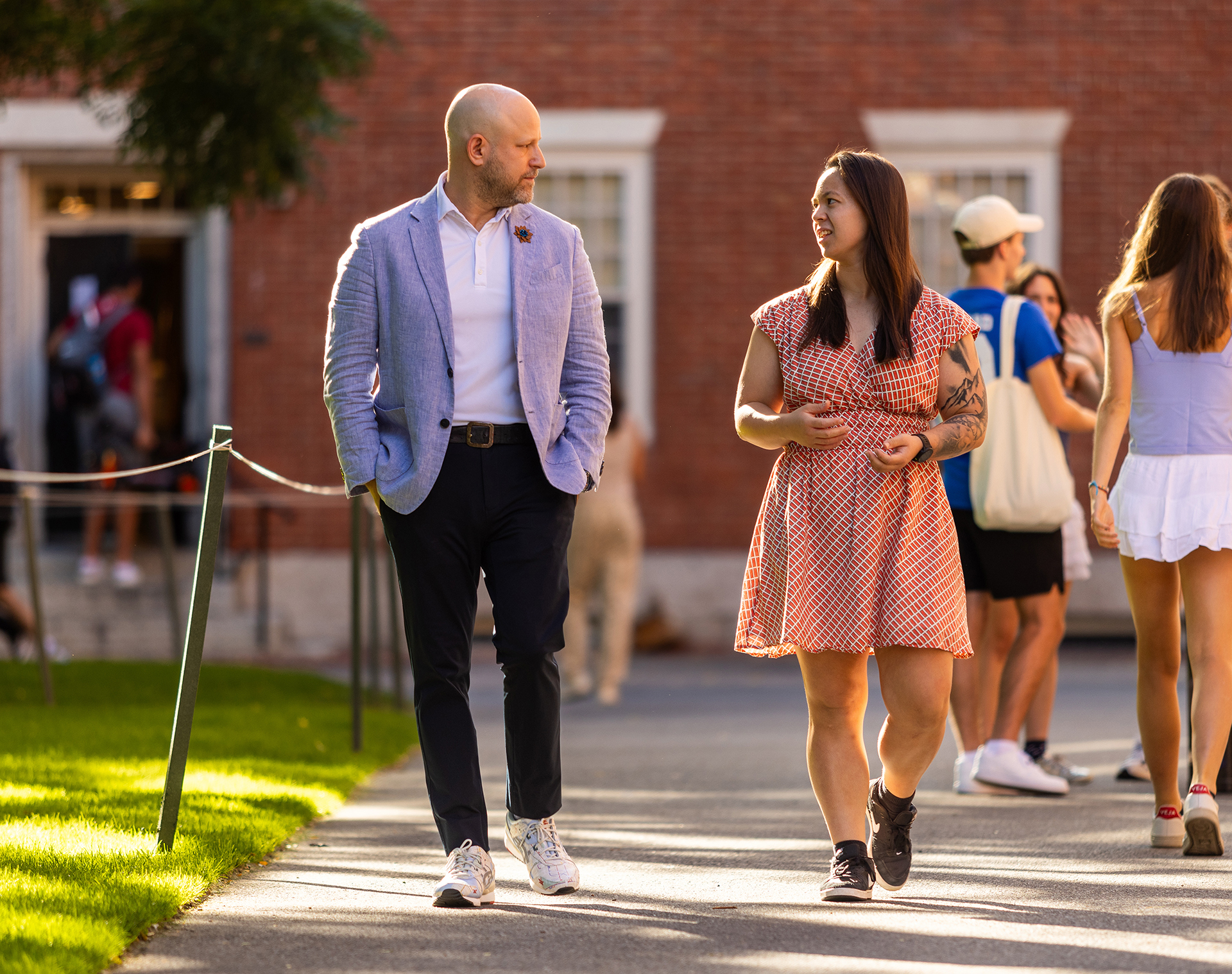
The two began to meet regularly, and Epstein introduced Williams, who was searching for community, to other secular students.
“Something about Greg that I really love and admire is he always wants a space to be as welcoming to everyone as possible, and he never casts himself as the teacher, per se,” Williams says. “He’s always facilitating conversation. He’s not one to give prescriptive advice. . . . Greg was just phenomenal at being a very inviting, kind, compassionate person that maybe is opposite to how some of society views nonreligious people.”

Epstein is one of the world’s most prominent humanist chaplains, and the second to hold the position at Harvard. After spending years exploring his own relationship to religion at the University of Michigan and around the world, Epstein was introduced to humanism and realized the humanist chaplaincy was the vocation he’d been seeking.
“It was a job that I had not known existed and was immediately fascinated by,” he says, “because here was a chance to do humanism in a communal context — humanism focused around meaning and purpose and the exploration of who young people were and who they wanted to be.”
The Path to Humanism
Epstein grew up in Queens, New York, in a culturally Jewish but nonreligious family.
“We were probably either atheist or agnostic, depending on the day,” he says, “but we never talked about it that way.”
His family valued asking the “big questions” and pursuing meaning and purpose.
“But how to do so, or what that required, the theology behind that, was an unanswered question in my childhood,” Epstein says. “And my time at U-M . . . was an opportunity to ask those questions more directly, and to combine a scholarly or academic approach to such questions with a very personal, practical search for answers.”
He came to the University of Michigan because he had decided he wanted to see the America that lay beyond New York City. His first day in Near Eastern Religions class, Ralph Williams, an “incredibly unusual and ultimately very charismatic and wise professor,” bounded to the lectern. Within minutes of the start of Williams’ lecture — punctuated by his enthusiastic hand gestures — Epstein was hooked. He declared a religion major, which he considered “a way to study what it is to be human.”
Epstein imagined Buddhism might hold the spiritual enlightenment he was seeking. At the suggestion of Robert Sharf, PhD’91, who taught Eastern religions, he became fluent enough in Mandarin Chinese to study Chan (or Zen) Buddhism in Taiwan over a summer.
“I went there looking for something transcendent, something beyond human,” he says. “I drew this conclusion that every religion was a human creation, and that I wasn’t going to find any special spiritual truth there that I couldn’t find anywhere else.”
After graduation, Epstein spent a year touring with Sugar Pill, a rock band that headlined The Blind Pig in Ann Arbor. Somewhat adrift, he met Rabbi Binyamin Biber, MSW’00, a student at the International Institute for Secular Humanistic Judaism in Farmington Hills, Michigan. Epstein remembers Biber observing that, despite Epstein’s lack of religious affiliation, the career interests he described resembled a clergy position.
Biber invited him to a class taught by Rabbi Sherwin Wine, ’50, MA’51, the founder of humanistic Judaism. The movement marries Jewish culture with humanism, which Epstein describes as “a positive, affirming, ethical philosophy of life for nonreligious people.”
Humanism, and Wine’s position as a secular rabbi, so resonated with Epstein that he enrolled that summer in the rabbinical program at the Institute. It required a master’s degree, so he began work toward a master’s in Judaic Studies at U-M.
Helping Others Find Purpose
In 2001, during a trip to Boston, Epstein arranged to meet with Tom Ferrick, who had served as Harvard’s first humanist chaplain since the 1970s. It was through their conversations that Epstein realized this was the calling he was looking for. When Ferrick hired an assistant in 2004, Epstein got the job, and he took over when Ferrick retired the following year.
Epstein earned a master’s in theological studies from Harvard Divinity School and in 2009 published “Good Without God.” The book argues that people can lead purposeful, affirming, compassionate lives without subscribing to a theistic worldview and concludes with an appeal for readers to start humanist communities.
Epstein launched the Humanist Hub, a secular congregation in Cambridge that grew to hundreds of weekly attendees, in December 2013. The Hub, which at its peak employed 11 staff, organized meditation and book groups, activities for families, and interfaith community service programs such as packing meals for food-insecure families in Boston.
But by 2018, Epstein was no longer convinced that secular humanist congregations were the answer.
The congregational model “requires such an enormous investment of human resources,” he says. “Even a lot of traditional religions are struggling to maintain their congregations, because it’s so labor intensive to do so.”
Over its 13-year run, Epstein had invested numerous 80-hour weeks in the fundraising and administrative work necessary to keep the Humanist Hub running. He was ready to focus his energy on something new.
"I started making a list of ways in which modern-day Silicon Valley tech can be compared to religion — and that list is never ending."
One day, while reading in a café, he was struck by an idea: in many people’s lives, social media had overtaken the religious (or secular) congregation as a source of human connection.
“I started thinking, are there other ways in which we’re getting our sense of meaning, our sense of purpose, our sense of our own humanity, from tech?’” he says. “I started making a list of ways in which modern-day Silicon Valley tech can be compared with religion — and that list is never ending.”
Tech executives, often portrayed as messianic geniuses, prophesied about the utopian futures their products would create. Thought leaders opined about what it meant to be human — but in debates about artificial intelligence, not how to lead an ethical life. Sometimes they took the metaphorical language even further.
“It’s not an accident that so many leaders in the AI world have referred to their creations as literal divinities,” Epstein says.
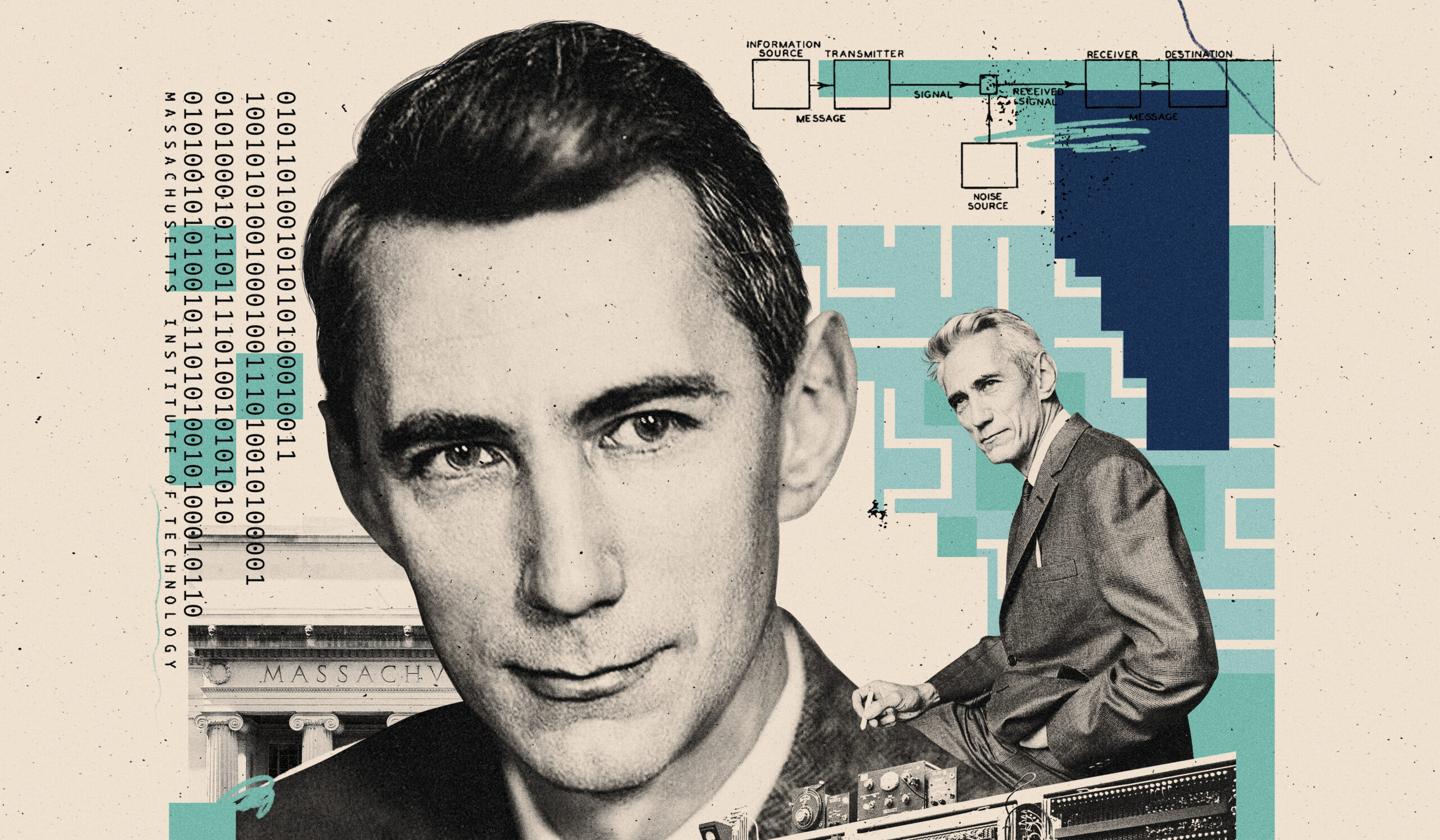
In October 2024, he published his analysis in “Tech Agnostic: How Technology Became the World’s Most Powerful Religion, and Why It Desperately Needs a Reformation” (MIT Press).
“I think many of those people are, without knowing so, worshiping at the altar of tech,” Epstein says, adding that he wrote “Tech Agnostic” partly as a consciousness-raising exercise. The book probes the “tech religion’s” theology, doctrine, visions of the future, views on charity, rituals, and leadership hierarchy.
Epstein expresses his skepticism about the tech religion, one that has the potential to exacerbate inequality, isolation, surveillance and exploitation.
“What I’m calling the tech religion may be more powerful at this point in time than all the other religions combined,” he says. “And that is not always for the good.”
The Big Questions
Epstein is working on more books to help a broad audience think through questions of meaning and ethics, including a graphic novel series, written with his friend Siwatu Moore, ’00, in which humanist philosophy figures prominently.
He’s also working on a project funded by the Omidyar Network, a tech- and social justice-focused foundation supported by eBay founder Pierre Omidyar, that will convene leaders of religious and humanist communities — and even tech leaders — for discussions about Silicon Valley’s cultural influence and what it means to be human.
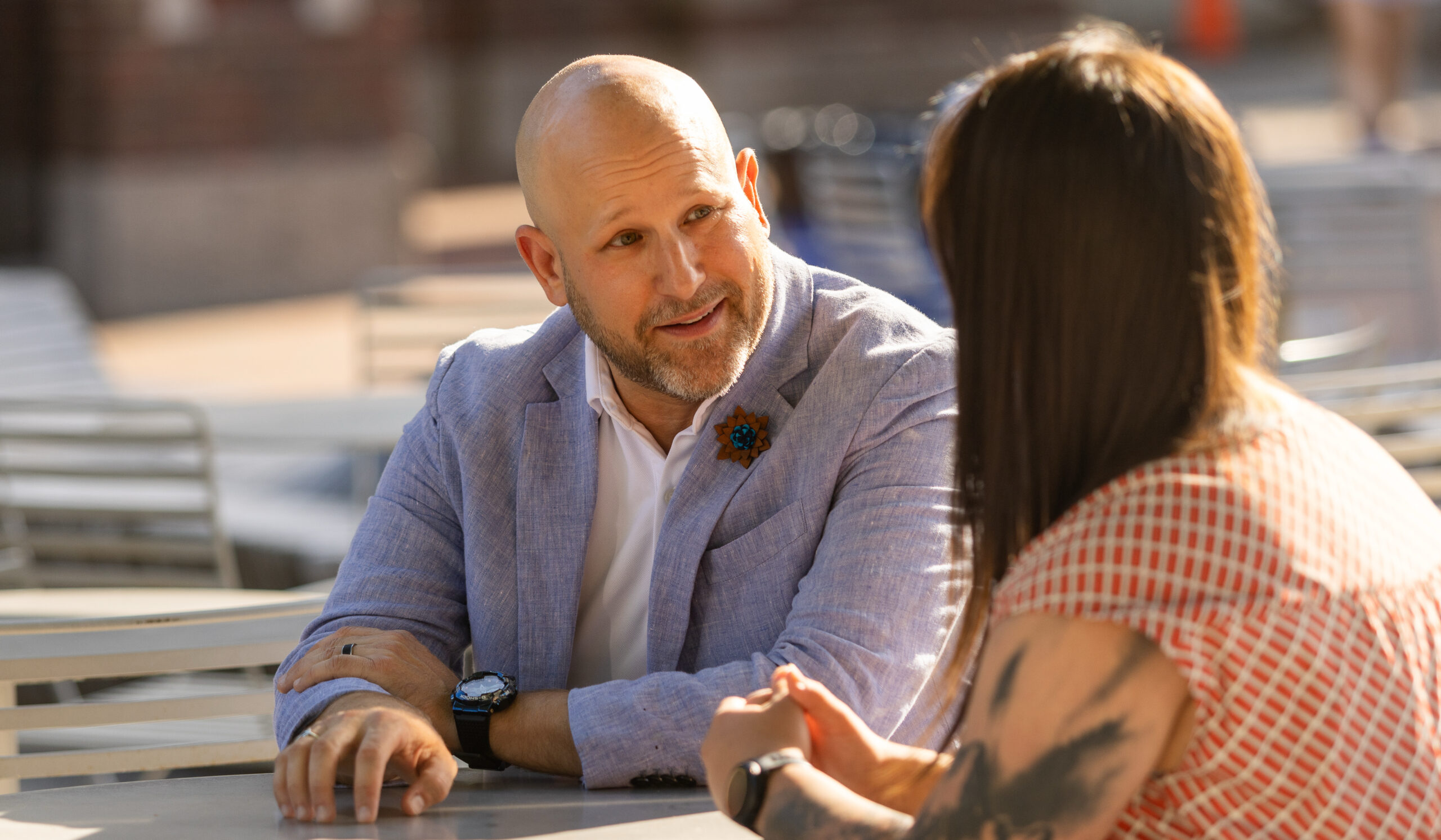
But since ending operations of the Humanist Hub, Epstein has dedicated additional time to chaplaincy work at Harvard and at the Massachusetts Institute of Technology, where he was appointed in 2018. He wanted to spend more time helping students think about humanity’s important questions: “Who do I want to be? How do I want to live?”
“I can’t think of a more important thing to do in one’s time on this planet than to determine the purpose of one’s life,” Epstein says. “What makes for meaningful work to me at this stage of my career is I want to help people to feel that they are achieving a sense of meaningful purpose in their life. I want to help people who are coming at any kind of search for purpose from a mostly secular or nonreligious perspective to feel that there are positive nonreligious values, aka humanism, that they can draw on to live a meaningful and ethical life, and have a sense of connection to community.”
Robyn Ross is a freelance journalist based in Austin, Texas.