The years 1970-71 were not the carefree college years I had expected. I began as a freshman at the University of Michigan in 1968, amidst the “free love,” hippie-influenced years. The anti-war and civil rights movements were gaining acceptance and peace seemed possible; social change, inevitable.
But something was off. Richard Nixon had been elected President in a chaotic campaign during which Martin Luther King Jr. and Robert F. Kennedy were assassinated and George Wallace stirred violent white supremacist undercurrents. Civil unrest and violence dominated the news cycles. The Tate/LaBianca murders were said to have been the beginning of the end for the flower power movement. A serial killer who had terrorized the Ann Arbor area was finally arrested and convicted. Then, in May 1970, National Guardsmen opened fire on unarmed students at Kent State, killing four and wounding nine others. Echoes of the 1960s civil rights, anti-war, and liberation movements continued to ripple through American society, even as violence and intolerance reigned.
And I wasn’t having much fun as a psychology major, unable to comprehend this swerve into chaos. By 1972, I was feeling like I just needed to finish school as soon as possible and find my way “out there.” I enrolled in Psychology 474, Introduction to Behavior Modification, without many expectations. A new book by Harvard behavioral psychologist B.F. Skinner — “Beyond Freedom and Dignity” — was making waves and I wanted to know more about this emerging field of behavior modification. Teaching that trimester was James V. McConnell. He was to mark a turning point for me in my U-M studies.

McConnell was already (in)famous around campus and nationally for his Journal of Biological Psychology which was co-published (upside down and backwards) with the Worm Runner’s Digest, a satirical “journal” of pseudoscience masquerading as serious research. Each of the articles was flawed in sometimes obvious, sometimes obscure ways. A reader had to think critically and systematically about the content before discovering the fatal flaws in theory or methodology that signaled “fake.”
The first day of class in January 1972 with McConnell set the tone. He sat to the side of the rows of desks as students filed in, seemingly oblivious to their passing. Minutes ticked by and he made no move. Then, he suddenly rose and walked over to an unsuspecting student and, standing over them without introduction, asked, “Why did you come here today?” The perplexed student muttered a response, something like, “Because I’m signed up for this class.” McConnell responded, “And why did you sign up for this class?” And the inquisition went on and on and on until finally the embarrassed and baffled student responded to one of McConnell’s endless questions with, “Uh, I don’t know…”
“BINGO,” shouted McConnell, and handed the confused student a candy bar. “That’s what we’re here for — to understand why we do what we do.”
The candy bar was, of course, intended as positive reinforcement for bearing up under his questioning and would reappear during succeeding classes when McConnell would employ his Socratic Q&A to encourage students to examine their own beliefs and assumptions. At first, it all seemed so staged and unfeeling. But between discussions of operant vs. classical conditioning, positive vs. negative reinforcement, and extinction, it started to dawn on me and my fellow classmates that McConnell was challenging basic assumptions about human behavior, autonomy, and freedom (à la Skinner).
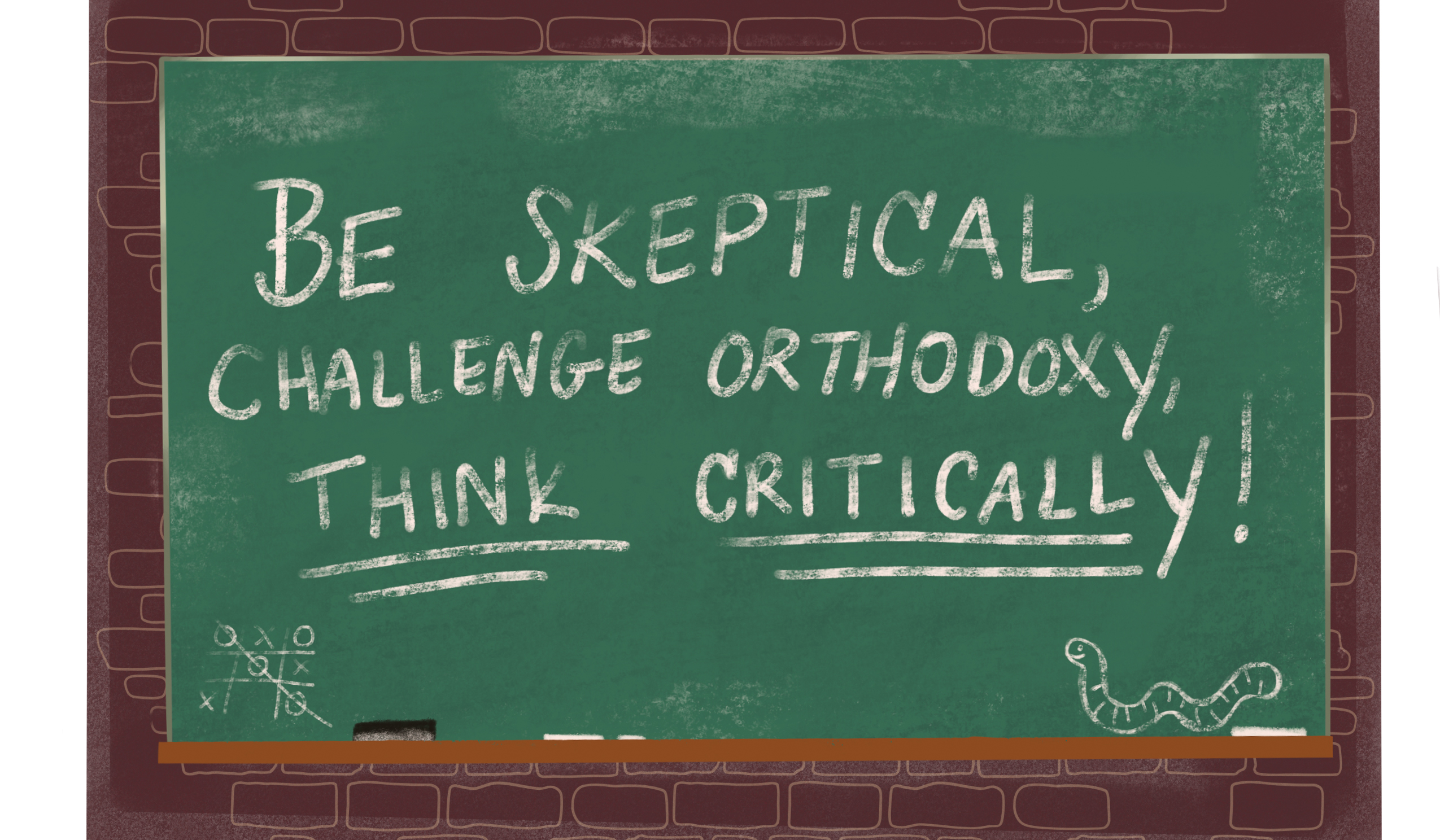
“Be skeptical; challenge orthodoxy; think critically” were McConnell’s bywords. In his psychological view, much (or all) of human behavior was predetermined by how one’s expectations of rewards and punishments had been shaped by the environment. He openly challenged psychoanalysts to “prove” they could cure their patients using behavioral measures. Antisocial and aberrant behaviors were the result of environments which rewarded such behavior, but these behaviors could be modified by changing the environmental conditions of those so affected.
I started to look at social upheaval not as inherently malicious but the result of a predictable and omnipresent set of conditions that could be changed to make a better world. Most importantly, I started to see a future for myself in psychology. Oh — and I got an “A.”
In an ironic epilogue, James McConnell was partially deafened when the 10th known package bomb from Ted Kaczynski, MA’64, PhD’67, — the Unabomber — arrived at his Ann Arbor home in 1985. Social violence may be predictable but is not always preventable.
Bruce Flynn, ’72, a third-generation Wolverine, is retired and hails from Sonoma, California.