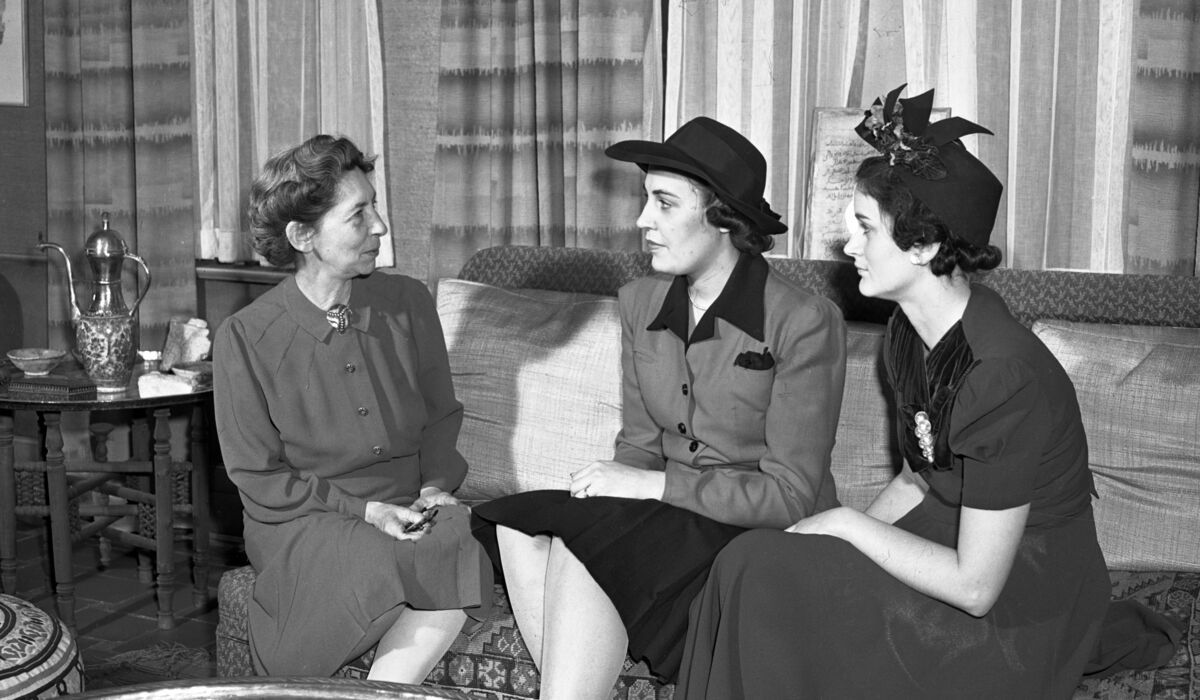
“The wives of graduate students and interns,” wrote Michigan Daily associate editor Ethel Norberg, ’40, ’42, in 1939, “Make up the membership of one of the most active organizations on the University campus, the University of Michigan Dames.”
Dedicated to a mission of providing betterment for its members, the Michigan Dames funded various social, educational, special interest, and charitable activities. Most of all, the Dames provided a structure of assistance and chance to connect with others in what could easily be an isolating experience.
While the place of female students continued to be pushed forward at U-M and broadly, they had to deal with the realities of the present. As their husbands pursued advanced degrees at U-M, most of the wives themselves were college graduates in fields ranging from romance languages to aerospace engineering by the late 1930s. Often, both husband and wife took part-time jobs to afford school while also taking care of their children. But with homemaking and housekeeping responsibilities still falling to the women, a club to connect them in community made sense.
In 1890, years before U-M appointed Eliza Mosher, MD1875, as its first dean of women students, female faculty and wives of students formed the Women’s League to help organize and alleviate the experience for incoming women.
Perhaps sensing a need for a more specialized club, graduate student Frances Adams organized an initial group of 20 women as the Michigan Dames in 1914. The idea was not U-M’s alone. Possibly the earliest Dames club was formed at Harvard University in 1896. The National Association of University Dames was formed initially by chapters at the University of Chicago and the University of Iowa in 1921; in the same year, U-M’s club became the fourth to be granted a charter.
The year 1921 would prove to be significant for women at U-M. It marked the launch of the Alumnae Council of the Alumni Association’s fundraising for the building of the Michigan League, which would serve the female students as the Michigan Union did for the men. The year also saw the formation of U-M’s Faculty Women’s Club, which supported its own members and as patronesses and advisors to the Michigan Dames. The Dames had an official advisory board of wives of administrative officers and faculty members of the University, such as Florence Ruthven, 1904, wife of U-M President Alexander G. Ruthven, PhD1906, HLLD’53.
It’s not clear when the Michigan Dames ceased activities. While similar organizations continue today at other schools (such as the Harvard Students’ Spouses & Partners Association), and the Faculty Women’s Club celebrates its 104th year this fall, recruitment and general meeting notices for the Michigan Dames disappear from The Michigan Daily in the early 1970s. A parallel may lie in the story of the Women’s League. Over the course of the 1960s, women at U-M began to hold office in student government, the Office of Student Affairs took over for separate dean positions overseeing men and women, and student activities for the Michigan Union and League also became centralized (directly leading to the official end of any gendered use of the facility or its doors).
The spirit of the Women’s League’s work was certainly not finished, but its form dissolved and reformed in other avenues. So, too, does that appear to be the case with U-M’s chapter of Dames.
Gregory Lucas-Myers, ’10, is the senior associate editor of Michigan Alum.