Through decades of collecting and research, David Tinder, ’49, amassed a comprehensive archive of early Michigan photography, now preserved at the Clements Library.
David Tinder, ’49, had a favorite “stunt” he liked to perform when a new visitor arrived in his suburban metro Detroit apartment. He’d ask what town in Michigan they were from, dig in his photography collection — “packed to the ceiling,” as several friends recall — and find an old photograph of that town the new friend had never seen before.
“Dave just delighted in that kind of stuff, with a big smile on his face, he’d pull out these photos and the visitor would just be awestruck,” says Clayton Lewis. “He did that time and time again, but he was very willing to share, willing to let his photos be published by others, and be used for different projects. And that, I think, made him an attractive figure to a lot of people.”
Tinder was a renowned collector of early Michigan photography. As the curator of graphic materials at U-M’s William L. Clements Library in 2002, Lewis was encouraged to get to know the collectors of the area, as the library had a long history of collection building in this manner, beginning with William Clements, 1882, himself.
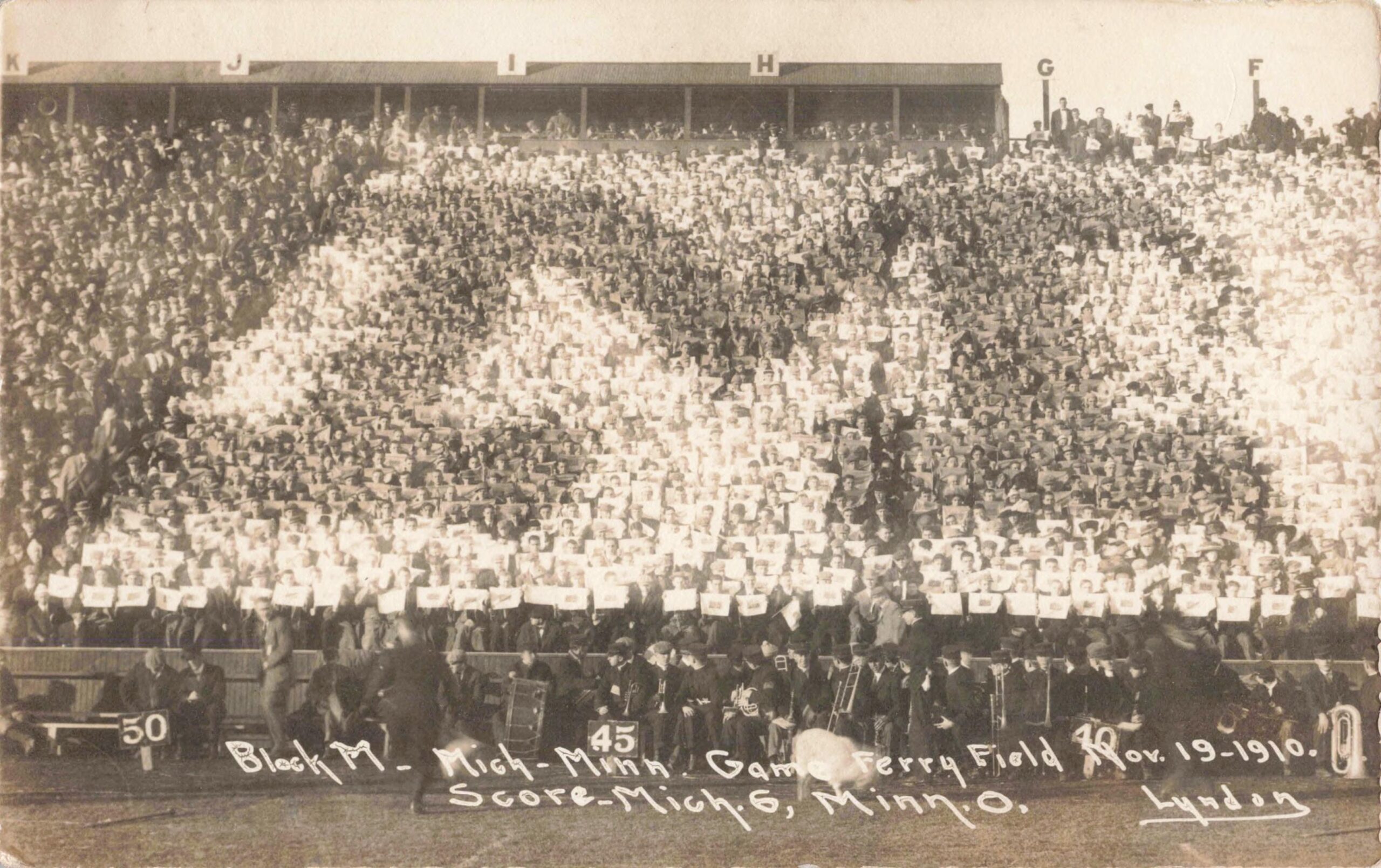
U-M students hold blue and yellow flags to create the Block M in the crowd at the Michigan vs Minnesota football game on Nov. 19, 1910. Photo courtesy of the William L. Clements Library.
Knowing photography would be a revelatory research resource, Lewis was introduced to Tinder on a visit to his apartment, alongside the library’s director, and was wildly impressed with the significance of what he’d seen.
“We started brainstorming ideas about how the University could possibly acquire this great collection. Dave Tinder was not a rich man. He wasn’t in a position where he could just outright donate it, and he had invested pretty much almost everything he had in terms of his financial resources into his collection.
“That’s when Dave Walters stepped in and helped guarantee that that could happen,” Lewis says.
Purchased by Clements Library Associates Board of Governors member David Walters in 2006 and incrementally donated to the University’s research library in honor of Walters’ parents, Harold L. Walters, ’47, and Marilyn S. Walters, ’50, the David V. Tinder Collection of Michigan Photography consists of more than 100,000 images in a variety of formats, capturing everyday life in Michigan from the 1840s into the mid-twentieth century. Amassed over Tinder’s lifetime, the collection is now housed at the Clements Library on the University of Michigan’s Central Campus.
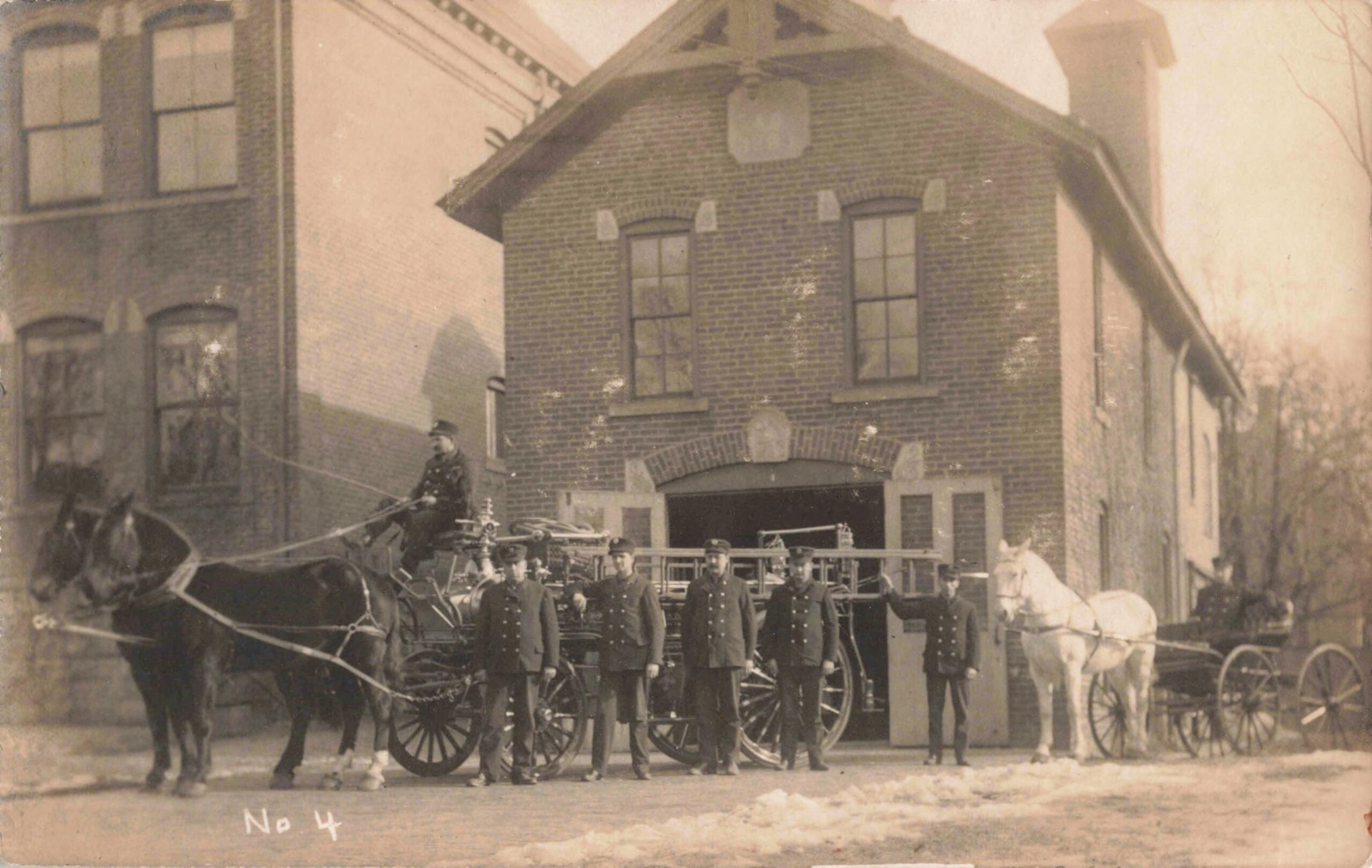
An Ann Arbor, Michigan fire station in 1908. Photo courtesy of the William L. Clements Library.
“It was very gratifying for me to be able to have a small hand in that, but certainly, it was Dave [Tinder’s] effort that made this whole thing possible,” Walters says. “I don’t think there will be a serious publication about the state of Michigan that doesn’t include material from the Tinder Collection. There are other great collections of state photography, but I think Tinder certainly ranks up there as a seminal collection of state photography.”
Developing an Archive
Tinder graduated from the University of Michigan with a degree in physics after serving in the U.S. Navy as an electronic technician’s mate. He spent the majority of his career as a project engineer and product development manager for automotive manufacturers and suppliers in the Detroit area, and was issued 16 U.S. patents.
Tinder began collecting antiques and art in the 1950s, and shifted to international photographic stereo views before focusing on early Michigan photography in the 1970s. By the following decade, he was a well-known collector in the state.
Cynthia Motzenbecker, who served as treasurer of the Michigan Photographic Historical Society for 20 years and president for another 18, first heard about Tinder at local flea markets before finally meeting him at one such event. The two started trading photos and became lifelong friends. Motzenbecker recalls attending many antique shows with Tinder.
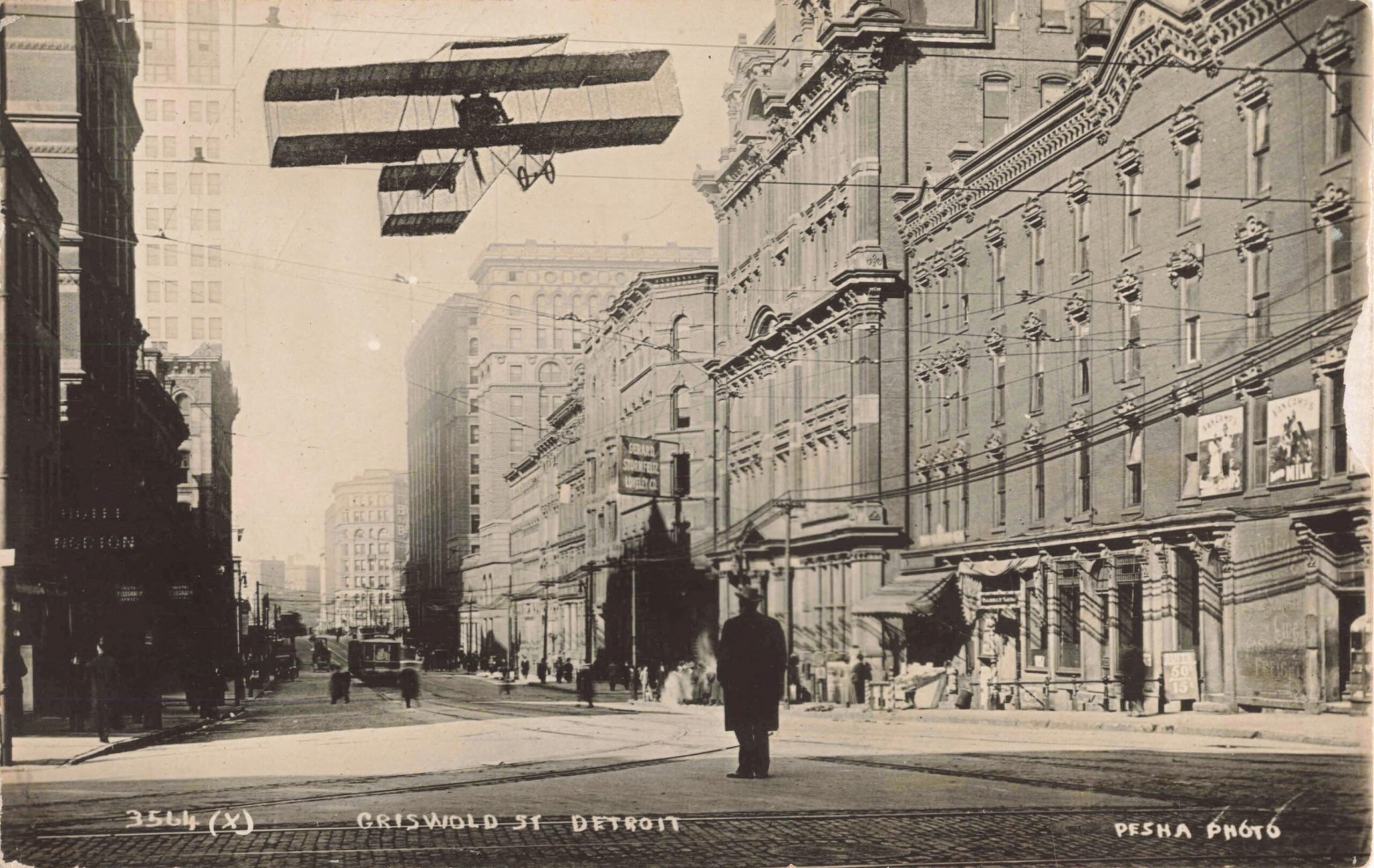
This 1910 image by Louis James Pesha depicts Griswold Street in Detroit. Photo courtesy of the William L. Clements Library.
“He would wear a T-shirt and with a button-up shirt over it, and then he would stick the shirt in his pants and he’d fill up his shirt with all this stuff so he wouldn’t have to carry it,” Motzenbecker recalls. “And then on the way home in the car, he’d start looking at [the photographs].”
Tinder collected images at antique and trade shows and by traveling to small shops around the state, and later with the help of online reselling platforms like eBay and Etsy. But the community he established also largely aided his efforts.
“A lot of these dealers got to know Dave and what he was interested in, and they’d set stuff aside for him. So when Dave showed up at one of these antique fairs, the dealers would have a little box of stuff just for him to go through, and he would buy it up,” Lewis says. “I think it got to the point where other collectors of early Michigan photography would feel guilty if they had something really good.”
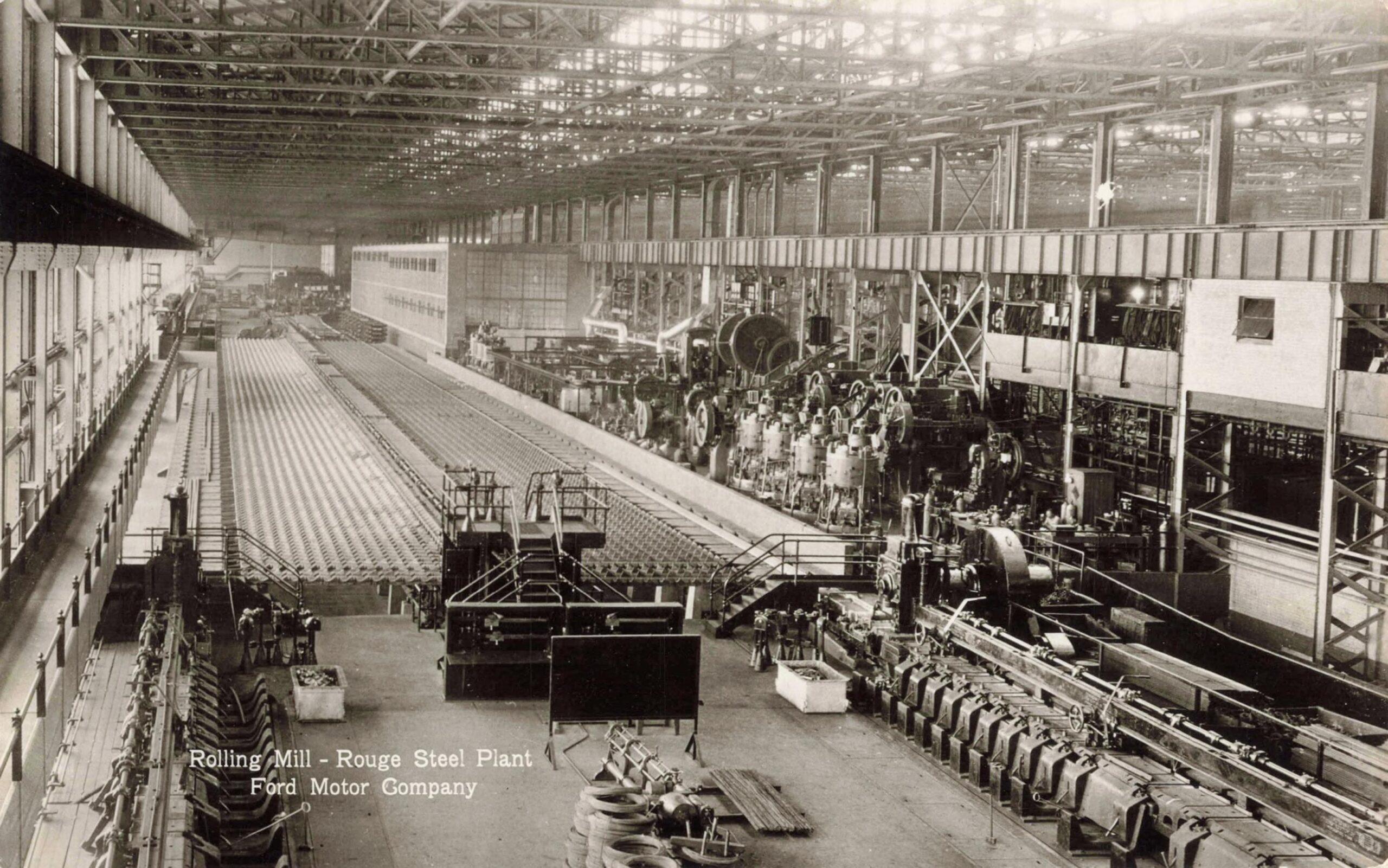
The interior of the Rolling Mill in Ford Motor Company's Rouge Steel Plant. Photo courtesy of the William L. Clements Library.
Today, the Tinder Collection is comprised of daguerreotypes, cartes de visites, cabinet photographs, real photo postcards, and many other photo formats, with images by professional and amateur photographers, capturing Michigan towns, societal and construction development, and glimpses into ways of life.
“The significance is both the quality of the images, some of which are exceedingly rare, and show us glimpses of American life that are unrecorded in any other form. But it’s also, in the case of the Tinder Collection, the sheer size, the number of images, is extraordinary. By using the collection as a research resource, there’s no stone unturned. You’re seeing this incredibly wide swath of information in visual American life,” Lewis says.
It wasn’t a simple decision to have Tinder’s expansive archive entrusted to the Clements.
Though the collection could have been sold for a significant price, Tinder wasn’t interested in selling. But years earlier, there had been a small fire in his apartment, where about 10 percent of the collection was lost, emphasizing a concern over secure guardianship, both to protect the collection and preserve Tinder’s work. Through an agreement between Tinder, Walters, and the library, Walters purchased and incrementally donated the images to the Clements, which also offered Tinder the means to continue to grow the collection.
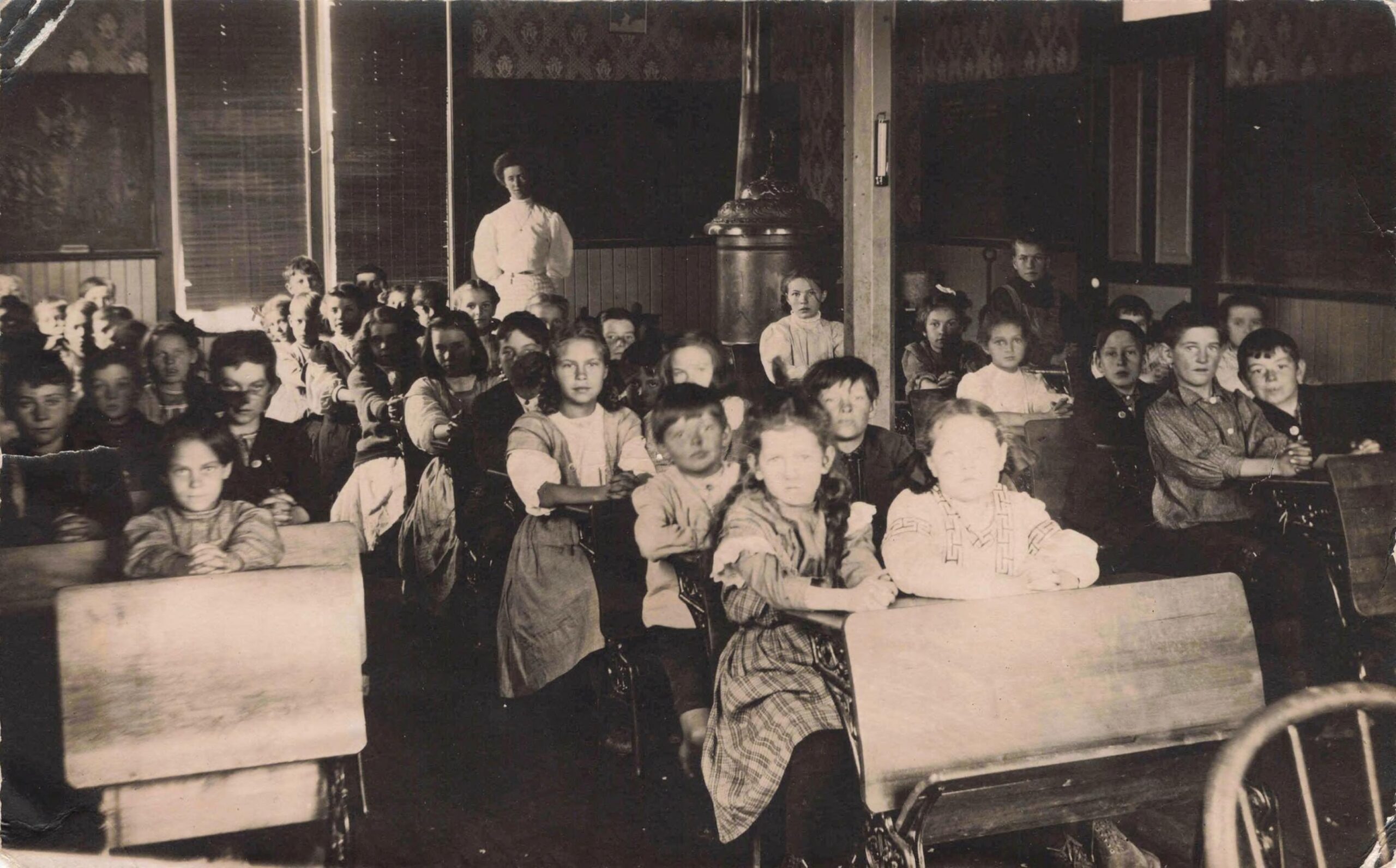
The inside of the Boyne School schoolroom in 1908. Photo courtesy of the William L. Clements Library.
Though Tinder died in 2016, his friends remember that Tinder felt the collection going to the Clements was “bittersweet,” but ultimately a positive development for him and the collection. After his death, Lewis recalls finding a letter Tinder penned to another collector about the archive’s transfer.
“The first load of material had just gone to the Clements Library, and he said he had initially a lot of mixed feelings about it, sort of a sadness of losing so much of this collection that he had built up over the years. But then he said he came around to the idea of how great he felt about the idea of other people putting it to use,” Lewis says. “I can’t remember exactly how he expressed it, but he said he was really surprised within himself how good he felt about the whole thing. It definitely energized him to keep on going.”
Seminal Collection
As Tinder amassed photographs, his pursuits took on a research dimension that extended into the people behind the images.
“Different collectors have a different vision and a different idea of what is important. For Dave, he got really interested in the photographers themselves. These 19th century entrepreneurs that were taking the pictures, he wanted to know more about how they worked and what their lives were like, and a lot of his collecting was for the purpose of documenting the behavior of the photographers — where they worked and what kinds of pictures they took and who their clients were — and he ultimately started putting together a reference work, a directory of early Michigan photographers that is unlike anything else anybody had ever done in terms of its detail,” Lewis says.
Published in 2013, the “Directory of Early Michigan Photographers” is a 2,850-page document, covering more than 8,000 men and women who played significant roles in the first 80 years of the photography business in Michigan, with an alphabetical directory of each photographer and short biographies, as well as a community directory, with photographers listed by the Michigan communities and towns they worked in.
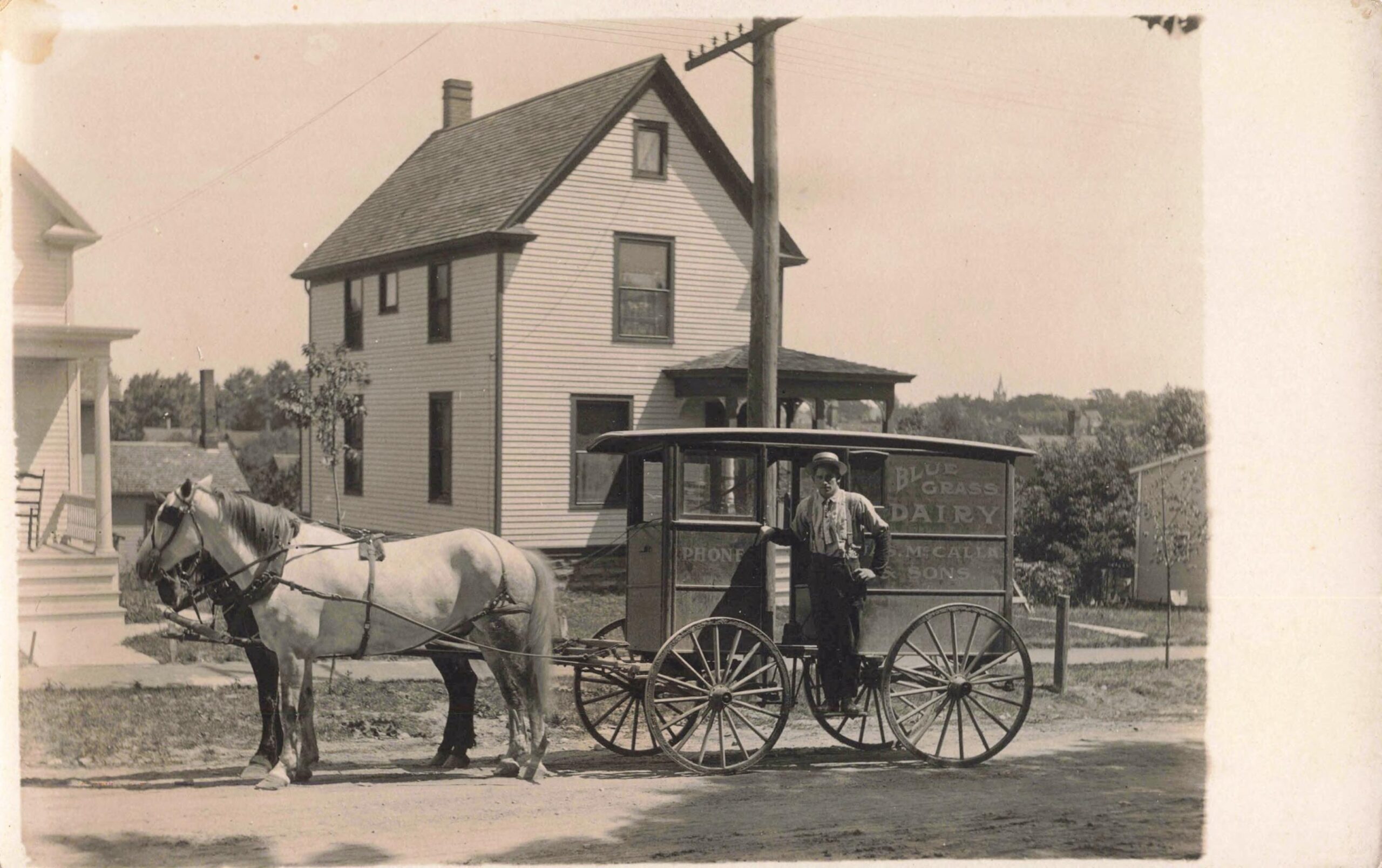
Taken in Ann Arbor, this photo from 1900 shows a horse-drawn carriage for a "dairy man" or "milk dealer," as was written on the back of this photograph. Photo courtesy of the William L. Clements Library.
Sierra Luddasaw, the current curator of graphics at the Clements Library, says the directory is impressive, but even more so are Tinder’s notes that reveal the depth of his research.
“That database is based on his three-ring binders and there’s even more in the binders. It’s all of his research of trying to track down every place this [photographer] had a studio and what years their studio was there, which you see reflected in that photographer file that’s online and thousands of pages long — amplify that to a whole cart of three binders,” she says. “His knowledge and research, encompassing almost all of the early photographers in Michigan, is really what makes it special.”
Scholars, researchers, and students will continue to use the Tinder Collection to reveal new insights about photography, our history, and our society — and it’s all thanks to the team at the Clements and Tinder’s lifetime of work on the collection and directory. About 66,000 photographs from the collection have been digitized, and library staff have been working diligently to digitize and open more of the collection for research.
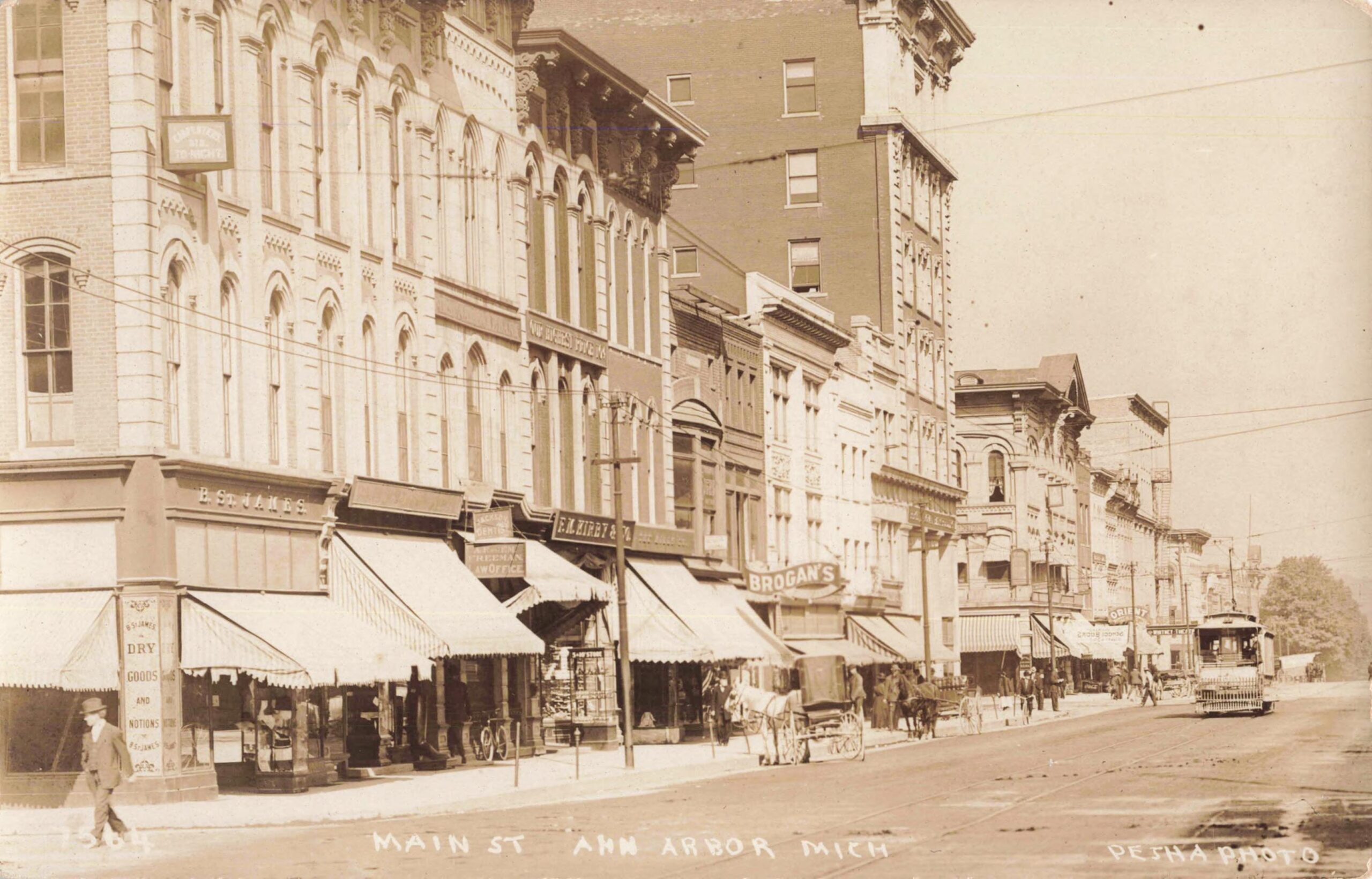
Main Street in Ann Arbor, year unknown. Photo courtesy of the William L. Clements Library.
“A point that often gets overlooked by historical researchers and scholars who are working in a museum, working in a library collection, or an archive somewhere, it’s important to remember that there was some individual person like Dave Tinder who put that material together for them to use,” Lewis says. “When a scholar has a ‘eureka’ moment in the library, it gets forgotten that there was a librarian who planted that thing there. He planted an awful lot of ‘eureka’ moments for others to discover. We don’t know exactly who those people will be, but the stuff is there, and it will happen. There’s still discoveries to be made in that collection.”
KATHERINE FIORILLO is the senior editor of Michigan Alum.
Become a Member Today!
Your membership dollars allow us to tell stories that celebrate U-M alums’ achievements and their impact in the world. Support this work and get access to all Michigan Alum articles by joining today.