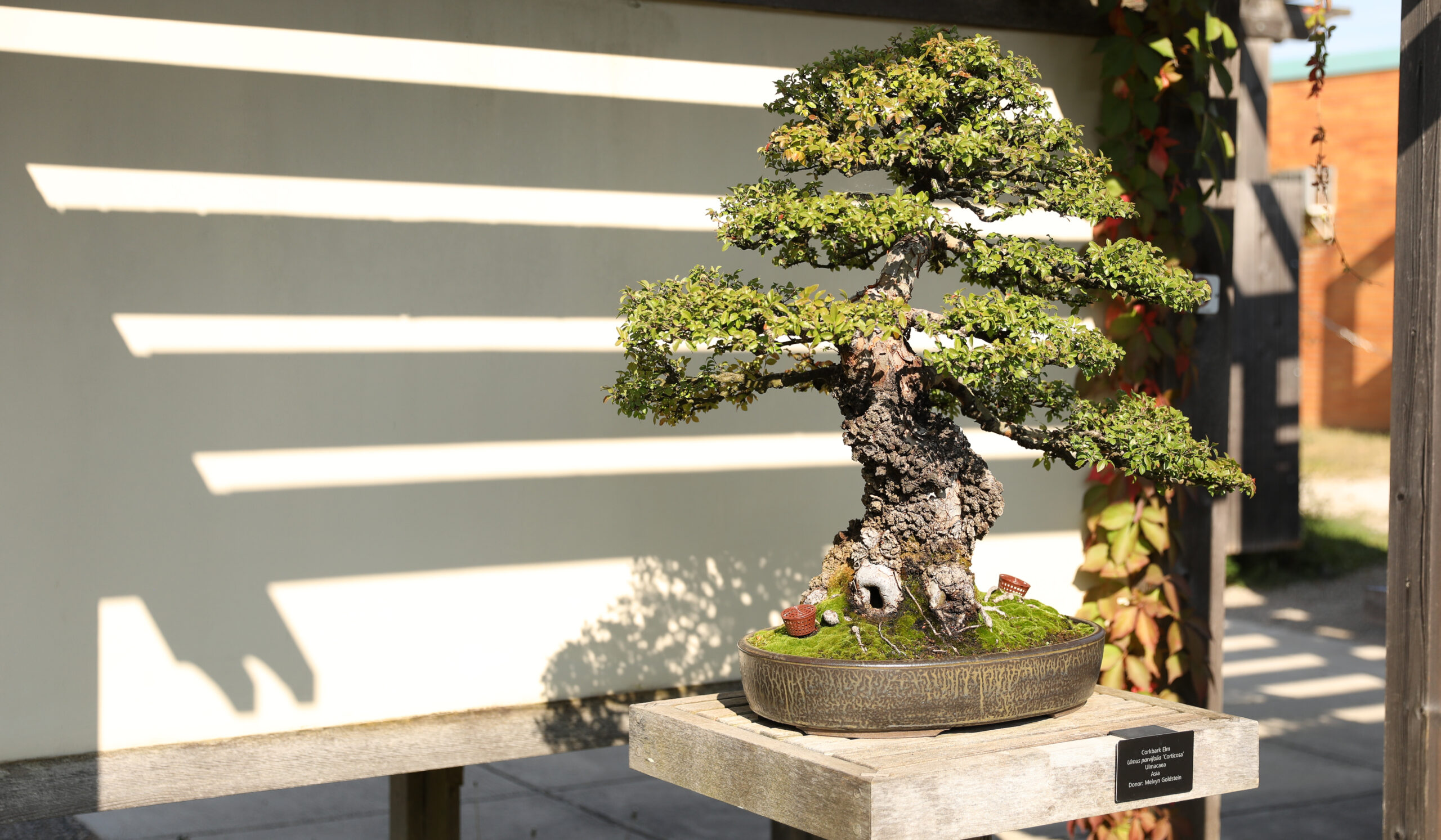
On the second to last Saturday in August, Matthaei Botanical Gardens turns into a miniature forest of elm trees, trident maples, scott pines, rocky mountain junipers, and yew trees — tiny versions of their 60-foot-tall brethren lining tables elegantly set with black tablecloths.
This is the Ann Arbor Bonsai Society’s annual show.
The society started in 1970 when Dexter, Michigan, resident Mary Westman placed an ad in the Ann Arbor News, inviting people to meet at her home — a tree farm run by her husband, complete with a bonsai forest she managed. Fifteen people attended the first meeting, and the group’s membership had doubled by the following year.
These days, the bonsai society has grown to more than 200 members who meet on the fourth Wednesday of every month between February and October. The group holds programs — talks and lectures from people prominent in the bonsai community — to educate members, who come from all walks of life and all ages. Among them are doctors and artists, as well as general plant enthusiasts.
The society has hosted moss specialists, pottery experts, and a teacher in yamadori, the art of collecting bonsais from wild trees. While it’s illegal to collect from public lands in Michigan, you can get permits to collect from the wilderness in many states.
Michael Bruneau is a bonsai technician at the Matthaei Botanical Gardens and has been a member of the Ann Arbor Bonsai Society since 2022, serving now as the annual show chairman. Bruneau says there are “a thousand little things” to keep in mind when nurturing and shaping bonsai, but the most important is to simply keep the tree alive.
“It looks complicated, [but] it’s not particularly complicated. It’s a little bit of horticulture, a little bit of art, a little bit of common sense,” he says. “If you’re going to start, start by keeping the tree alive.”
Some bonsais live year-round in the botanical garden’s conservatory, but from May to October, the major display is within the Melvyn C. Goldstein Bonsai Garden. Many Ann Arbor Bonsai Society members volunteer to maintain the collection housed within it. For many years, the collection was without a permanent home and was rarely displayed, instead rotating through unsuitable greenhouses where conditions were never quite right for the small trees.
In 2023, several members of the society and Melvyn Goldstein, ’59, MA’60, donated funds and more than 125 trees to the Matthaei Botanical Gardens to create the Melvyn C. Goldstein Bonsai Garden. The Ann Arbor Bonsai Society has been meeting in the garden ever since, and Goldstein continues to donate new bonsai.
As the society’s membership continues to grow, so does the impact the group — and the trees — have on the people who nurture them.
“I get a lot of connection to nature from bonsai,” Bruneau says. “There’s a thing called plant blindness, where people don’t recognize plants in the natural world and don’t find them either interesting or worth their time. With bonsai, you just start to notice different aspects of plants and trees, like branching and leaf structure — a lot of things people don’t really pay attention to.”
Jesse Klein, ’15, is a freelance writer based in California.