
A Life in Full Bloom

By Jenny Sherman

 • 

Read time: 6 minutes

Photos courtesy of Kristen Muehlhauser 

One nursing alum finds joy by embracing change through seasons of life as a flower farmer.

When Kristen Muehlhauser, ’10, and her husband made the pivotal decision to move their family out of Ann Arbor to a small farm just north of the city, she had big dreams and few expectations for how things could turn out.

“I didn’t really know how to set up a farm,” she says. “We tried a lot of different things over the first five years, and we were growing like 90 different crops — which is a little bit crazy to try to learn the nuance and the best time for seed starting and for planting, and the stage of harvest, and how to wash and pack that.”

Raindance Farm is now in its ninth growing season in Whitmore Lake, Michigan, and for the last three years they’ve narrowed their focus toward growing flowers exclusively — a move that, despite presenting its own challenges, has proven to be a labor of love for Muehlhauser and her family.

“Instead of that winter rest, where you take stock and reflect and then set up the plans for next year, now we just keep going,” she says. “But my husband was able to leave his corporate career with Toyota in 2024 and come work with me full-time, so now we get to do this as a family, which feels like a huge privilege and gift.”

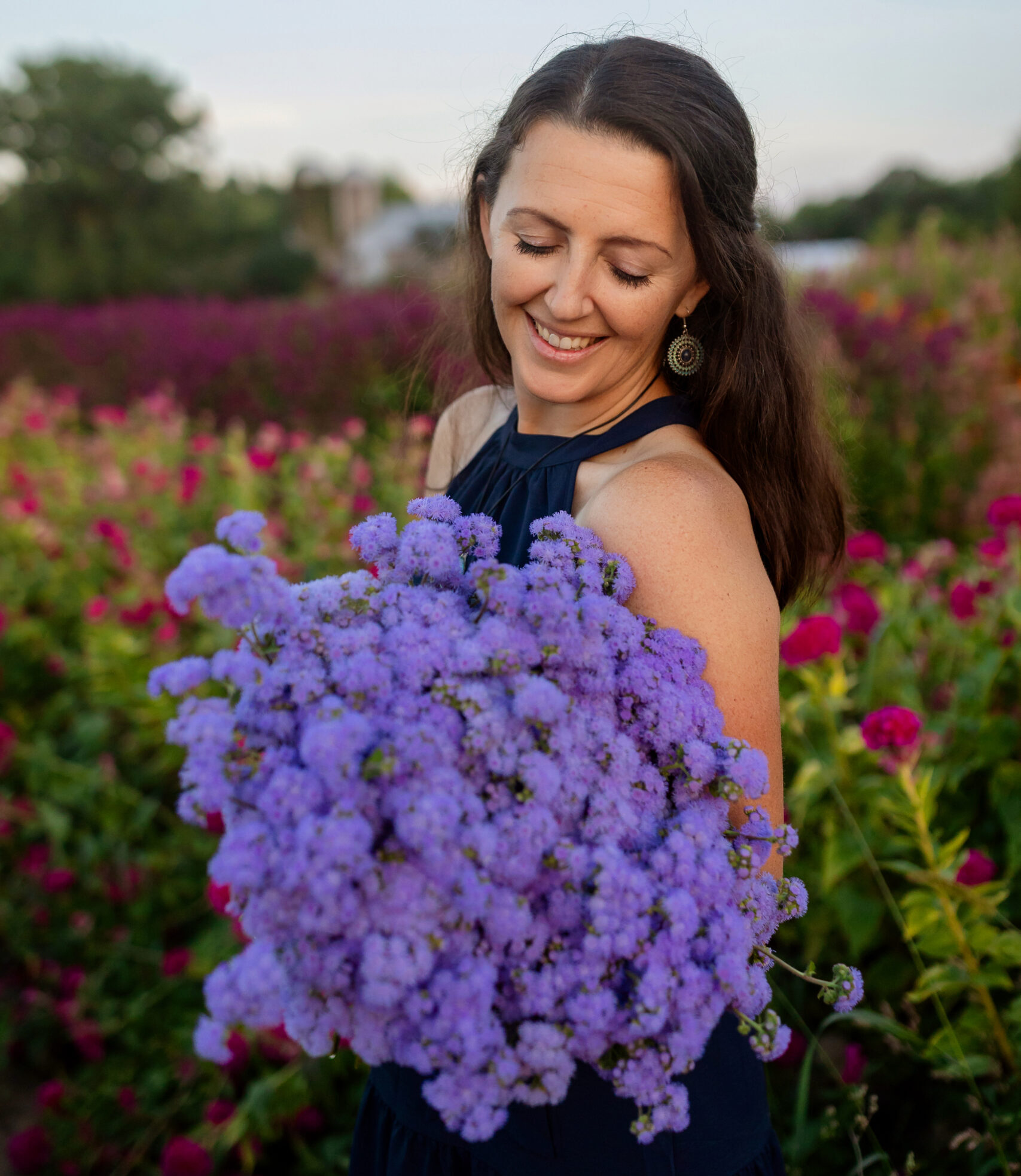
A woman with long dark hair in a navy dress smiles, holding purple flowers, in a colorful field.
Photo courtesy of Kristen Muehlhauser.

A decade before purchasing the farm in 2018, Muehlhauser was working toward a nursing degree at the University of Michigan, envisioning a very different future for herself as a family nurse practitioner. She and her husband were just beginning to explore their budding interest in gardening, getting their feet wet by renting a small plot through the Project Grow community garden program.

The first year, Muehlhauser says, “the weeds grew bigger than the tomato plants” but she began reading every gardening book she could get her hands on, determined to learn more about local food production.

“I followed to a T what the instructions were for spacing, and what plants for which seasons,” she says. “In our second year, the garden was super productive.”

In the years that followed, Muehlhauser sought out much more growing space, expanding into community garden plots at County Farm Park and Buhr Park in Ann Arbor, as well as into her own backyard. She began to foster deep connections with local growers who often were just as eager to share their knowledge and gardening tips, along with some of their best seeds for swapping.

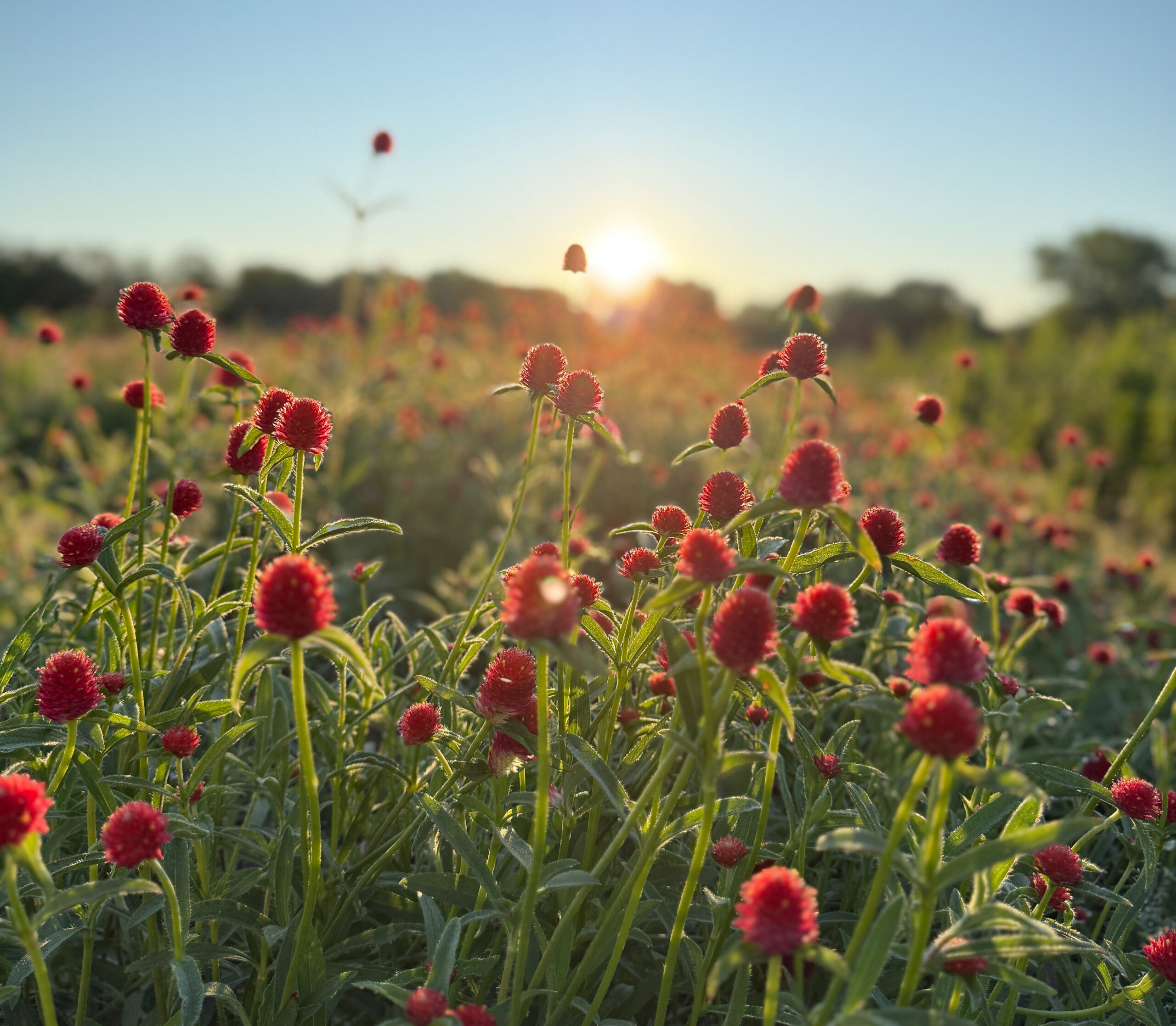
A field of red flowers in full bloom glows in sunset sunlight, with green stems, leaves, and trees under a clear sky behind.
Photo courtesy of Kristen Muehlhauser.

Muehlhauser earned her undergraduate nursing degree from U-M in 2010 and enrolled in graduate school to earn her advanced nursing degree shortly thereafter. At the end of her first year, she and her husband welcomed their first child into the world.

“That first semester I just brought her along with me,” she says. “But then I started clinicals, which are eight- to 10-hour days.”

Faced with the emotional challenge of spending long hours away from her young daughter, she decided to finish her degree in a later season of life.

“As it turned out, I started a farm instead,” she says. “It’s all worked out well, and I’m grateful for the time that I had at U-M and especially the connections and friendships I formed there.”

Cultivating a Dream

Muehlhauser was working as a nurse at St. Joseph Mercy Health and Michigan Medicine before she started the farm. She witnessed firsthand how limited access to sustainable food systems and a lack of education around nutrition can contribute to poor health outcomes for many individuals later in life. This is part of what led her to think more deeply about how to fill education gaps locally and fueled her passion for building community around sustainable agriculture.

“Building a business that produces something with our own hands and then selling it all within a 10-mile radius of where it came from — that’s really meaningful work,” she says, “and it feels like a thing that is worth doing.”

Before transitioning to growing flowers predominantly, Raindance operated under a Community Supported Agriculture (CSA) business model where customers paid upfront to receive a portion of the farm’s future harvests.

“They would actually come to the farm every week and harvest their own share and hang out with people. And our kids would run around and pick tomatoes and cucumbers off the vines and eat them while the grown-ups would sit around in the barnyard, nursing babies and talking,” Muehlhauser says. “That was the dream, and it was a lot of work.”

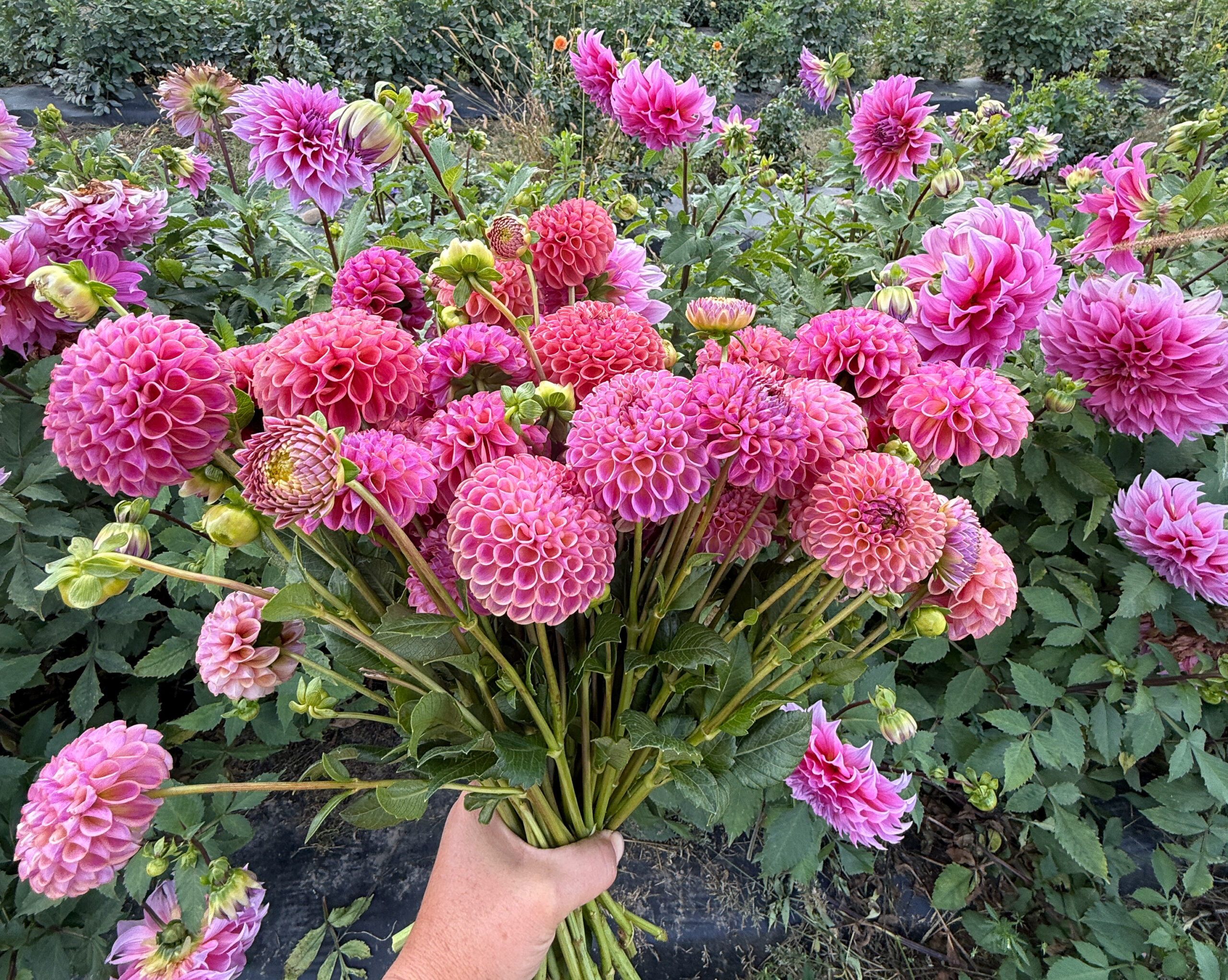
A hand holds a large bouquet of round, pink dahlias in front of a lush garden, with dahlias in pink hues and abundant foliage.
Photo courtesy of Kristen Muehlhauser.

As their CSA community continued to grow — from 20 families the first year to 50 the next — so too did their own family, with their youngest of three children born in 2021. By their third summer, the number of families surged to more than 100, requiring Muehlhauser to hire additional staff and paid interns for support.

“We were hosting like 400 people a week in our farmyard,” she says. “After two more years of super sleep deprivation and trying to run a business and parent three kids … it got to a point where I needed a sabbatical year.”

As difficult as it was, Muehlhauser knew that taking a year to recalibrate was what her family needed to get back to a healthy and sustainable work-life balance. Shifting to growing flowers full-time helped relieve the stress of being responsible to customers for produce, regardless of the growing season’s success.

“That was a lot of pressure — especially for a newer farmer who didn’t have decades of experience dealing with weather,” she says. “We also didn’t have the resources of older generational farms that plant with tractors.”

As a regenerative farm, Muehlhauser says they utilize greenhouses and other sustainable farming practices to steward their 44 acres of land, helping to improve soil health, enhance biodiversity, sequester carbon, and protect pollinators.
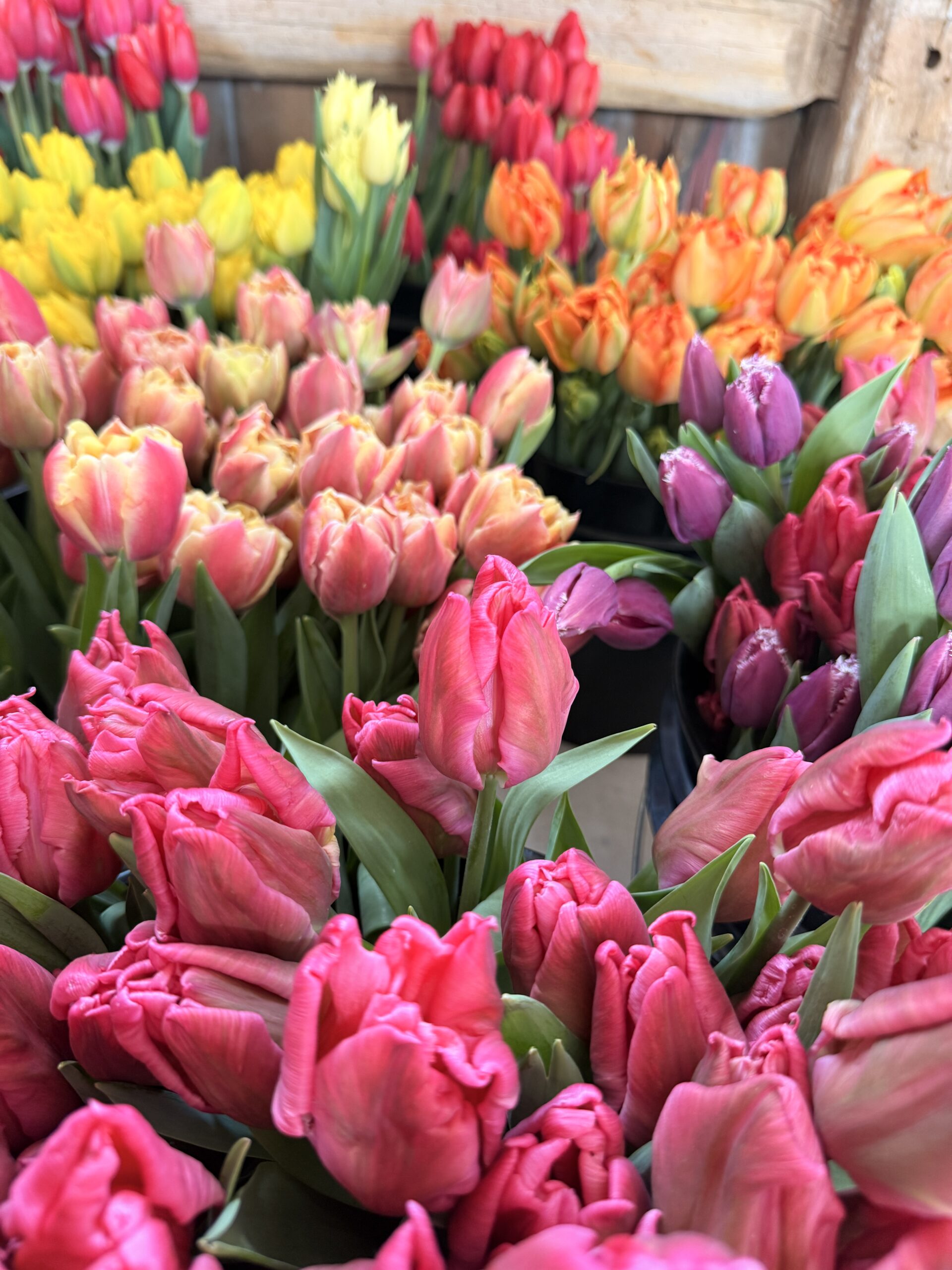
Buckets of colorful tulips in shades of pink, purple, yellow, and orange are closely arranged in a rustic wooden setting.
Photo courtesy of Kristen Muehlhauser.

Though no longer hosting large-scale community gatherings like they have in years past, Raindance now opens to the public for select “you-pick” events, where visitors can stroll through their stunning two acres of flower fields and fill a jar with a rainbow of dahlias, unusual varieties of sunflowers, and other annual blooms.

They also grow a wide variety of perennials throughout the year as the seasons change — tulips, peonies, anemones, ranunculus, and many more — which can be purchased year-round at local farmers markets and farm stops, or through Raindance’s bouquet subscriptions and “buckets of blooms” program.

Like anyone who puts their whole heart into an endeavor that doesn’t pan out exactly how they may have envisioned, Muehlhauser admits that she struggled at times with whether she was making the right choice in pivoting to flowers.

“I had a sense of shame about thinking ‘I can’t keep doing this’ … for the people who loved this CSA and came back year after year, that really valued it,” she says. “But instead of seeing changes and pivots as failure, I’m just seeing them as ‘we evolve and grow as we get older.’ I think that’s OK. It’s OK to keep changing, and I feel that really strongly.”


Jenny Sherman is a writer and copy editor for Michigan Alum.

Become a Member Today!

Your membership dollars allow us to tell stories that celebrate U-M alums’ achievements and their impact in the world. Support this work and get access to all Michigan Alum articles by joining today.

Share This Story
We use cookies to ensure you get the best experience on our website. By using this site, you accept our use of cookies.