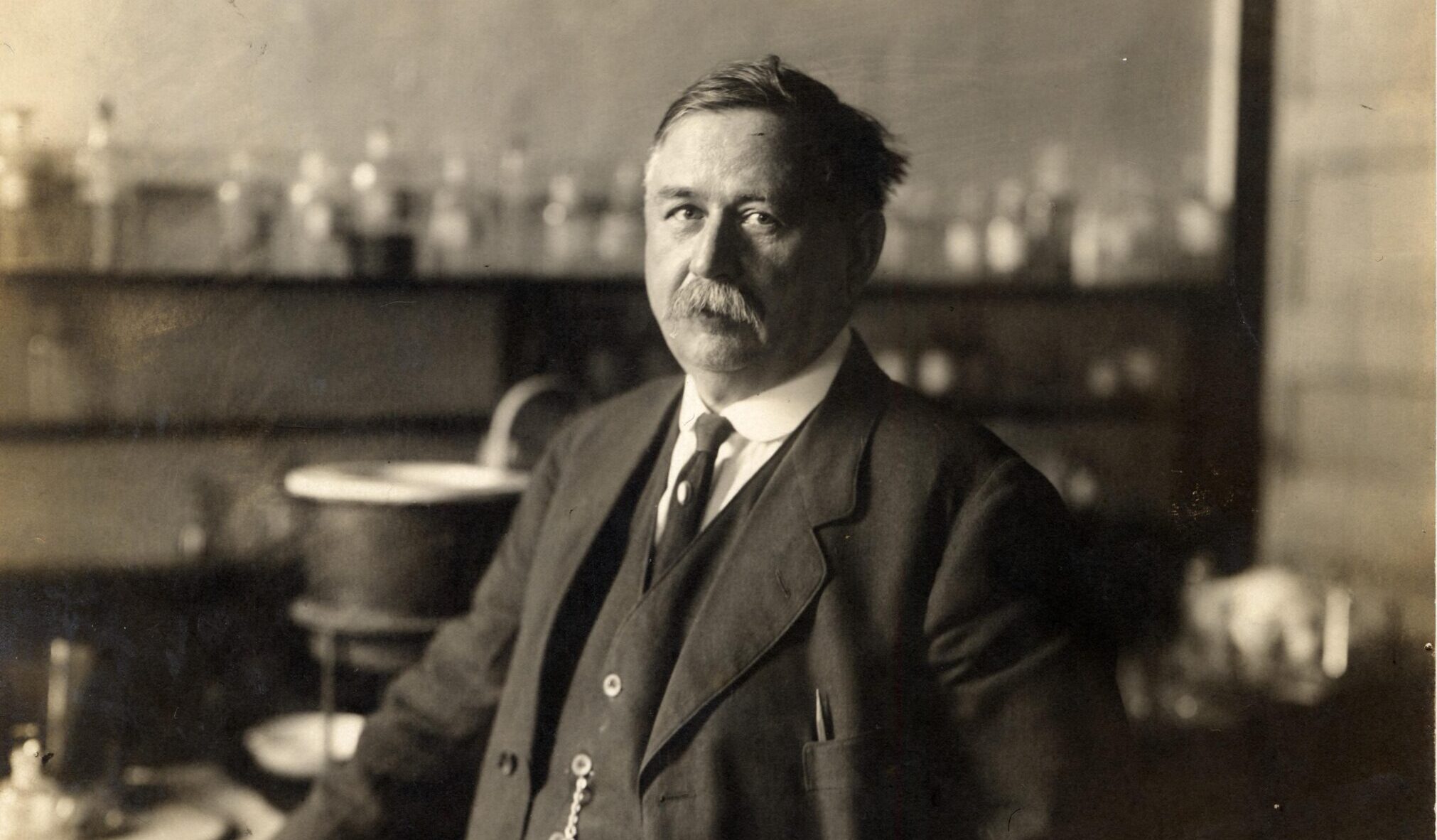
When Victor Vaughan helped establish the Hygienic Laboratory in 1887, he was constructing more of a community shield than a research facility. Vaughan, a scientist and public health authority who would later serve as dean of U-M’s medical school, modeled the laboratory in part after prestigious counterparts in Europe. It was among the first of its kind in the United States, marking a moment when the University looked beyond its campus borders to secure the well-being of the state at large.
The Michigan State Board of Health had urged the University to establish the laboratory as a center with a threefold purpose: conducting disease research, preventing outbreaks, and instructing the next generation in the science of hygiene. The research was groundbreaking, and its applications were lifesaving. Staff tested food and water for bacterial contamination and conducted “diagnostic services and research activities” for the Board of Health.
A January 1910 notice from then-University President Harry Hutchins illustrates how the research could affect daily life. Hutchins warned against drinking Ann Arbor city water without boiling it first, citing the laboratory’s reports that the water “contains at the present time colon germs,” indicating the water was contaminated. The laboratory turned scientific research toward people’s everyday lives into information the University and state could use to protect public health.
As the 20th century progressed, the lab’s specific functions were gradually absorbed into the broader department of microbiology and immunology — the Hygienic Laboratory’s founding was also the founding of the department itself. This transition was a logical evolution as the methods developed in the Hygienic Laboratory helped inform public health departments across the state of Michigan.
The name “Hygienic Laboratory” may no longer exist, but the work it began continued in the University’s medical and public health programs. Its history reflects the University’s enduring commitment to public service, demonstrating how University research can serve the public good.
Matthew Benz, ’98, is a freelance writer based in Michigan.