THE BASICS
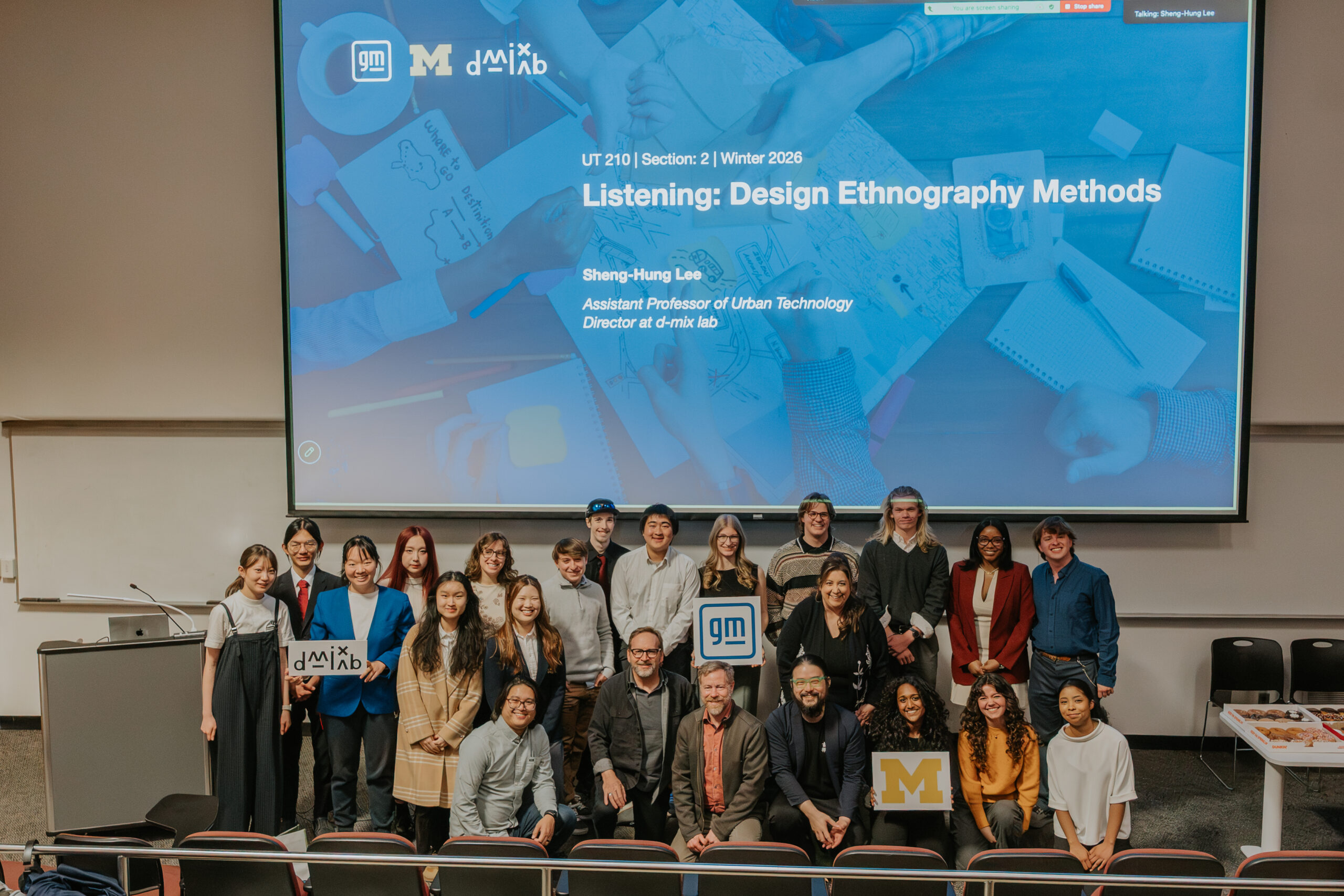
Offered through the Taubman College of Architecture and Urban Planning, UT210 is a core course in the Urban Technology program, primarily enrolling second-year students. During the winter semester, 18 students developed foundational skills training in the course, building the research tool-kit they will draw on throughout their design careers.
WHAT STUDENTS ARE LEARNING
Lee frames what students are building as “human skills” — a deliberate integration of hard skills (software, sketching, fabrication) and soft skills (communication, teamwork) — to understand context, listen deeply, and translate what people experience into design decisions. Methodologically, the course moves students through three scales of inquiry — peoplescape, servicescape, and cityscape — and teaches them to collect and synthesize data.
FEATURED CASE STUDY
Students are introduced to Tsutaya, a Japanese bookstore that curated experiences for inquiring readers. For example, a customer perusing photography books will find cameras, film, and accessories near related books. On a visit of his own, Lee was offered two versions of a book: one open to flip through, and another preserved in a plastic cover for purchase. Lee uses this example to illustrate what thoughtful design centered on human experience looks like in practice.
SHENG-HUNG LEE’S RESEARCH
Lee researches “design for longevity,” focusing on the multigenerational aspect of our social infrastructure, including social, emotional, and logistical aspects of aging well, such as purpose and motivation, mobility and independence, and community engagement. His research uses the same foundational principles taught in UT210 that require studying and understanding a specific population to design a solution that uniquely serves their needs.
COURSE COLLABORATION
UT210 students partner with General Motors’ Advanced Studio on the theme of future autonomous vehicle experiences. Students break into four teams with different research focuses. One team might investigate what it would take for parents to trust a driverless vehicle to transport their children. Another might examine the experience of riders with visual impairments, including how they interact with a voice-controlled interface, and what happens when the car arrives at its destination, and the passenger must now navigate a potentially unfamiliar environment on their own. Students identify challenges and map potential solutions through the interview and design process.
“As we explore the future of autonomous vehicle experiences with U-M, this project has been a wonderful research collaboration among Professor Sheng-Hung Lee, his students, and our General Motors project team. By using ethnographic research, the students are learning research methods like those we use at GM … to listen deeply, empathize, and explore consumers’ needs and use cases,” says Suzette Avolio Malek, ’90, the senior manager of global societal trends and innovation insights at General Motors. “They are uncovering inclusive, real-world use cases — including autonomous vehicles for busy families, pre-drivers, the aging, and people who are currently underserved by today’s transportation solutions — that will inspire ideas for the future of mobility.”
The course also uses ATLAS.ti, a qualitative analysis software developed by Lumivero, to support the research.
“Collaborations like this highlight what’s possible when strong teaching, applied research, and the right analytical tools come together,” says Tessa Barron, Lumivero’s chief marketing officer.
Katherine Fiorillo is the senior editor of Michigan Alum.