Life of a Luthier
•
Photos by Jenny Sherman
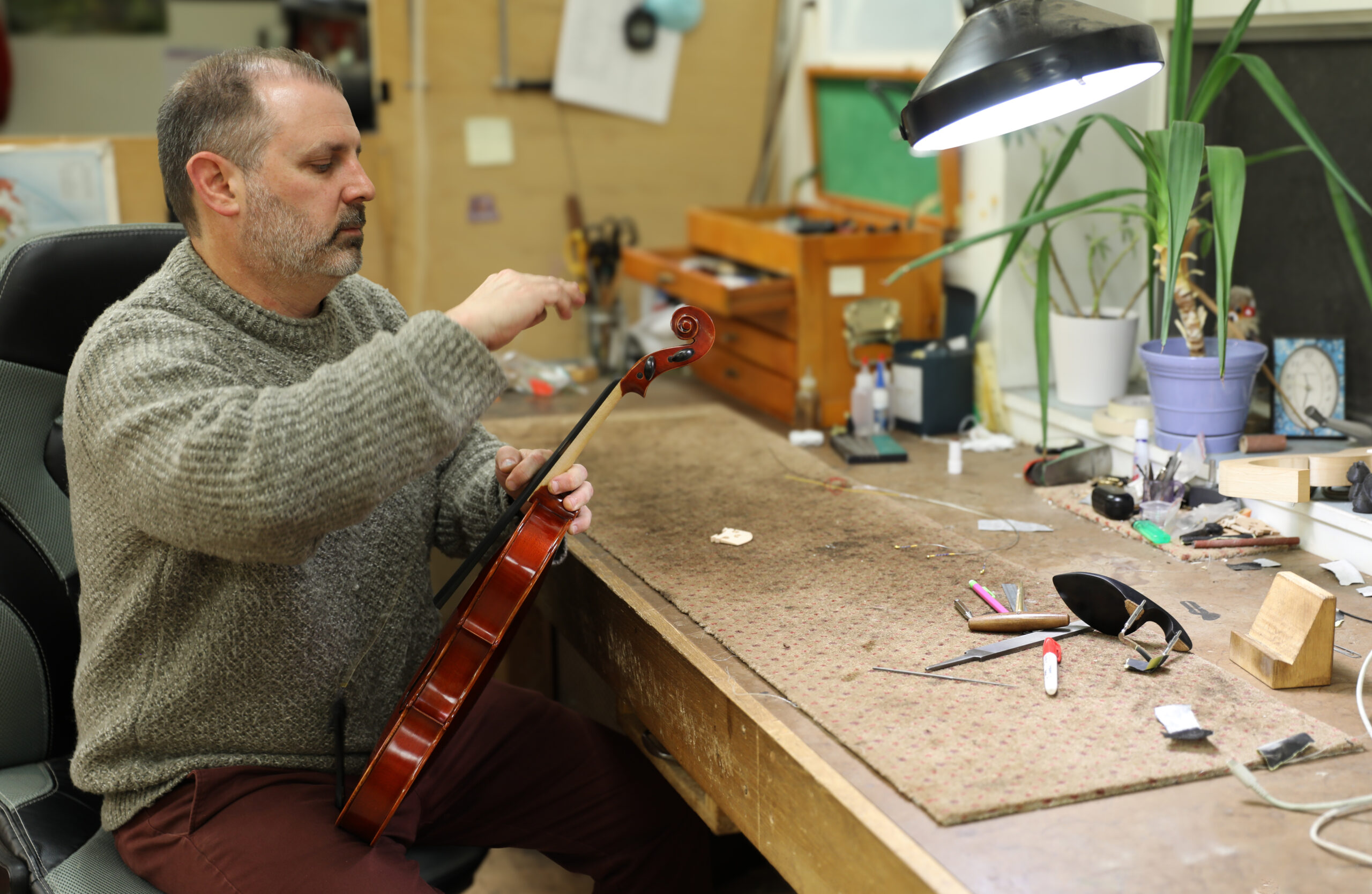
In a warmly lit workshop, tucked at the back of Shar Music in Ann Arbor, you’re likely to find Ryan Bodiford, PhD’17, toiling away on his latest violin restoration project.
“It’s very eclectic work,” Bodiford says of his job as a luthier, artfully repairing and restoring string instruments to their former glory. “It involves a lot of creativity and problem solving. There’s always a new way that a violin could break.”
Though he didn’t get a formal education from a luthier school — and didn’t foresee the age-old craft becoming his career — Bodiford has managed to refine his skills over the last 20 years by soaking up everything he can from his mentors and masters in the field.
Bodiford started at Shar Music in 2009, apprenticing with renowned master violin maker and luthier Ashot Vartanian. Today, alongside his day job as a musicology lecturer at the University of Michigan, Bodiford supervises the repair, restoration, and production department at the family-owned violin shop.
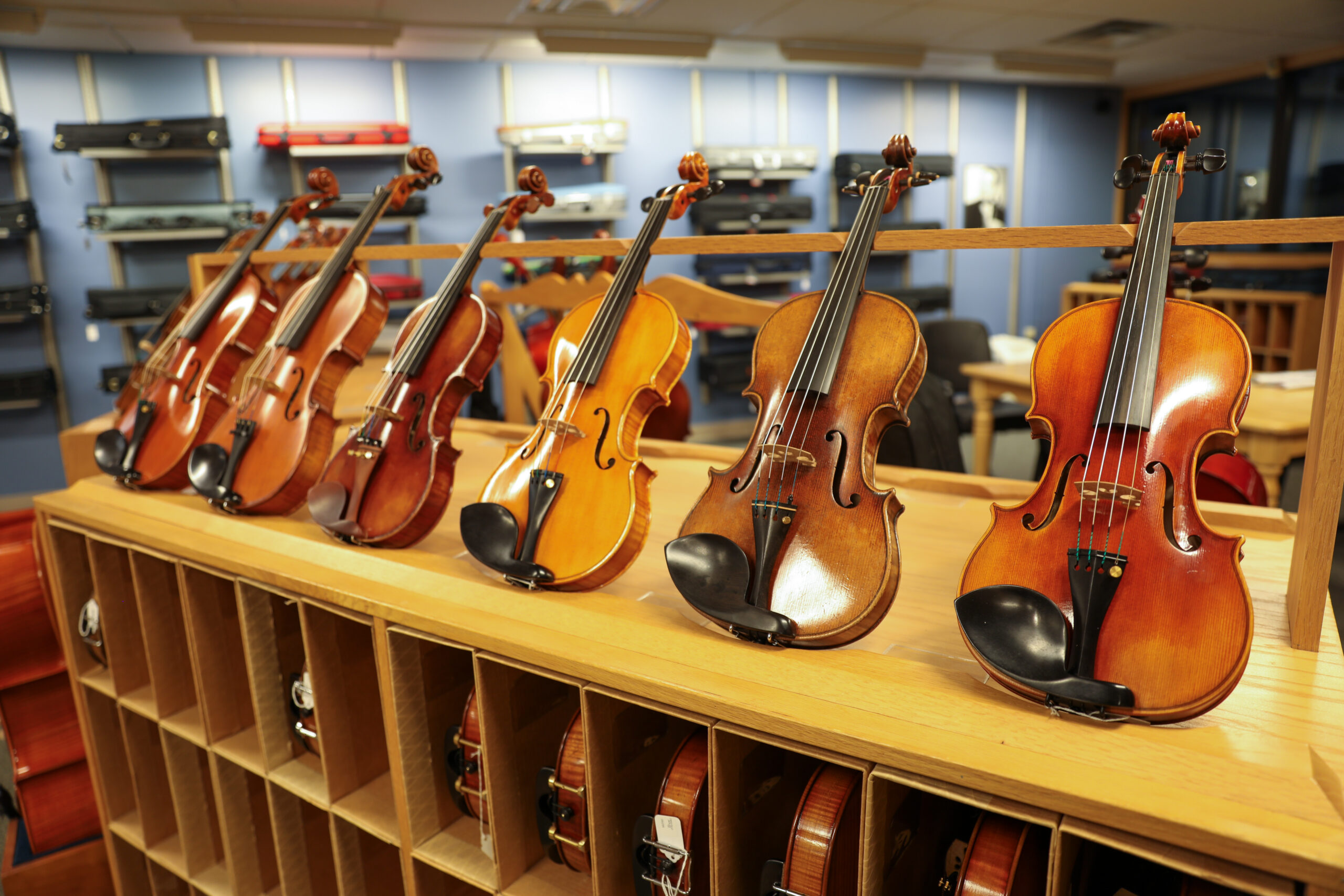
“I really love the passion that everybody here has,” he says. “That dedication is really what I think has driven the family — the Avsharians, who founded this business and are still overseeing it — and all of us have kind of modeled our career on that sense of, first and foremost, [that] we’re here to support musicians.”
As a musician himself, that passion and enthusiasm comes naturally, and is exactly what led Bodiford to fall in love with lutherie in the first place.
“Learning music is hard enough, but when you’re fighting against your instrument — that just makes it so much harder,” he says. “So if I can make an instrument play a little bit easier for a kid or bring out a little extra tone for somebody who’s already an amazing musician … that’s what we’re here to do.”
A Love For Lutherie Blooms
Growing up in northern Michigan, Bodiford didn’t have an orchestra program at his school. Though if he did, he says, “I absolutely would have gravitated to the cello.”
Instead, he learned the guitar and piano and played bass clarinet in the school band, and his love of music and instruments only continued to grow from there. As an undergraduate student at Michigan State University (MSU), Bodiford got a job at a small music shop where he learned the basics of instrument repair and restoration.
“I just went in as somebody who loved music, looking for a job that was relevant to my interest,” he says. “Everybody there helped out a little bit with some repairs, gluing seams, cleaning things up, simple stuff like that that anybody could do.”
After graduating, Bodiford spent several months traveling in South America — a decision that would later inform the focus of his research as a graduate student at MSU and U-M.
“I knew I wanted to do something in Latin America, and I was interested in music and social movements,” he says. “My research for the Ph.D. was related to electronic music and new media distribution in Chile, so those two parts of my career kind of run parallel.”
Before pursuing his master’s degree in ethnomusicology from MSU, Bodiford started working at Guarneri House in 2002, a widely respected music shop and lutherie near Grand Rapids, Michigan, where he had the opportunity to apprentice under master bass and bow maker, Steve Reiley, ’73, MMUS’74.
It was there that he began to truly hone his skills as a luthier, taking part in large-scale restorations on some remarkable instruments.
Recalling one of the more complex projects he helped complete at Guarneri House — a Maggini double bass worth an estimated $250,000 at the time — Bodiford says he was enthralled by its craftsmanship, especially when they determined the approximate age of the tree used to construct the instrument by counting the rings in the wood grain.
The more I learned about instrument restoration, the more it became hard to imagine a career that didn’t involve that in some way."
—Ryan Bodiford, PhD’17
“We realized that the tree itself must have been at least 400 years old when it was cut down,” he says. “The base [of the violin] was completed in about 1608. So this tree that we’re working on and restoring was in the ground at the time of Magna Carta.”
Still, whether working on a $250,000 violin or a $250 violin, Bodiford says he approaches every restoration and repair job with the same meticulous eye and care.
“As luthiers, we’re always trying to balance the costs versus the intricacy of the project,” he says. “Obviously anytime you’re working on somebody’s instrument, it’s important to them, no matter what the value is.”
From Protégé to Professor
While working toward his doctorate in musicology at U-M, Bodiford took what he learned during his four years at Guarneri House and accepted an associate luthier job at Shar, where he’s remained for the last 16 years.
Back then, he says, his sights were set on a career in academia with the goal of becoming a tenure-track professor. But as he poured more energy into luthier work and his experience at Shar deepened, so too did his love for the craft.
“The more I learned about instrument restoration, the more it became hard to imagine a career that didn’t involve that in some way,” he says. “I’ve kind of landed on the best of all possible worlds for me.”
Stepping into a leadership role at Shar, Bodiford has enjoyed the role reversal of guiding young aspiring luthiers in the same way his mentors guided him early on in his career.
“We’ve got a lot of new employees who are joining the team and excited to learn the same kind of skills I’ve been working on all these years,” he says. “So I get to move into that position of [mentorship] now.”
A Lifelong Pursuit
More than 20 years into his career, Bodiford remains eager to expand his skillset as a luthier. That tenacity to keep moving the needle forward led him to attempt his first violin build from start to finish — something he says he’s always wanted to do.
“Once you’ve completed making a violin, then almost anything that can happen to it, you’ll know how to repair it,” he says. “It’s kind of like the Ph.D. of violin restoration.”
Bodiford has also been working on a solo album, which he hopes to release in the coming year.
“I’m just getting back into trying to get back out and performing again,” he says. “That’s the component of my career that gets the least amount of professional attention, but probably what I get the most individual enjoyment from.”
When Bodiford reflects on his years at Shar, he is proud of the impact he’s made — both within his department and in the music community at large.
“Taking a piece of wood and turning it into something that’s both functional and beautiful is really very satisfying,” he says. “It’s also really satisfying when you know somebody has a beloved instrument that’s fallen on hard times for what-ever reason that you can restore, and a lot of times, get it back to them in even better condition.”
Jenny Sherman is a writer and copy editor for Michigan Alum.