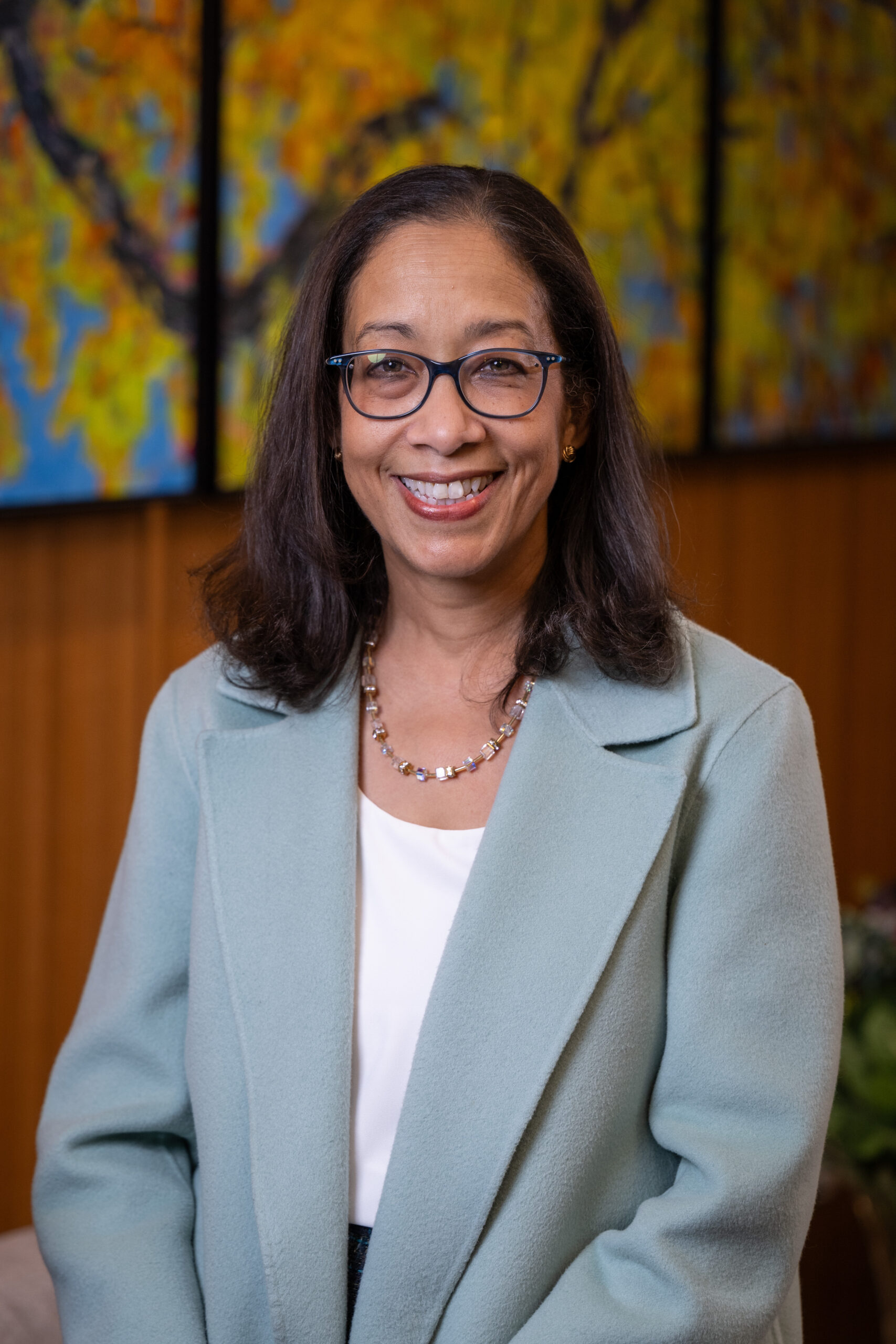
Dean Rosario Ceballo, MA’92, PhD’95, never imagined she’d spend 30 years in Ann Arbor.
In fact, when she was a graduate student studying psychology, one of her mentors approached her about applying to join the University of Michigan’s faculty. Ceballo says she “fell off her chair.”
“I was a first-generation student, and I had gone into psychology because I wanted to become a clinician,” Ceballo remembers. “And what happened in graduate school is I fell in love with teaching and research. But that was an identity shift … I did not go to grad school with the idea of becoming a faculty member or a professor.”
Ceballo grew up in New York City and attended Yale University for her undergraduate degree. After earning her master’s and Ph.D. in clinical and developmental psychology at U-M, she held numerous leadership or administrative positions in the College of Literature, Science, and the Arts (LSA), including chair of the department of women’s and gender studies and associate dean for the social sciences. In 2022, Ceballo became the dean of Georgetown’s College of Arts & Sciences, the oldest college within Georgetown University in Washington, D.C., before returning to Ann Arbor as the dean of LSA in 2024.
Now back at her alma mater, Ceballo has spent the last year listening to the LSA community and developing key priorities to guide U-M’s largest school through a unique period in higher education that centers student success, societal impact, transformational research, and the value of a liberal arts and sciences education.
Leading the Way
Higher education is facing immense challenges. But amid interrogations of curricula, admissions, and affordability from the federal government and the American public, Ceballo believes it’s more important than ever to champion the value and importance of a liberal arts and sciences education.
“I have absolutely no doubt about the critical importance of the education that LSA provides,” Ceballo says. “My opinion is that it is precisely the type of education that we provide that allows us to have a fair and equitable democracy, that allows us to have the type of society that we all want to live in.”
LSA is U-M’s largest and most academically diverse school — encompassing more than 85 majors and 41 academic departments — and Ceballo sees opportunity in its sheer size. One of her priorities is to incentivize interdisciplinary research and teaching, made simpler by LSA’s wide-ranging programs and expertise.
“We are, in LSA, so big that we can do interdisciplinary research within our school. We also do cross-school research endeavors, but we can have statisticians working on AI who are partnering with our philosophers to think about all the ethical questions involved. That is how big we are, that we can do ground-breaking scientific research by incentivizing collaborations across areas of expertise in our college.”
This interdisciplinary strength, along with internal innovations, is something the dean believes should fuel LSA’s public leadership.
“The College of LSA should be a national leader in advocating for liberal arts and sciences education,” she says. “I believe that LSA is poised to lead in this space, and it’s crucial that we do that now, at this moment.”
Student Experience
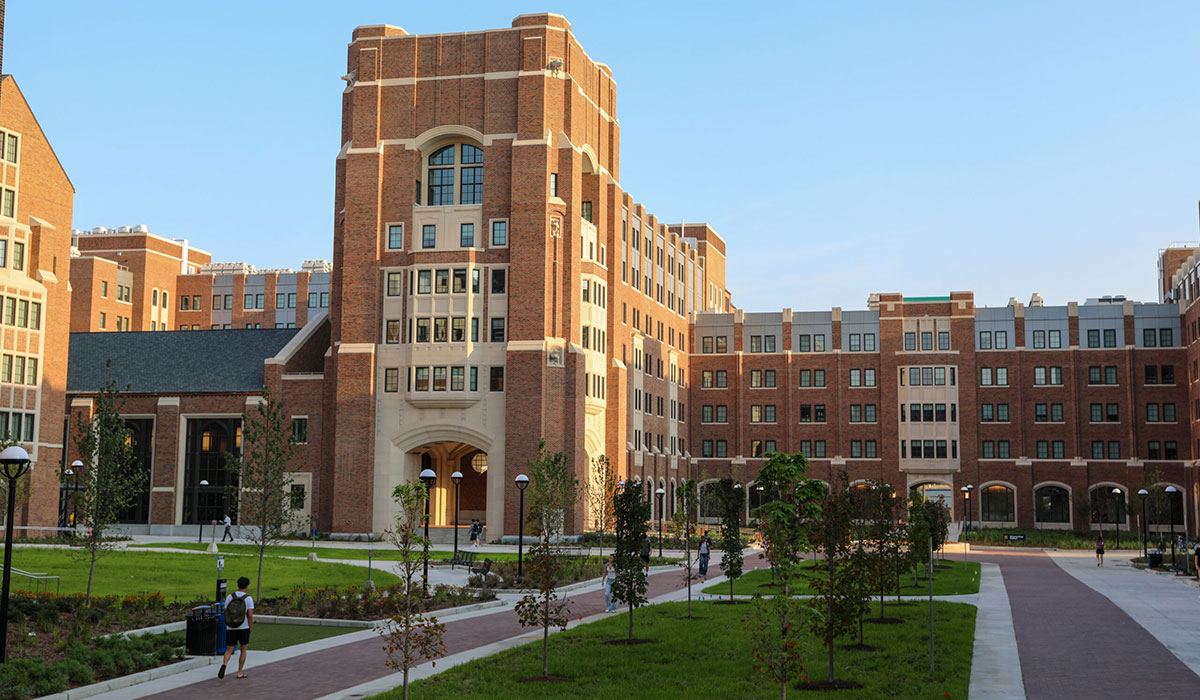
As a first-generation college student, Ceballo intimately understands the challenges students face when they arrive on a college campus for the first time, especially one as expansive as U-M.
Ceballo’s experiences on campus shaped her perspective and that of those around her. She witnessed firsthand how it benefited others to be exposed to classmates from diverse backgrounds, including those navigating college as first-generation students.
She sees expanding and scaling support for first-generation students as a priority that will benefit all students.
“Anything that we do for one group of our students benefits all our students. For our students to understand the different backgrounds of other students, that’s part of what our education is all about. It’s about meeting people who have different worldviews and different perspectives and who got here in very different ways. That’s just as important as what happens in the classroom.”
In and out of the classroom, an LSA education prepares students for the world with hard and soft skills, but one focus area for Ceballo is to nurture a tolerance for debate, disagreement, and dialogue across differences.
“We have got to model for our students and for our community, that we can disagree with each other and that we can debate respectfully,” she says.
Productive disagreement is also an aspect of the University’s theme year of life-changing education. The University says that one of the ways education changes lives is through open inquiry — where students build “the skills to disagree well and learn from difference.”
“We want to teach students how to think about things from different perspectives, how to be able to put themselves in somebody else’s shoes,” Ceballo says. “This is the other really important thing about debate, disagreement, dia-logue — you cannot do that respectfully if you’re not able to listen.”
Well-Being
According to U-M’s annual Healthy Minds study, 33 percent of students reported moderate to severe anxiety symptoms, and 37 percent reported moderate to severe depression symptoms last year. While some negative student mental health data spikes in recent years can be attributed to the pandemic, psychological distress has been an ever-growing trend among college students, and student well-being is at the forefront of Ceballo’s mind.
“How do we provide a learning environment that doesn’t breed this type of stress and anxiety? How do we create a culture where students can learn without sacrificing their sense of well-being and their sense of purpose?” she reflects.
One proposal that LSA is just beginning to consider would offer first-year students a “grade covered” semester, where, for example, final grades of a C minus or higher would be recorded as a “pass,” while Ds and Fs would not be recorded and students would not receive credit. While it might sound novel, it’s been a practice at the Massachusetts Institute of Technology since 1968.
Ceballo is looking toward initiatives like this to foster positive mental health and well-being; reduce competition among students; and promote the “love for learning and intellectual exploration” that she believes is at the core of a liberal arts and sciences education. Grade covering, she contends, would “give students the opportunity to explore new areas of study without worrying about the possibility of not doing well.”
“Historically, [a liberal arts and science education] has been rooted in a practice of discernment, and helping students identify their own paths and their own purpose. Embracing a search for knowledge and understanding of learning and study, that is going to be unique to every student, and that means making time for questioning, reflection, and exploration.”
That intellectual exploration is something that kept Ceballo in Ann Arbor and at the College of Literature, Science, and the Arts for decades.
“The thing about Michigan is … the only thing that limits you is how many hours there are in a day,” Ceballo says. “That’s one of the reasons why I stayed at Michigan, because we believe in that sort of capacious, incredible breadth of intellectual exploration where nothing limits you.”