Jessica Berman’s Goal-Oriented Career
•
Photo by Brad Smith/ISI Photos/Getty Images
As the horn sounded following a goal at a New York Islanders hockey game, a 16-year-old Jessica Berman, ’99, watched as two strangers near her erupted in joy, hugs, and high-fives.
That’s when the Brooklyn, New York, native had an epiphany.
“I remember clear as I’m sitting here today, turning to my parents and saying, ‛I need to work in sports because I can’t believe that the power of this moment,’” Berman says.
After doing some research, Berman locked onto the idea of becoming the commissioner of a sports league and began telling people that’s what she wanted to be when she grew up.
“I liked to be around sports, but I never knew it was something that could be for me directly,” she says. “I grew up in a community that was very diverse. My friends lacked access and privilege, but I saw the way that sport allowed for them to create hope and aspiration beyond what their parents had achieved.”
Some three decades later, Berman is living the career aspirations of her teenage self as the commissioner of the National Women’s Soccer League, helping propel the league forward as women’s sports explode in popularity.
Finding a Home at U-M
Berman started her college career at Brandeis University in Massachusetts, but a visit to Ann Arbor to see her cousin, Eve Rodsky, ’98, changed everything.
“I didn’t know I was not in the right place until I visited [Eve] at Michigan,” Berman says.
With an eye toward working in sports, she decided she needed to be at a university with a world-class athletic department. She transferred in the middle of her sophomore year and immediately went to work trying to learn all she could about the business of sports.
Berman interned with the athletic department and pounded on the door of the hockey team, saying she’d be willing to do anything to help out. At the time, only the football team had official team managers, but the hockey team took Berman in for an unofficial role, and she tracked stats, wrote articles, and got players prepped for interviews for the 1998 season.
That year, the men’s hockey team went on to win the national championship. But since Berman didn’t have an actual position with the team, she didn’t get a championship ring. The players, realizing that Berman was left out, got a jersey and had everyone sign it as a token of their appreciation for her hard work.
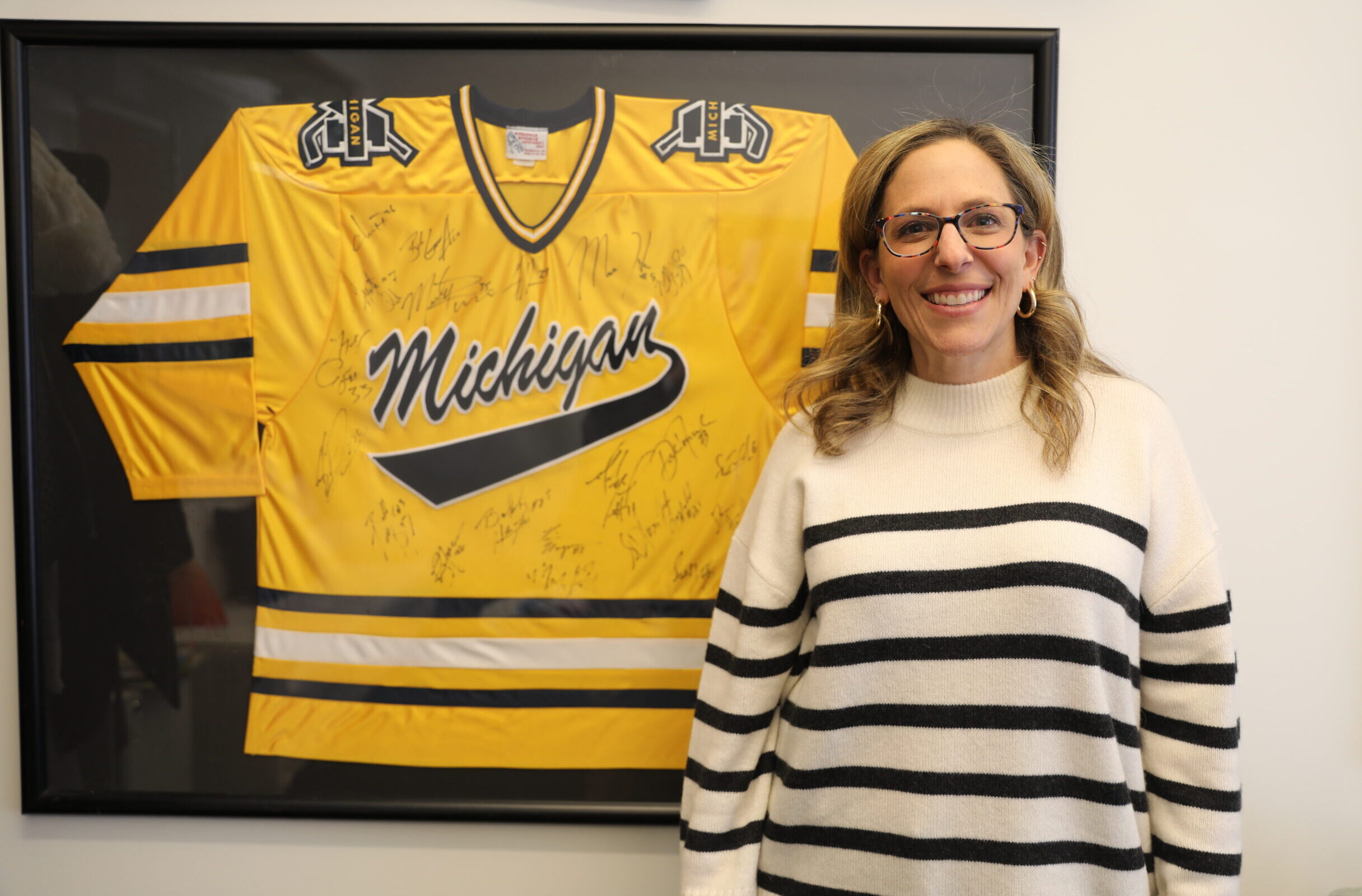
“That jersey has traveled with me, in that frame, to every single place I’ve worked,” Berman says. “It’s a reminder for me that the actual ring is much less important, it’s the impact I made on the players and how much they appreciated the work I did. That’s what drove me to do the work that I did.”
Berman worked with the football and baseball teams, took side jobs as a waitress and an entertainment DJ company, all while earning her degree in sports management communications through what would become the School of Kinesiology.
Having tracked that many sports commissioners were labor attorneys, Berman set off for law school at Fordham University before landing a job at Proskauer Rose, a firm that counted several major sports leagues among its clients.
Not long after she started, the National Hockey League (NHL) was preparing for a possible work stoppage and Berman raised her hand when one of the partners needed a young associate to work on the case. That’s how Berman found herself in the middle of the NHL lockout in 2004-05.
The NHL later hired Berman, and she spent 13 years working for the league, serving as deputy general counsel and later vice president of community development, culture, and growth. Berman says she loved working at the NHL, but knew that to achieve what she wanted, she would have to leave.
“Ultimately, I made the decision that I wouldn’t reach my maximum potential if I stayed and I had to make a decision about how ambitious I wanted to be in my life,” she says. “It’s really hard to leave something where you’re happy and content.”
In 2019, she became deputy commissioner of the National Lacrosse League, before taking the top job at the National Women’s Soccer League (NWSL) in 2022.
Rebuilding Trust
When Berman joined the NWSL, the league was in turmoil. A year earlier, allegations of emotional abuse and sexual misconduct surfaced among multiple teams. An investigation ultimately led to four coaches receiving lifetime bans from the league, and Berman’s predecessor resigned amid the scandal.
“The single biggest obstacle for this league to overcome was rebuilding trust with the players and building confidence that the league could become a successful and viable business,” she says.
Berman says her previous work with the NHL infused in her the importance of working in close partnership with the players and the union to build the business. The NWSL took the opportunity to open collective bargaining agreement discussions with the players several years before the contract was up in an effort to make a deal that was focused on the players and growing the league.
In addition to large increases in salaries, what resulted was a unique contract as it relates to sports in the U.S.: the entry draft was completely eliminated and players are free to sign with whatever team they like; no trades can be executed without the player’s consent; all contracts are now guaranteed; and all players have unrestricted free agency when their contracts expire. The deal was struck in 2024, more than two years before the previous contract was set to expire.
“[The contract] is consistent with our strategy to build a player-centric league that created agency for players and ownership of their professional careers in an entirely different way,” Berman says.
The resulting deal earned Berman wide praise in the sports press. She was named Executive of the Year by the Sports Business Journal and Sports Illustrated named her the Innovator of the Year.
Berman is not the only Wolverine in leadership at the NWSL. Anup Popat, ’95, is a co-owner and executive board member of the NWSL’s Portland Thorns FC. He says Berman has positioned the NWSL as a true global standard-bearer.
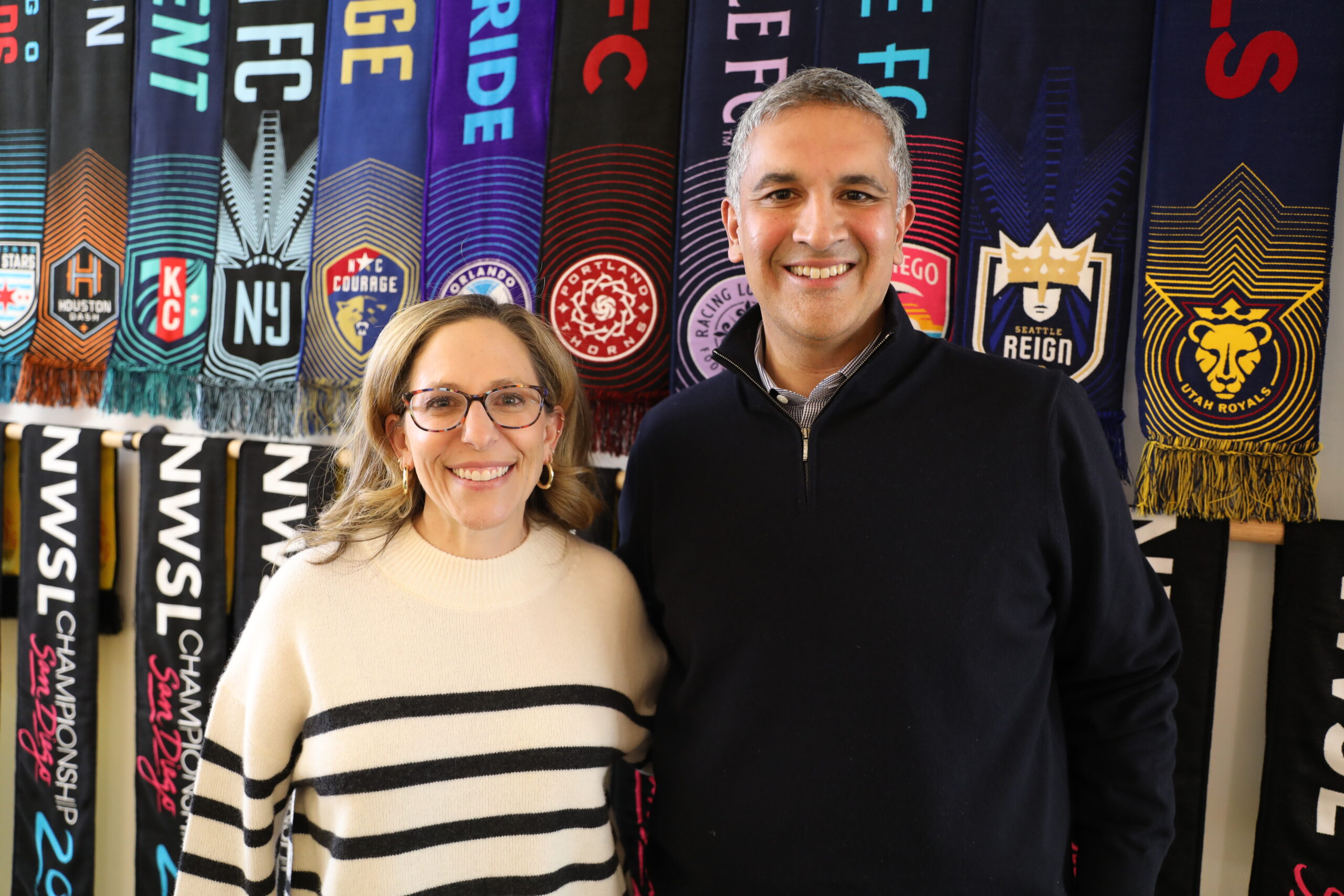
“The new benchmarks being set aren’t just about today, they’re about future-proofing the league against rapidly growing international competition,” he says. “That level of foresight ensures the NWSL can remain progressive, sustainable, and firmly established as one of the premier soccer leagues in the world.”
Growth of Women’s Sports
Berman says the surge in interest in women’s sports took a major turn during the COVID-19 pandemic.
“In the context of the women’s sports journey, I think COVID was the great equalizer because all the men’s sports were stripped of everything they had in terms of privilege and any sort of advantage they had as it related to attendance.”
In 2020, before Berman was commissioner, the NWSL was the first league to resume play after a pandemic hiatus. And with no other sports on television, the American public tuned in to NWSL games in record numbers with 572,000 viewers for its opener — triple the previous best viewership for an NWSL game.
“The ratings were shocking to everyone,” Berman says. “When everyone was forced to sit on their couch and not leave their house and there wasn’t any sort of inherent advantage that was given to men’s sports, all of a sudden, the product was speaking for itself.”
Viewership and attendance continues to climb for the NWSL. Total viewership across Nielsen-rated platforms in 2024 reached 18.7 million, a fivefold gain from the 2023 season. The league’s championship game viewership averaged nearly 1 million, an 18 percent increase from the previous season.
The increased interest in women’s sports isn’t just about soccer. At the same time, viewership and attendance for women’s basketball has skyrocketed since the emergence of Caitlin Clark and some of the most popular athletes to come out of the 2024 Summer Olympic Games were women.
“Women’s sport has always been amazing. The product hasn’t changed, the talent hasn’t changed. But what has changed is the investment, from an ownership, media, and sponsorship perspective,” Berman says. “There can be no doubt that the next generation of consumers and fans care about equity and meritocracy in a different way.”
Jeremy Carroll is the director of content and creative strategy for the Alumni Association of the University of Michigan.