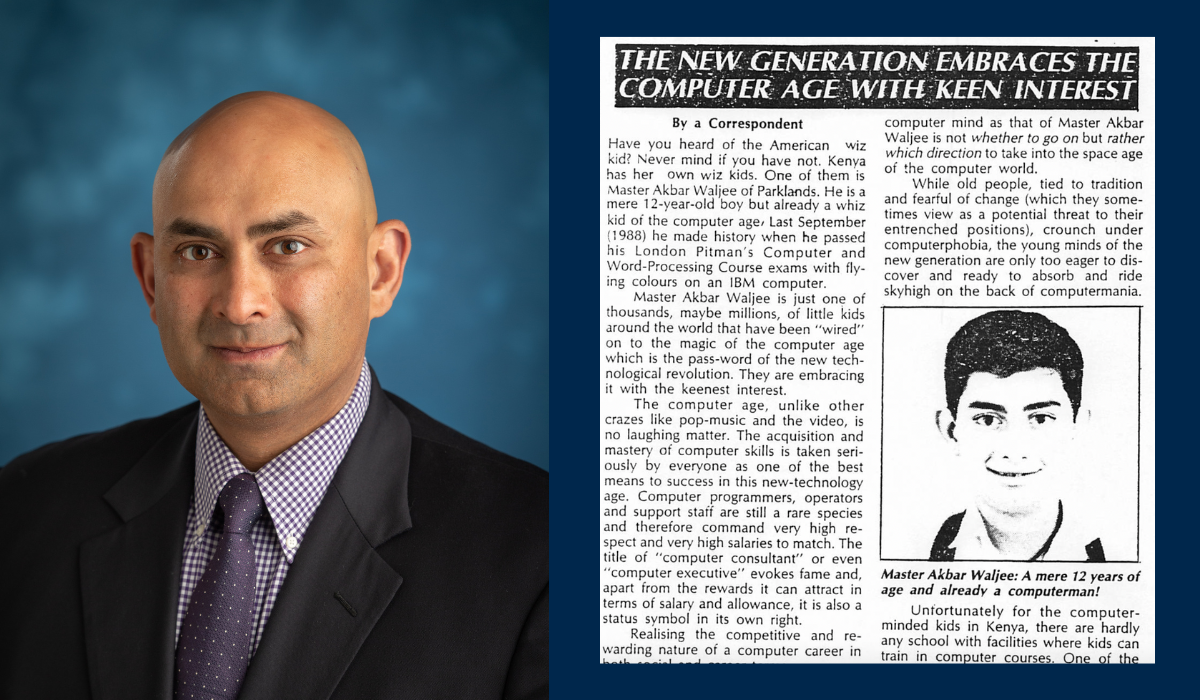
By the time he was 13 years old, Akbar Waljee, MDRES’05, MS’07, had learned multiple computer programming languages. His mom worked at a vocational college in Nairobi, Kenya, where Waljee was born, and he’d enrolled in one of the college’s programming courses. A local magazine even featured his accomplishments.
Now, Waljee leverages his computer skills as the director of U-M’s Center for Global Health Equity, collaborating with researchers across the globe to harness machine learning and artificial intelligence (AI) to improve global health outcomes. His most recent project offers hope for more effective detection of colorectal cancer, which the World Health Organization reports is the second-deadliest cancer in the world.
“We have the technological advancements here to perform colonoscopies and other tests, but what about lower-income countries with fewer clinicians? We’re exploring how AI can improve diagnosis in resource-limited areas,” Waljee says.
Michigan Beginnings
After graduating from the Emory School of Medicine, Waljee came to the University of Michigan in 2003 as an internal medicine resident and gastroenterology fellow, joining his wife, Jennifer Waljee, ’96, MPH’98, MS’07, MDRES’11, MDFEL’12. During his fellowship, Waljee also earned a master’s degree in health and health care research through Rackham Graduate School.
“What was very unique about the School of Public Health’s approach is that you worked on your area of interest instead of just textbook exercises,” Akbar Waljee recalls. “And you actually moved your research forward by learning all the skill sets you need.”
Waljee also developed an algorithm during his fellowship to help doctors accurately dose inexpensive medications for inflammatory digestive disorders like ulcerative colitis and Crohn’s disease. His efforts have saved patients thousands of dollars and preserved funding at the Veterans Affairs (VA) Ann Arbor Health Care System, where Waljee began working as a research scientist and staff physician in 2009.
In 2018, Waljee had a heart attack. His father had died of a heart attack when Waljee was 11 years old, and heart disease runs in his family. At the time, he’d been working at the VA Hospital and as an associate professor at Michigan Medicine, but this life-altering health scare inspired his commitment to work more in Kenya on health globally.
International Collaborations
An opportunity to collaborate with Kenyan scientists emerged for Waljee with the opening of U-M’s Center for Global Health Equity. Founded by former department of internal medicine chair Tachi Yamada, HDSC’15, and Leslie Yamada, the center is dedicated to improving health outcomes in low- and middle-income countries.
With Tachi Yamada’s mentorship, Waljee and colleagues at Aga Khan University in Nairobi earned a $6.5 million National Institutes of Health (NIH) grant to use machine learning and data science to improve maternal, child, and mental health care outcomes in Kenya.
Waljee emphasizes the collaborative nature of his work with international partners, in particular Amina Abubakar, director of Aga Khan University’s Institute for Human Development. “
These projects emerged from our collaborators’ analyses of their country’s needs, and they’re the ones really doing the work,” Waljee explains. “We might bring financial capital to the table, but we never want to ignore our partners’ intellectual capital.”
Encouraging Speedy Diagnoses
While colon cancer can be preventable or treatable with regular screening, patients in lower-income countries can lack access to colonoscopies or swift diagnoses. As Waljee explains, in some areas of Africa, there may be one pathologist per million people. By the time a clinician works through a backlog of biopsies and delivers results, a patient’s colon cancer may have advanced.
A few of Waljee’s Aga Khan University collaborators, Mansoor Saleh and Shahin Sayed, identified delayed colon cancer diagnosis as an issue of concern. U-M professors Ulysses Balis and Arvind Rao, MA’07, PhD’08, had already developed AI technologies to identify cancer from digital images. Together with other collaborators, the research team received a $750,000 NIH grant in 2023 to advance colorectal cancer diagnostics.
The collaborators ran studies in urban and rural areas of Kenya to test AI’s ability to detect colon cancer from images of patients’ biopsies. AI diagnoses may help pathologists prioritize patients with cancerous biopsies, speeding up diagnostic procedures and potentially saving lives. So far, the technology has been accurate, and the team has plans to test it next on breast cancer.
“Our research has really only emerged because U-M has been very supportive of these high-risk, high-reward projects that advance health care,” Waljee says. “Now the question is, can we expand this across countries and across disease states?”
For Waljee, global health and his work with U.S. veterans intersect. As he noted, some parts of the United States experience illness rates similarly to lower-income countries. His efforts with underserved communities in Kenya and Michigan inform his approaches to improving health outcomes across the globe.
“To be honest, I’m not sure I would have been as successful anywhere besides U-M,” Waljee says. “I’ve come to rely on the collegiality across Michigan Medicine and the entire University. There’s such a passion and dedication and wealth of talent here that’s been instrumental to my success. I wouldn’t be doing this any other place.”
Jen DeMoss, ’09, is a freelance writer based in Petoskey, Michigan.