
On Air Alums
•
Photos courtesy of Jordan harbinger, leah litman, and kristy king-pritzl
[UPBEAT MUSIC STARTS, FADES DOWN]
Podcasts are everywhere. There are literally millions of them worldwide. Four point five million to be precise.
People listen to them to pass time while doing housework, on their morning commute, or walking their dog.
And they cover everything from daily news and true crime to niche interests and celebrity interviews.
There are so many podcasts because they’re easy to start. … All you need is a microphone and a topic.
Heck, there’s a chance your buddy started one during the pandemic and abandoned it after making you listen to six episodes.
But on today’s show … we’re talking to three University of Michigan alumni who host podcasts of their own. … And none of them stopped after six episodes. …
I’m Steve Zoski and this is …
ON AIR ALUMS
[UPBEAT MUSIC FADES UP]
THIS IS… THE JORDAN HARBINGER SHOW
As a Michigan Law student in the mid-2000s, Jordan Harbinger, ’03, JD’07, would offer networking tips to fellow students during weekly meetups at Ashley’s bar on State Street.
They discussed confidence and nonverbal communication, and eventually the central topic morphed into dating advice.
“It was just my stream of consciousness thoughts on dating and relationships,” Harbinger says. “How to be vulnerable and work on yourself.”
But demand for his advice escalated and Harbinger started recording his talks and burning them onto CDs in his dorm room.
“All of a sudden, guys were asking to buy CDs, saying, ‘I need five,’” Harbinger says. “‘Me and my roommate need this. My brother and uncle need this. My dad just got divorced — he needs this’ . . . and I’m like, ‘Guys, I’m not selling these CDs. This is a class. You’re supposed to listen and give it back.’ And they were like, ‘Yeah, I still need five.’”
Harbinger’s friend told him a “new thing called podcasting” could help. As episodes went online, thousands of listeners around the world started to download them. Even as Harbinger joined a Wall Street law firm after graduation, he continued recording after hours.
In the midst of leaving the firm during the financial crisis of 2008, Harbinger realized that he loved podcasting far more than law and decided to attempt a full-time podcasting career. Throughout the next decade, he led popular shows on streaming platforms and satellite radio, but in 2018, he launched The Jordan Harbinger Show, which has now been downloaded more than 100 million times.

In its first year, the show was recognized as Apple’s Best & Most Downloaded New Show. With more than 1,195 episodes thus far, Harbinger has signed a long-term contract with the PodcastOne network to keep going.
Harbinger “unpacks guests’ wisdom into practical nuggets you can use to impact your work, life, and relationships.” Having overcome job losses and setbacks throughout his life, Harbinger hopes listeners gain practical wisdom from the show’s eclectic range of guests, which have included spies, diplomats, star athletes, and leading scientists.
“It’s fine if you’re only coming for entertainment,” Harbinger says. “But if you listen to my interview with someone and you take their advice and apply it to your everyday life, that’s even better, because my podcast did more than just entertain you — you learned something.”

Today, Harbinger selects interviewees often by following his own interests, an approach reminiscent of how he customized his individualized major while an undergraduate.
“Going to Michigan was one of the first experiences in my life where I had choice and agency,” Harbinger says. “All education up until that point had been about just getting to the next rung on the ladder. At Michigan, it’s encouraged to explore different interests of yours and see what clicks, and that encouragement to forge my own path in life came at a pivotal time.”
THIS IS… STRICT SCRUTINY
Each episode begins with two soundbites.
The first — “Mr. Chief Justice, may it please the Court. It’s an old joke, but when a man argues against two beautiful ladies like this, they are going to have the last word” — was spoken during the 1971 oral arguments before the U.S. Supreme Court in Roe v. Wade.
And then — “She spoke, not elegantly, but with unmistakable clarity. She said, ‘I ask no favor for my sex. All I ask of our brethren is that they take their feet off our necks’” — a line quoted by Ruth Bader Ginsberg ahead of her first oral argument before the Court in 1973.
The bites open Strict Scrutiny, a podcast started by Michigan Law professor Leah Litman, JD’10, and co-hosts Kate Shaw and Melissa Murray, professors at Penn Carey Law and New York University Law schools, respectively. Litman recalls asking if they would “be interested in starting a female-led podcast about the Supreme Court to draw attention to people whose perspectives weren’t always considered.”
“The Court is pretty hard to casually follow from the outside, but its decisions have such momentous effects on so many people’s lives, including substantive law, particularly with women’s rights, reproductive freedom, and civil rights,” Litman says. “We try to make the Court accessible, given how opaque and not well understood it is, and have fun while doing so.”
Strict Scrutiny analyzes the U.S. Supreme Court and the legal culture that surrounds it. With more than 250 episodes including deep-dives into Supreme Court decisions, summaries of oral arguments, and analyses of legal news and political updates, each detangling the often-complex web of legal jargon, culture, and history for the citizens these decisions affect.
“We’ve seen how omnipresent gender and sex are in modern politics, and that includes what is happening at the Supreme Court,” Litman says.
This year, the trio was honored with the highest award recognizing women in the legal profession, the Arabella Babb Mansfield Award, named after the first woman admitted to a state bar in the U.S.
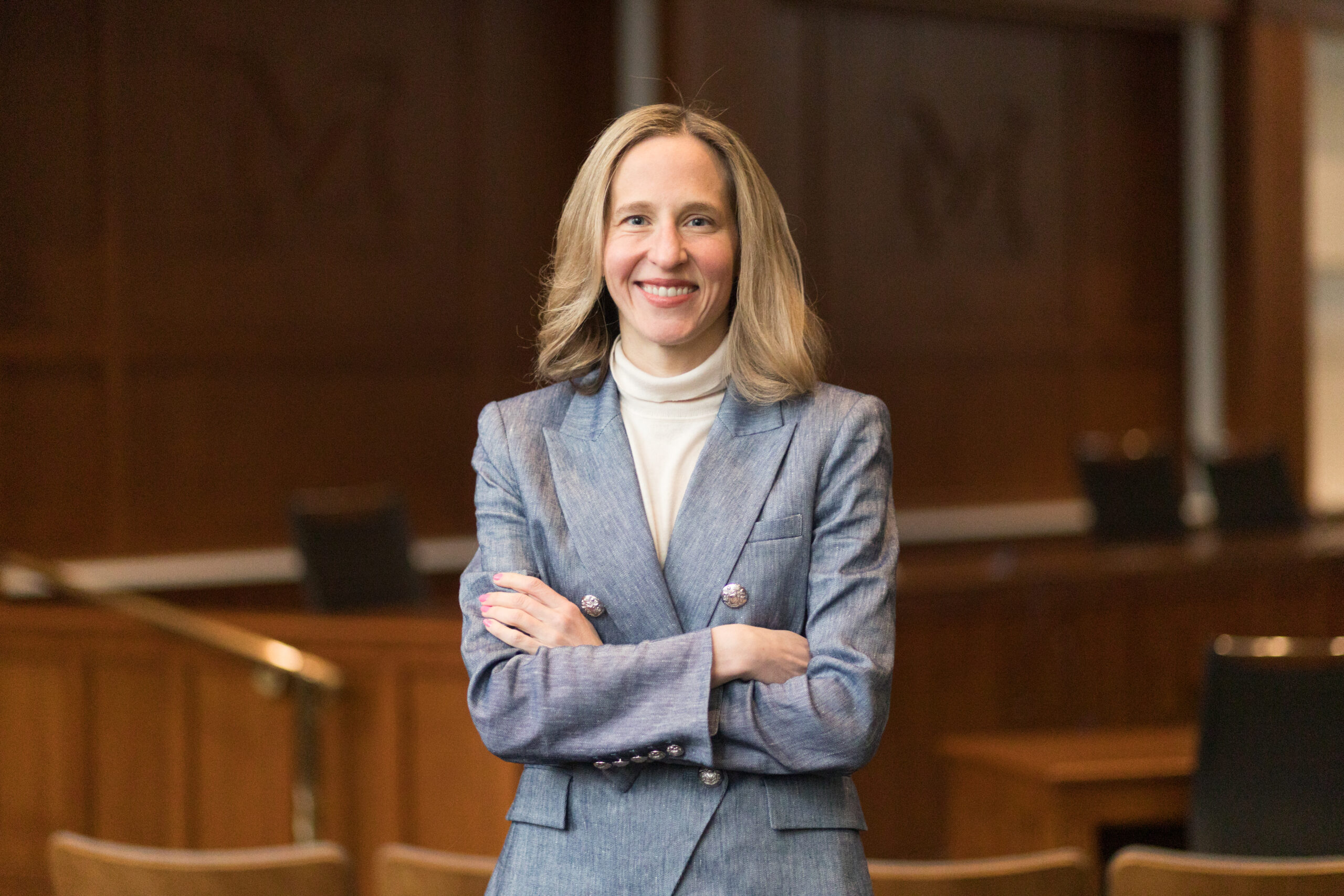
“Elevating and highlighting women’s voices was an important part of starting the podcast, and hearing from women law students and aspiring law students — or just women interested in the law — is one of the best parts of it. It is very meaningful to have our podcast and its unique perspective mentioned alongside such incredible previous honorees like Justice Sonia Sotomayor, Justice Elena Kagan, and Stacey Abrams,” Litman said in an interview with Michigan Law.
The group independently operated the podcast for three years before being picked up by Crooked Media, a change that allows them to focus on producing content and handling their other responsibilities as professors, writers, and lawyers. Litman says podcasting and professorship are fulfilling ways to contribute to a better-informed populace.
“The impulses that led me to start the podcast are also what I enjoy about being at a public university — they are both designed to be accessible to the public,” she says. “I think part of the Court’s power to date has come from being misunderstood or at least from people not paying a lot of attention to it, and that is what we are trying to correct.”
THIS IS… BOOKS I MAKE MY HUSBAND READ
The first book Kristy King-Pritzl, MPA’22, ever told her now-husband to read was “The Hunger Games.”
By day, King-Pritzl is a special assistant to the CEO for a national nonprofit that connects young people and adults to good jobs. By night, she reads fiction — an average of six novels a month — and works on Books I Make My Husband Read, the podcast she founded in 2024, with co-host and her husband of nearly 13 years, Jon King-Pritzl.
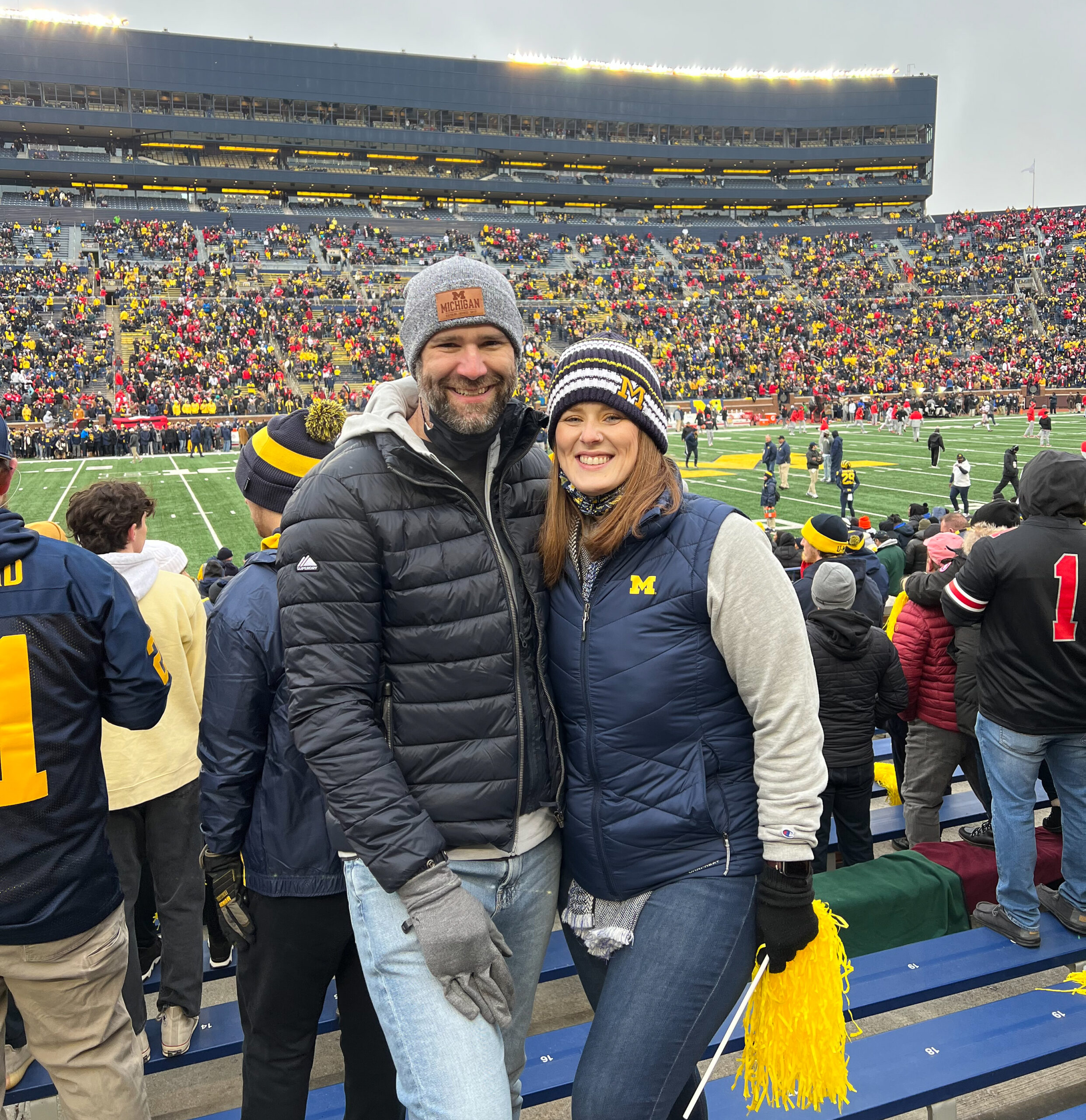
King-Pritzl cites Season 1: Episode 4 as one of her favorites. Alongside their discussion of “Just for the Summer” by Abby Jimenez, a book in which two unlucky-in-love characters figure they might as well date each other, the hosts touch on how mental health plays a role with the main characters.
King-Pritzl said she has been amused by how much her husband enjoys some of the romantic fiction they cover.
“A lot of the romantic fiction audience is female, and he’s like, ‘I get it, I enjoy it, I understand,’” King-Pritzl says. “‘Just for the Summer’ was unexpectedly one of his favorite books last year. We laughed so hard in that episode and had such a good time. We still talk about it.”
The couple has repurposed a room in their home to serve as their library and podcasting studio that includes two chairs situated so they can face each other when speaking, and places for their two dogs, the “chief barketing officers” Harvey and Spencer, to lounge.
King-Pritzl says the authentic banter between her and Jon is part of the podcast’s appeal. She believes working on the show together has enhanced their marriage, noting how reading and discussing books together has been a way to overcome difficult circumstances.

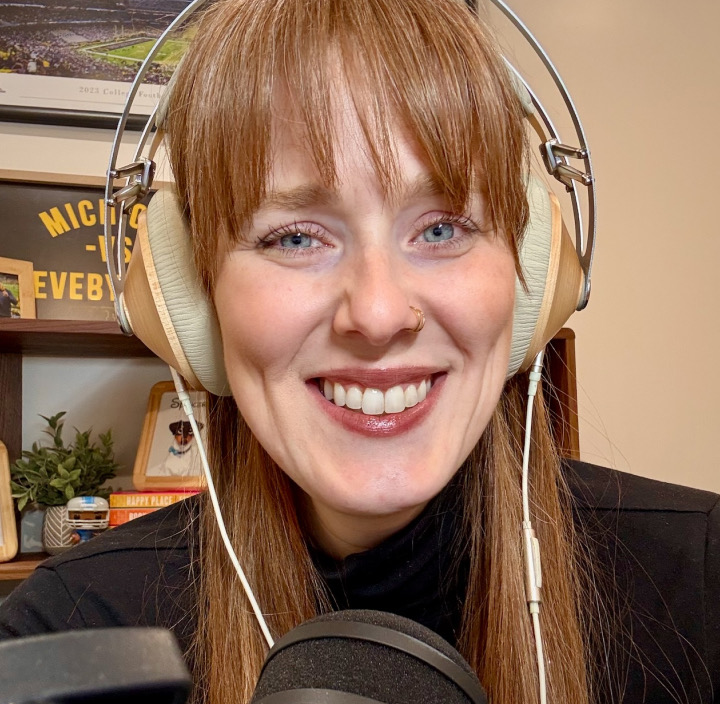
“We are unable to have children and that has been a journey for us,” King-Pritzl says. “I knew I wanted to start a podcast, and thought maybe it could be about our story with that, but I also remembered how I had been making Jon read books since the beginning of our relationship and thought Books I Make My Husband Read could be a podcast about books, but also a podcast about us and who we are as people.”
King-Pritzl says she finds the impactful nonprofit work she accomplishes very fulfilling, but appreciates being able to come home and recharge in fictional worlds.
“Fiction offers a way to live different lives in a way and explore different cultures and ways of thinking and feeling emotions,” King-Pritzl says. “Through other people’s stories, you can process your own emotions and what you have going on.”
Steve Zoski, ’13, is a freelance writer based in Dearborn, Michigan.