One Stitch at a Time
•
Photo Courtesy of Beili Liu
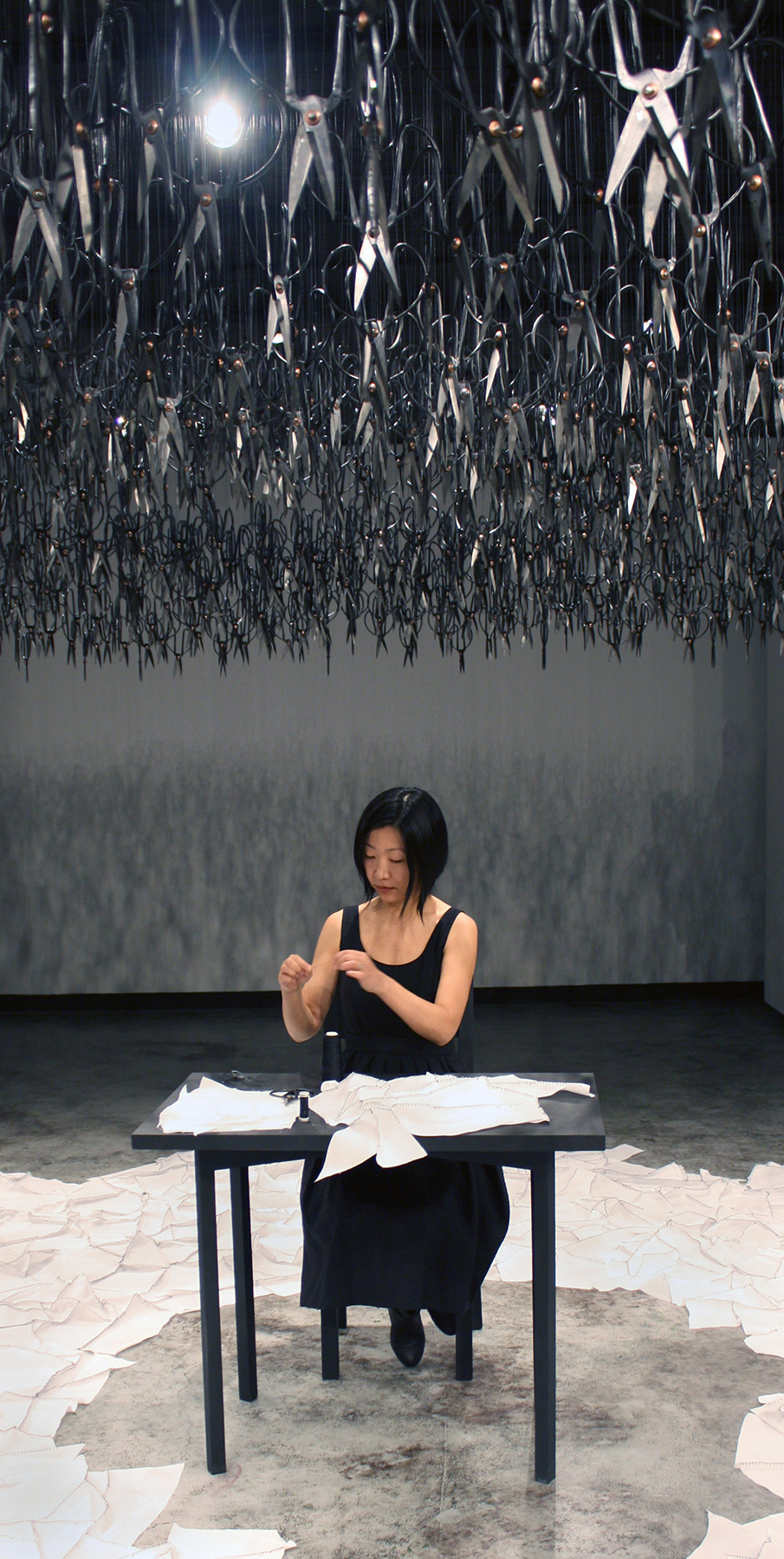
A woman sits at a small table, wordlessly sewing together pieces of white cloth as visitors watch.
Above her head, 1,500 pairs of gleaming Chinese iron scissors are suspended, point-down, from the gallery ceiling. Yet the woman, seemingly oblivious to the threat overhead, continues to stitch the white cloth into an ever-larger patchwork that encircles her feet like the crumpled train of a bridal gown.
Some viewers at Women and Their Work Gallery in Austin focused on the woman’s vulnerability. But Beili Liu, MFA’03, the artist and performer, had a different message. The woman sewing beneath the scissors has power, Liu says, “from her commitment to something small and healing.”
Liu was born in a village in northeastern China and spent her early childhood surrounded by women who were constantly sewing. Rather than viewing the work as oppressive, Liu saw it as empowering: they were making something from nothing. In “The Mending Project,” installed for six weeks in spring 2011, Liu used that same generative power to stitch cloth fragments into a soft cloud, counteracting the menace implied by the canopy of scissors.
An installation and performance artist based in Austin, Liu creates room-size artworks that prompt viewers to reflect on gender, migration, human rights, and the environment. Her ethereal sculptures and fiber artworks have been presented around the world, and she was named the 2018 Artist of the Year in Texas. Her projects assemble thousands of individual components — needles, threads, feathers, pieces of cloth — into works of art with a much larger effect.
Her practice echoes the approach of the woman in “The Mending Project.”
“Do something small, simple, and ongoing, and slowly it accumulates to become something transformative and powerful,” she says.
Finding Her Voice
Liu came to the United States to earn her undergraduate degree in graphic design from the University of Tennessee, Knoxville. When she began her MFA at U-M, she shifted to mixed media, which gave her freedom to work in three dimensions. As an international student, Liu’s financial assistance options were limited, but the School of Art and Design helped her apply successfully for two awards: the Barbour Scholarship for Asian women graduate students and a Center for the Education of Women Scholarship. Associate professor Stephanie Rowden helped Liu build confidence and became a trusted friend.
“The University of Michigan is the place I was first able to identify my voice,” Liu says. “I learned how to be an artist, to have faith, to trust myself and to allow this drive to grow.”
Liu moved to Austin in 2008 to teach at the University of Texas, where she is a studio art professor. Three years after she arrived, the state entered a withering drought that lasted two years and killed at least 300 million trees.
“It was just such a crazy number,” Liu says. “Think about how much loss we all experienced.”
In response, she created “Thirst,” a public memorial. The executive director of the nonprofit Women and Their Work, Chris Cowden, who appreciated Liu’s daring approach in “The Mending Project,” invited her to join a crossdisciplinary group that successfully applied for a grant from the Robert Rauschenberg Foundation. Liu suggested a project that responded to the drought.
“In fact, the invitation made me become fully aware of the drought,” she says. “Like most Austin citizens, I didn’t fully understand the impact until I did the research.”
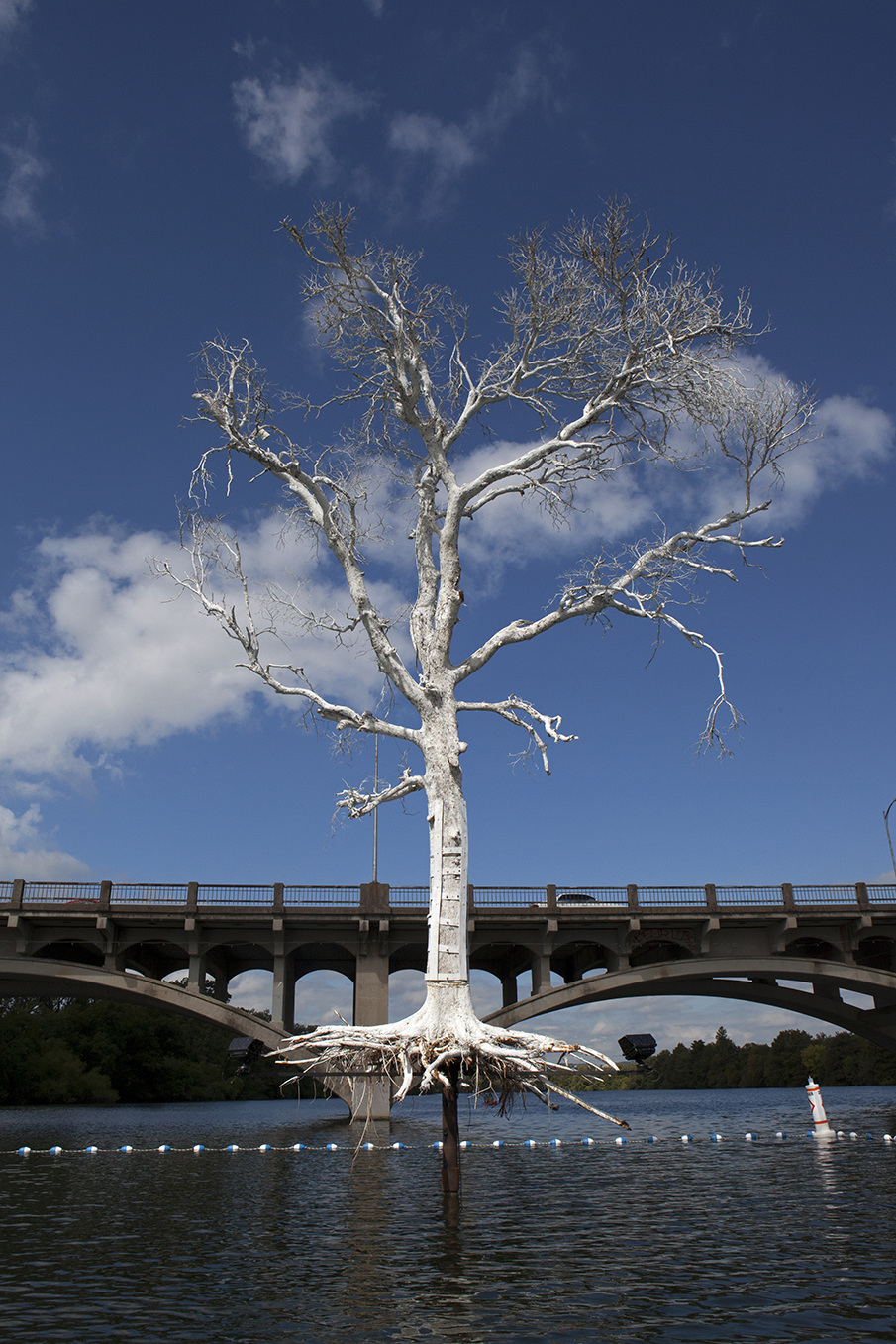
The all-women team, which included Women and Their Work staff, two architects, a landscape architect, and Liu, worked together to realize Liu’s concept: a 38-foot-tall drought-killed cedar elm anchored on a pole in Lady Bird Lake in the heart of the city. Painted an ashy white, the tree appeared to hover several feet above the lake, its roots stretching downward in a futile effort to reach the surface.
“I needed the roots to be preserved to express the sense of reaching to the water but not touching it,” Liu says. “The title speaks to the thirst that eventually takes away the life of the tree and the urgency of the water crisis.”
Although the project used no public funds, it required a city permit. Liu and the team had dozens of meetings to win approval from the parks and watershed protection departments and even the rowing teams who would temporarily lose a few lanes. The tree was displayed in the middle of the lake, between heavily used road and pedestrian bridges and flanked on two sides by a hike-and-bike trail that draws nearly 14,000 people daily. Along the trail, thousands of white prayer flags bearing the tree’s silhouette rippled in the wind.
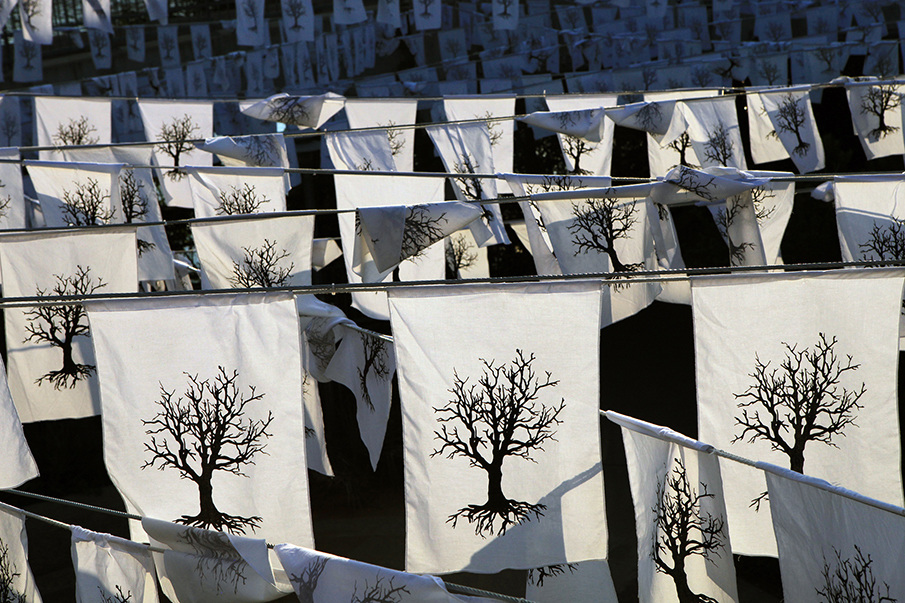
“It was like a walking meditation,” Liu says.
Because the lake level remains constant and the shore is lush with cypress trees, urban dwellers could forget that other parts of Texas were bone dry. After “Thirst” was installed, Liu would occasionally overhear people on the trail talking about the tree and wondering aloud, “Are we in drought?” She was gratified to think people might go home and read more about the ongoing disaster.
“That’s a moment where the piece worked,” she says.
Counting Breaths
A thousand unused prayer flags from “Thirst” took on a new purpose in spring 2020. In the early days of the COVID-19 pandemic, Liu transformed the extra flags into face masks to help protect people from the virus. As in “The Mending Project,” the act of sewing calmed her and gave her purpose.
“We can do something small that can be helpful,” she remembers thinking.
Later that spring, she was asked to participate in a group show. The invitation arrived just after George Floyd’s murder, and Liu couldn’t stop thinking about the eight minutes and 46 seconds officer Derek Chauvin was initially reported to have held his knee on Floyd’s neck, preventing him from breathing. She counted her own inhales and exhales over that duration: 149.
“That’s how many breaths were missing, and that took away the life of a person,” she says.
The previous year, Liu had made another work, “Each and Every,” a response to the intermittent U.S. policy of separating migrant children from their parents at the border, in which she dipped children’s clothing in cement, stiffening the pieces and turning them gray. Using the same technique, Liu dipped 149 masks in cement and arranged them in rows of 15. The last row in the grid is conspicuously missing a mask, prompting the viewer to think of what is missing: “A Breath,” the title of the piece.
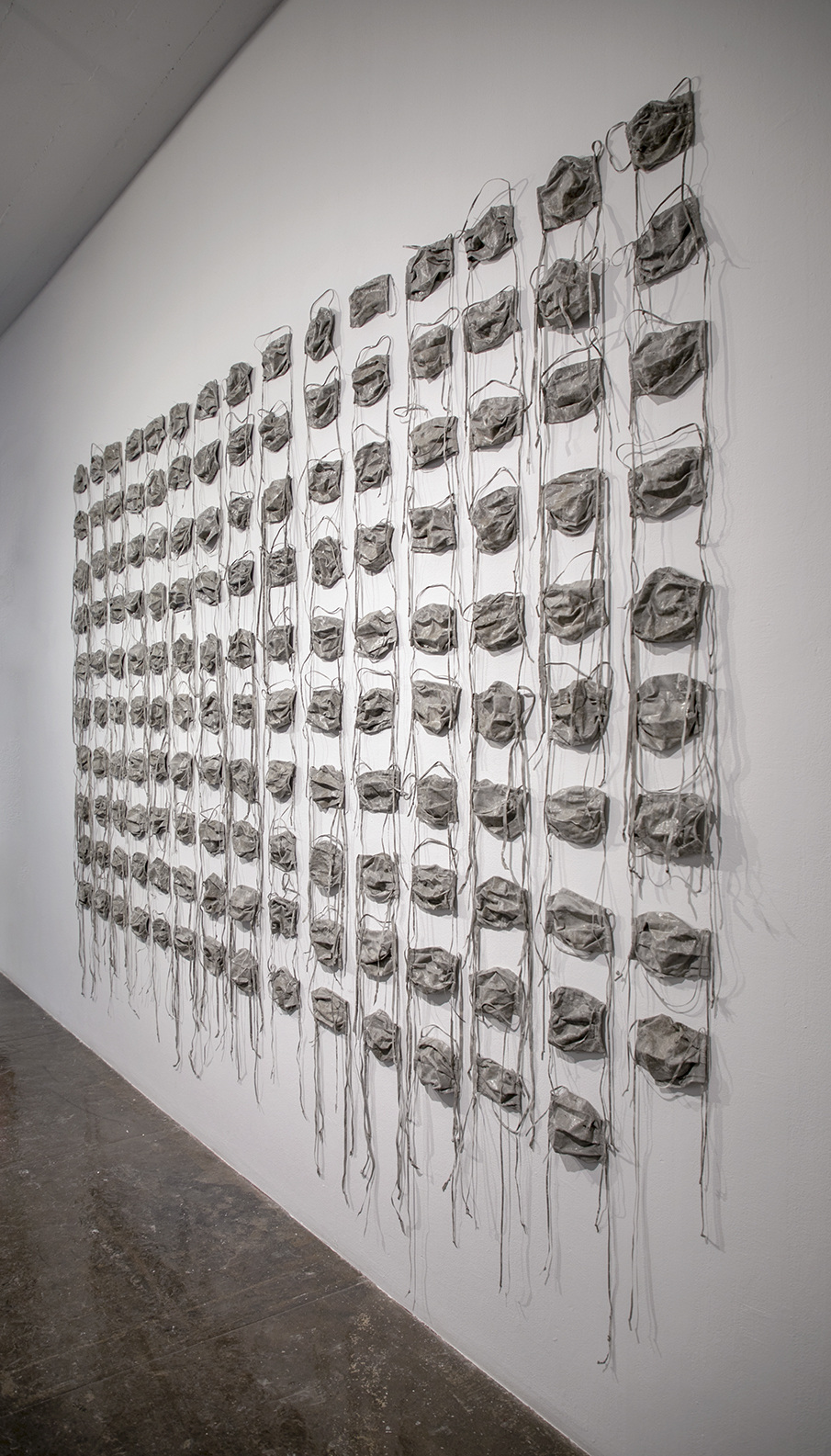
“In both ‘Each and Every’ and ‘A Breath,’ the cement removes the essence of life,” Liu says. “It removes the mask’s breathability and makes it this solid, hardened thing — instead of protecting our breath, as it did in the pandemic, it makes it impossible to breathe.”
Connecting to the Landscape
The shutdowns and uncertainty of the pandemic prompted Liu to reassess her artistic priorities. She realized she wanted to focus on environmental concerns and, in particular, felt called to visit the Arctic to create work responding to the effects of climate change.
“Whatever impacts these regions will impact all of us,” Liu says. “They’re the bellwether of what will happen in the rest of the world.”
Her research in the Arctic was supported by several residencies and awards, including the Pollock Prize for Creativity, a highly selective honor that pays tribute to the artistic legacies of Lee Krasner and Jackson Pollock. She was also selected as the Fulbright Arctic Chair, a prestigious scholarly appointment in the Fulbright research and cultural exchange program.
During her travels, she witnessed the ongoing evolution of a remote glacier. As the river of ice slowly moved forward, enormous sheets calved off with an explosive rumble. Between calvings, the glacier continued to creak and click, a sound reminiscent of the rattling of bones.
“It’s speaking the entire time,” she says.
Liu learned that climate change is imperiling the livelihood of the Sámi people, who are Indigenous to the Arctic. The reindeer dig through snow to forage, but sudden warm spells in the midst of winter, followed by plummeting temperatures, melt the snow and refreeze it into an ice crust that prevents the animals from reaching their food.
“As an artist, I don’t know what I can do, other than to observe, to respond, and to make work,” Liu says.
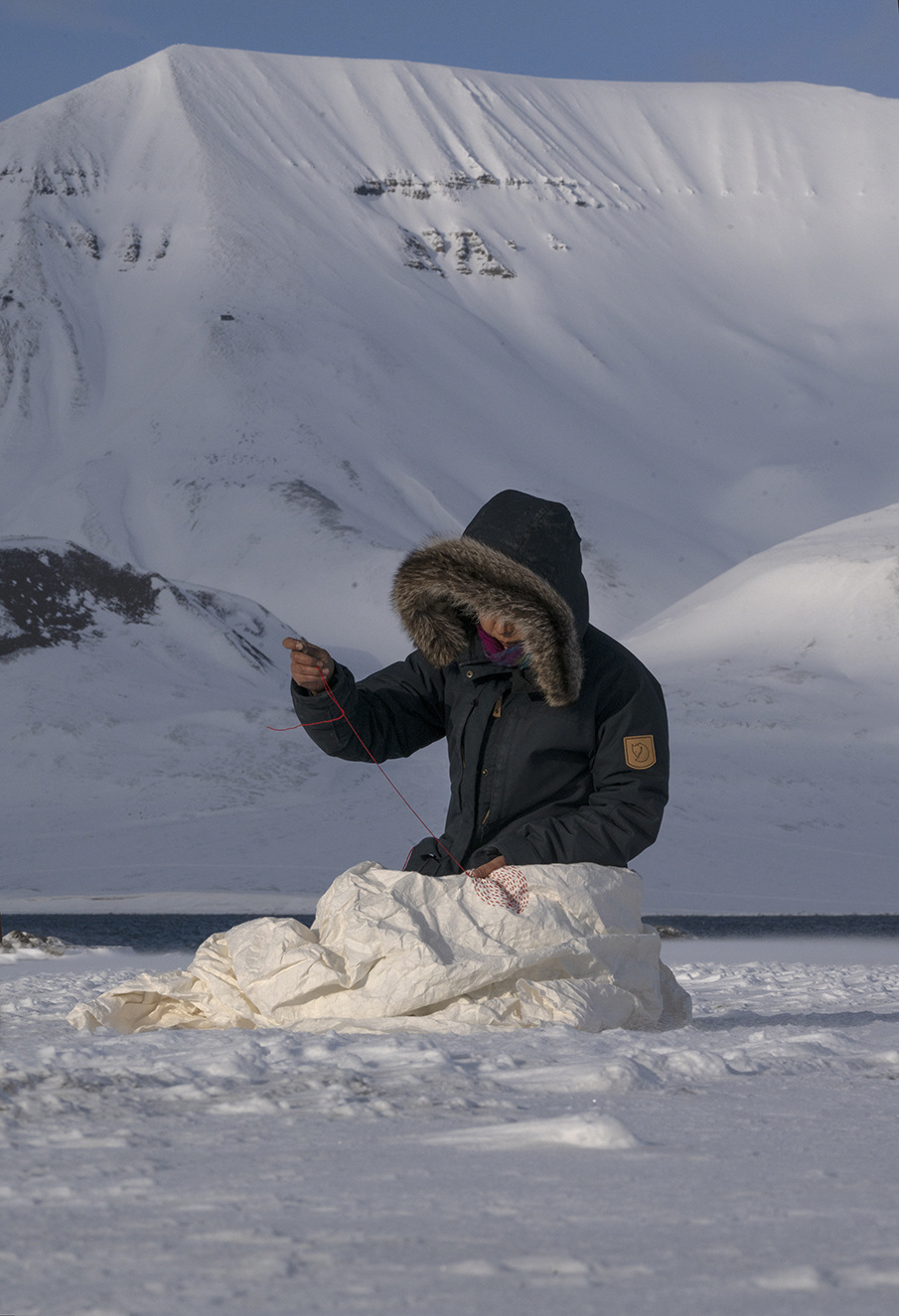
She decided to pick up her familiar tools of needle and thread. In a video-recorded performance she called “Arctic Mending,” Liu sat silently in the snow in several locations in Norway, sewing lines of tiny red stitches into a vast sheet of crumpled mulberry paper. As her fingers grew sore and then numb, she was filled with the same sense of calm she’d felt a decade earlier as she sewed beneath the canopy of scissors.
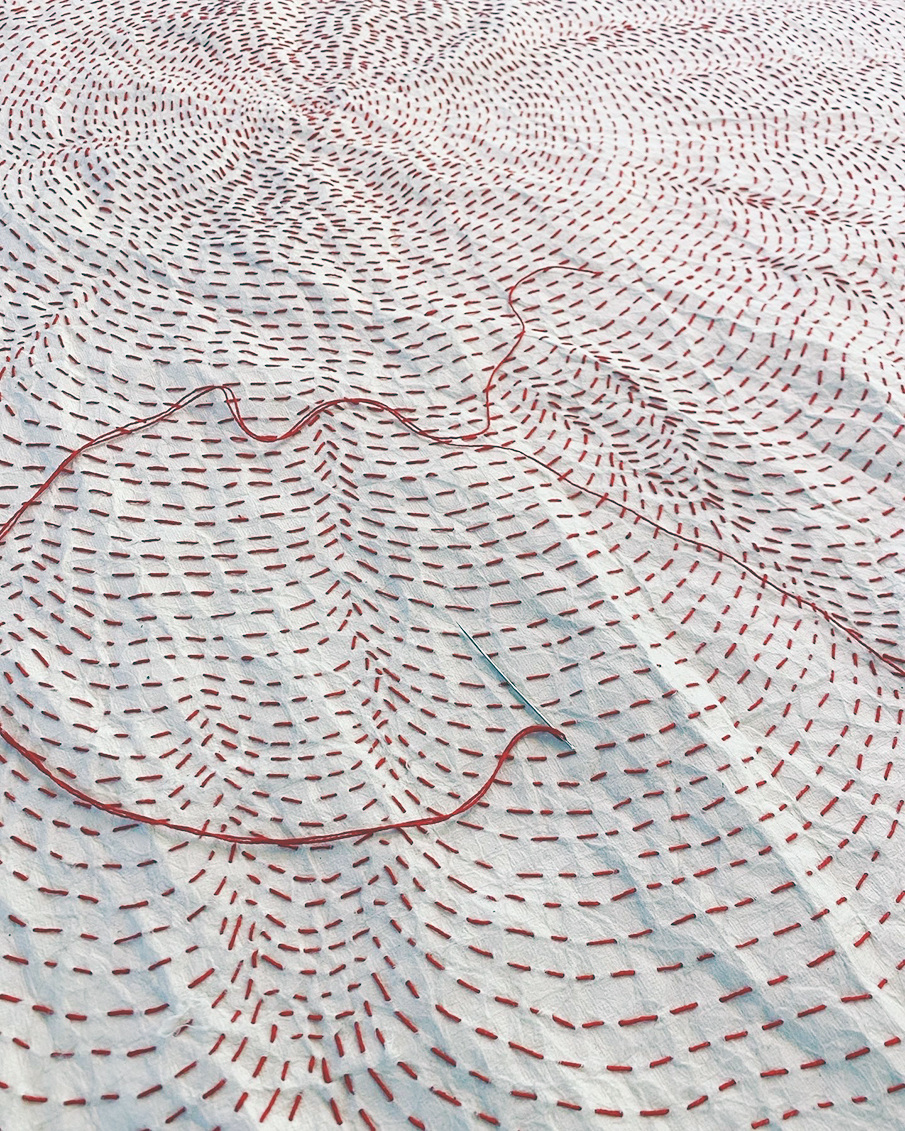
“This gesture of sewing, to me, is a gesture of healing, a sense of connection with the landscape, and an offering,” she says. The stitch-dotted paper, “Snow Mandala,” was displayed along with the footage of the performance at Hå Gamle Prestegard, an art and cultural institution in southern Norway, in 2023 and as part of the show “Buddha / Nature: Five Dialogues on Our Shared World” at the Museum of Fine Arts, Houston, in spring 2026.
In 2018, the Texas Commission on the Arts declared Liu the state artist of the year in three-dimensional media. In 2022, she was named an Andrew Carnegie Fellow, an honor that comes with a $200,000 award and is granted to scholars in the humanities and social sciences researching significant contemporary issues.
Even as Liu’s work continues to grow in scale and recognition, it is grounded in the same belief at the center of “The Mending Project”: that a repeated, humble gesture can accumulate into something powerful.
“Every small thing could lead to another,” she says. “An art piece could touch people. I have my needles and threads, and, with this act, if I can move one person, that’s making a difference.”
Robyn Ross is a freelance writer based in Austin.