Bridging Two Worlds
•
Photos by Ana Elisa Sotelo
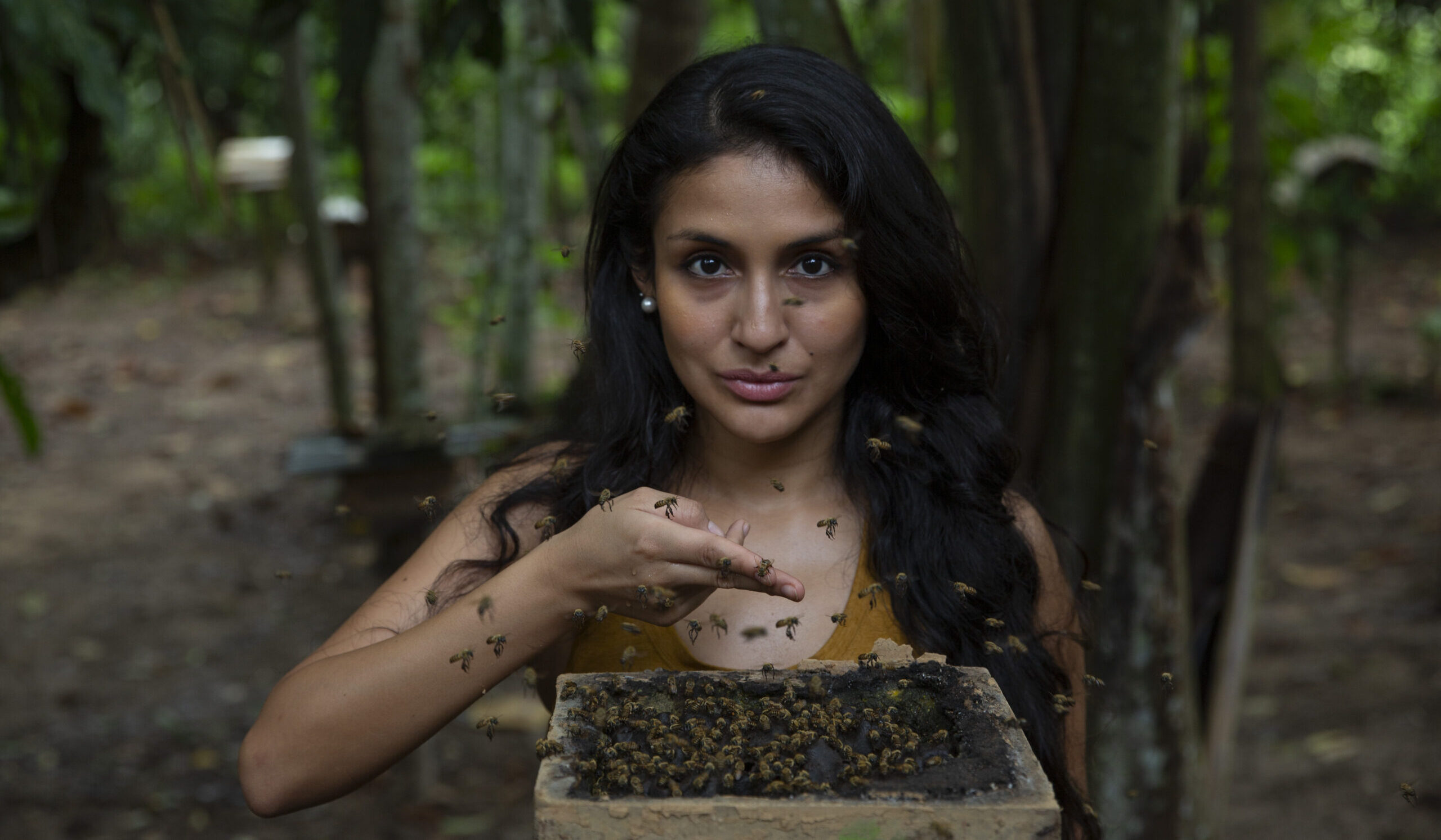
Rosa Vásquez Espinoza, PhD’21, stepped forward, leaning over the hive that contained thousands of Amazonian stingless bees. Her face was wet with honey she and her team had applied to draw the insects toward her. Almost immediately, she felt the brush of wings and the tickle of tiny feet on her face. She closed her eyes and focused on each slow inhale to still the pounding of her heart. Although she was surrounded by the cacophonous calls of jungle animals and birds, in her meditative state, she could hear only a persistent buzzing and her own breath.
Peruvian photographer Ana Elisa Sotelo captured image after image of Vásquez Espinoza’s face covered in bees. They were counting on the photos, which would be published in National Geographic, drawing the world’s attention to the insects. Stingless bees play a vital role in both the ecosystem and native Amazonian cultures, but they are increasingly threatened by deforestation and climate change.
The harrowing photoshoot paid off; shortly after the photos’ publication, Vásquez Espinoza was able to meet with members of the Peruvian Congress about the bees’ plight. Then, in fall 2025, the province of Satipo and the town of Nauta passed laws granting the bees the legal right to live free from human-created threats to their survival.
The ordinances were the world’s first granting such rights to an insect. A broad coalition of scientists, advocacy groups, and environmental lawyers joined Vásquez Espinoza in pressing for the change. The effort drew on her knowledge of science, her relationship with the rainforest and its Indigenous cultures, and her communication skills. The photoshoot played a key role.
“It was an intense and beautiful experience that has started a whole conversation,” she says.
Vásquez Espinoza is working to convene a larger conversation about how humans understand the natural world. A descendant of Quechua and Amazonian peoples, she has spent extensive time in the Peruvian rainforest, absorbing the traditional knowledge and spirituality of Indigenous peoples. She also has earned a doctorate in chemical biology from the University of Michigan, following the scientific method to analyze and understand natural phenomena.
Both perspectives have wisdom to contribute, Vásquez Espinoza argues in her book, “The Spirit of the Rainforest” (Gaia, 2025).
“The Western scientific world needs traditional knowledge to accelerate discovery,” she says. “But we need to do it in a way that integrates it into the conversation as co-authors and co-makers.”
Divergent Perspectives
Vásquez Espinoza grew up in urban Lima but spent holidays visiting the remote mountain and jungle communities of her ancestors. Her grandmother showed her how to extract traditional medicines and spiritual purifications from the plants she cultivated in her backyard.
“At home it was just so common to have these rituals and traditions and ways of interacting with nature,” Vásquez Espinoza says.
Only after a scholarship brought her to the United States for college did she realize the extent of the divide between the two worlds she occupied. In her final year, she interned at a hospital in Beijing that had wings dedicated to both Western medicine and traditional Chinese medicine.
“At a very unconscious level, I think I was trying to reconnect with some sort of traditional knowledge,” she says.
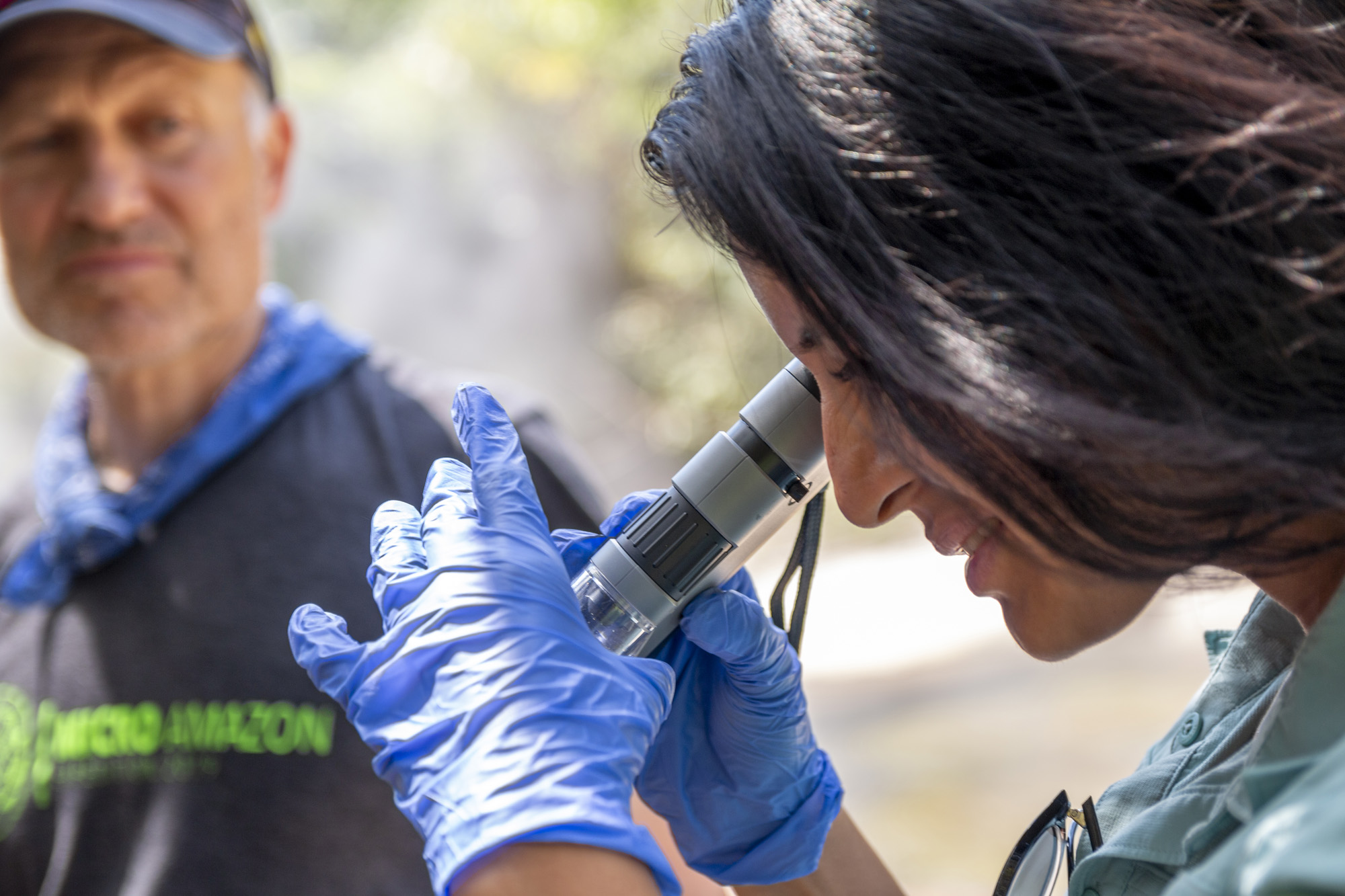
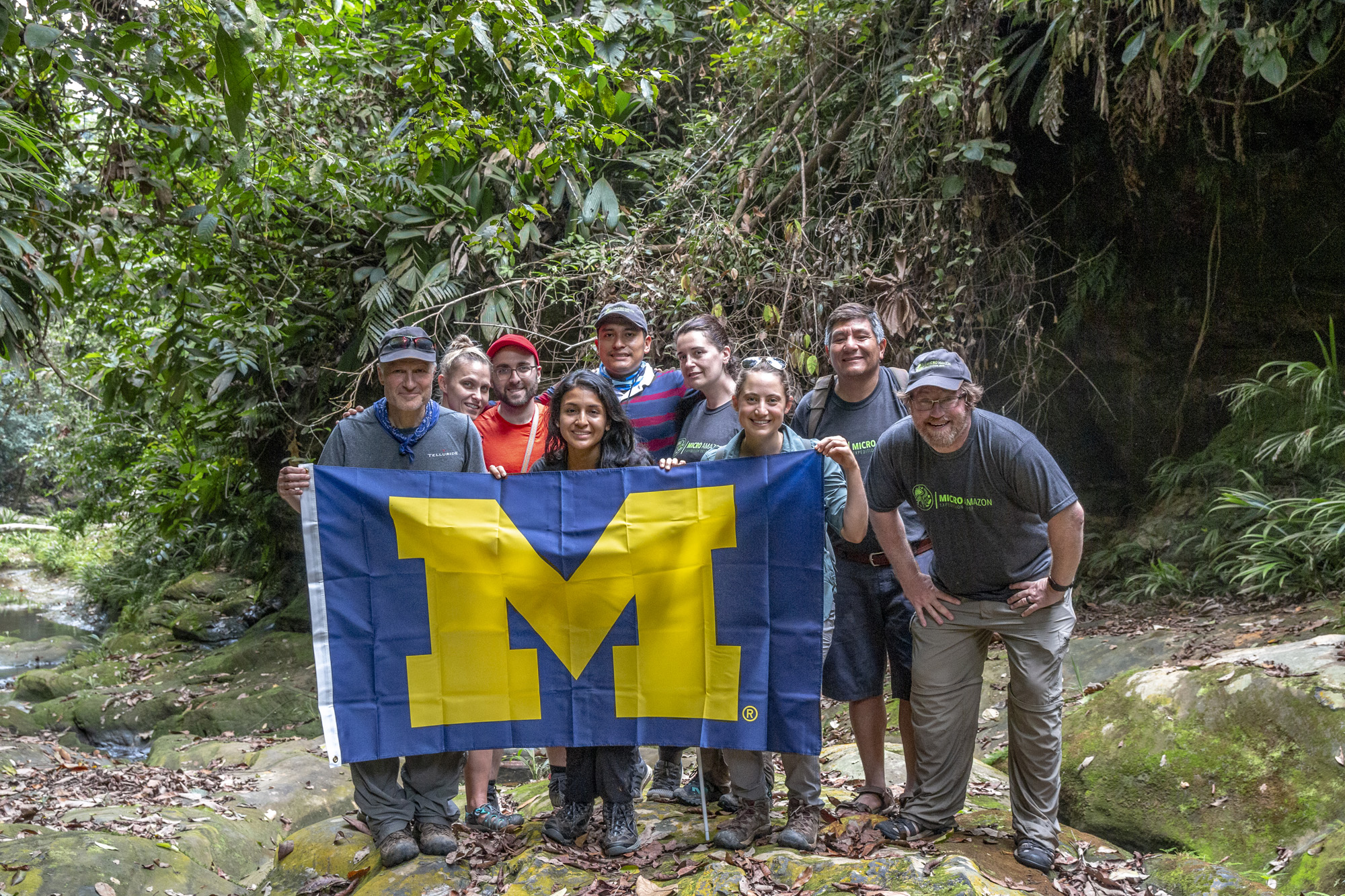
The experience inspired her to work to integrate science and Indigenous knowledge in her native Peru. To pursue that goal, she earned her doctorate in chemical biology at U-M, where she worked in the lab of U-M Life Sciences Institute research professor David Sherman, whose expertise is in nature-derived medicines.
“The University of Michigan was quite instrumental to forming my mindset in terms of scientific advancement,” she says. She specialized in the biochemical characterization of bacterial enzymes and molecules. At Sherman’s suggestion, she applied for — and earned — the role of National Geographic Explorer, a position for scientists who excel at communication and are ambassadors for the natural world. The honor came with funding that allowed her to accompany Sherman on a research expedition to a dramatic locale in her home country: the Boiling River.
A Dual Identity
Located deep in the rainforest — accessible only via a small plane and then a four-wheel-drive vehicle — the stretch of river froths and steams although it’s nowhere near a volcano. The team, which included researchers from Peru’s National Agrarian University La Molina, aimed to study the site’s microbes to see if they produced molecules that helped them survive and that might be useful in medicines.
The extreme environment “puts so much pressure on them that they are in this fight-or-flight mode, and then that forces them to make new chemistry that perhaps we haven’t seen before,” she says.
Sherman and Vásquez Espinoza collected soils and sediments at the bank of the river to remove samples of the brilliantly colored photosynthetic bacteria. Later, in the lab, they sequenced the organisms’ genomes and began analyzing the natural compounds they produce.
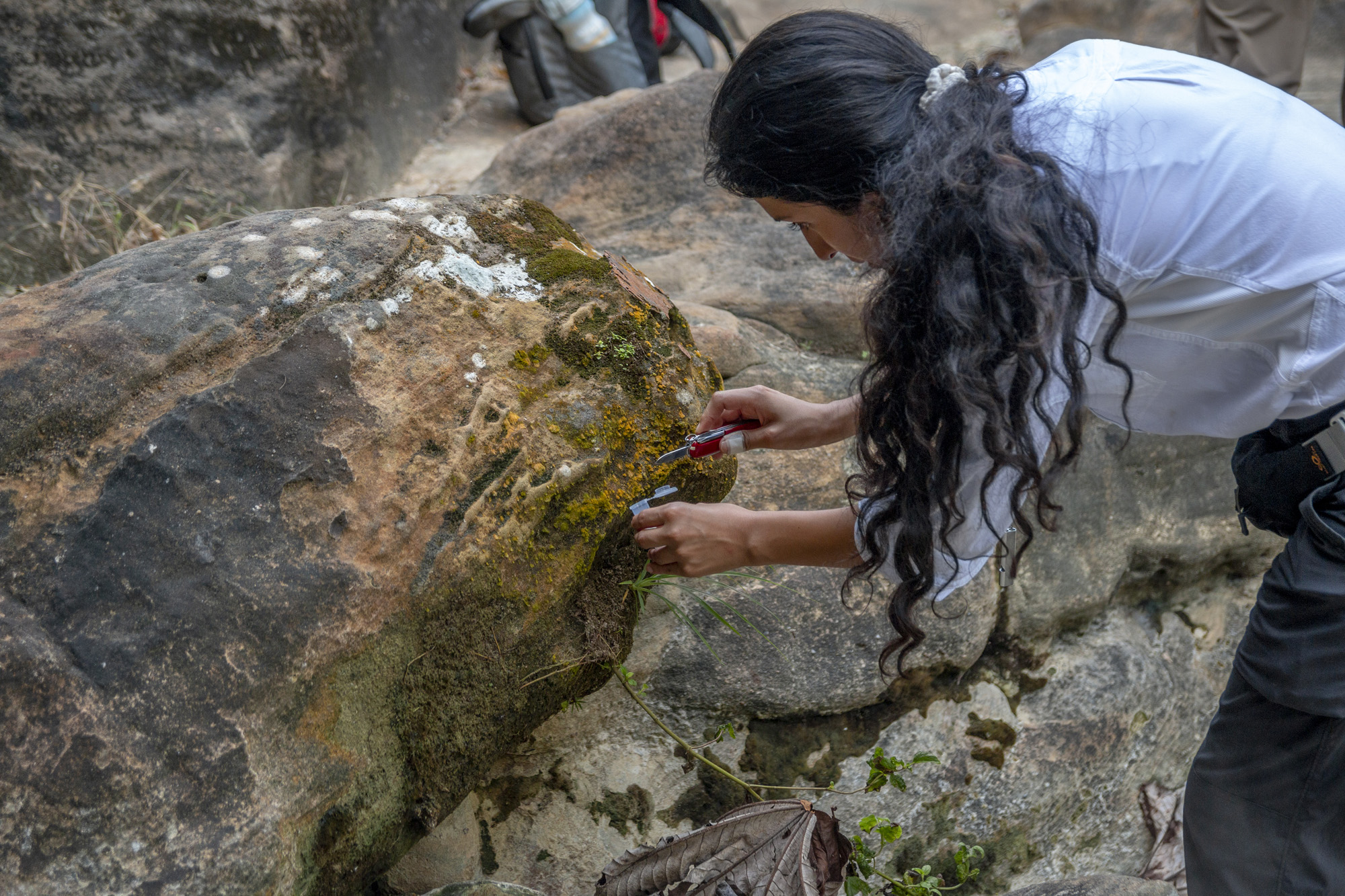
“She was really an outstanding student,” Sherman says. “Exceptionally ambitious, very talented, a unique person with access to both Indigenous culture and Western science. The duality she brings to the table is truly unique.”
The trip to the Boiling River, located in semi-autonomous Indigenous lands, had nudged Vásquez Espinoza to think more about that duality. She wondered if it was possible for science and traditional knowledge to enrich one another.
The Indigenous people in the region had little formal education and a different worldview from the researchers, but they had an abundance of knowledge about how the forest worked. If one of them had wanted to contribute to the science, how might that happen?
“All the scientific educational systems we have in academic universities, globally, are very Westernized,” she says. “We have one knowledge system, which is, of course, incredible for the achievements we’ve managed as a human people. But none of us are really exposed to other ways of acquiring information and Indigenous knowledge systems.”
Science as Justice
Vásquez Espinoza was pondering that challenge when a colleague in Peru contacted her about the stingless bees. People in Peru were using the bees’ honey to ease the symptoms of COVID-19, he said, and it seemed to work. As a chemical biologist, Vásquez Espinoza immediately wanted to understand the molecular composition of the honey, which could explain its medicinal properties.
But she soon realized the significance of the bees themselves. As the native bees of the Amazon, the insects were responsible for pollinating perhaps 80 percent of the rainforest flora. What’s more, some Indigenous groups’ origin stories described the bees as their ancestors.
“Not only do we have one of the most important pollinating species, but there is such a cultural connection with it,” she says.
Working with her Peruvian colleague Cesar Delgado, a scientist at the Institute of Investigation of the Peruvian Amazon, Vásquez Espinoza focused the energies of her newly formed nonprofit, Amazon Research Internacional, on raising awareness of the bees’ importance and the threats to their survival. She went on nocturnal expeditions with a native Kukama guide who could find them, by ear, buzzing in their hives in hollow tree trunks or holes in the soil. She advocated for their recognition and protection with Peruvian leaders but made little progress until the photos ran in National Geographic.
Meanwhile, Delgado introduced her to Richar Antonio Demetrio, an Indigenous Asháninka park ranger with an interest in science. In March 2025, Vásquez Espinoza, Antonio Demetrio, and three co-authors published a paper on traditional ecological knowledge about stingless bees in the journal Ethnobiology and Conservation. It was the first paper by an Asháninka Peruvian published in a scientific journal.
Collaborating with Indigenous researchers is “one of the ways in which we're starting to democratize science and the innovations or benefits that come from it."
—Rosa Vásquez Espinoza, PhD’21
A second paper published four months later in the Journal of Ecology and Environment called for the bees to be recognized under the Rights of Nature, a legal framework that would protect the bees and, by extension, the local communities that rely on them.
Collaborating with Indigenous researchers is “one of the ways in which we’re starting to democratize science and the innovations or benefits that come from it,” Vásquez Espinoza says. The publications provided the scientific justification for the Peruvian communities to change their policies to grant legal rights to stingless bees.
“Science is a tool of justice,” she says.
Vásquez Espinoza, who is based in the U.K., continues to advocate for the bees while working on other projects that use her gifts for science communication: public speaking, including appearances on behalf of National Geographic; nature and science documentaries such as short films promoting recycling and green cosmetics; and writing books about nature. Last year, she was honored with the prestigious UNESCO-Al Fozan International Prize, recognizing her “work on biodiversity in the Amazon integrating scientific innovation with Indigenous knowledge through multinational partnerships, for her mentorship of underrepresented researchers, and for advancing conservation strategies.”
She also received the New Explorer Award from the Explorers Club, a society founded in 1904 to promote scientific research and conservation. And she was among 13 women recognized with the Orden al Mérito de la Mujer, the highest honor given to women by the Peruvian government.
“Rosa is unstoppable,” says Andrés Ruzo, the director of the Boiling River Project, who met Vásquez Espinoza when she and Sherman first traveled to the region and has continued to collaborate with her. “If she wants to do something, she will approach it with a method and a focus and a determination that are really admirable.”
After the photos of her with the bees were published, she received hundreds of messages from girls and Indigenous people who were inspired by seeing a scientist who looked like them. Last year, Amazon Research Internacional organized a first-of-its-kind conference for Peruvian women, an event exploring the intersection of ancestral wisdom and modern science. Many attendees were from Indigenous communities, Vásquez Espinoza says, and made comments to the effect of, “If you’re doing this work, then I can too.”
“We’re making Indigenous people in science normalized,” she says. “That’s evidence that we’re heading in the right direction.”
Robyn Ross is a freelance journalist based in Austin, Texas.