In spring 1973, the job prospects for a recent LSA graduate with a journalism major looked dim, so I interviewed with a campus recruiter from Aetna insurance company and resigned myself to shuffling insurance policies and spending my working life in an office cubicle.
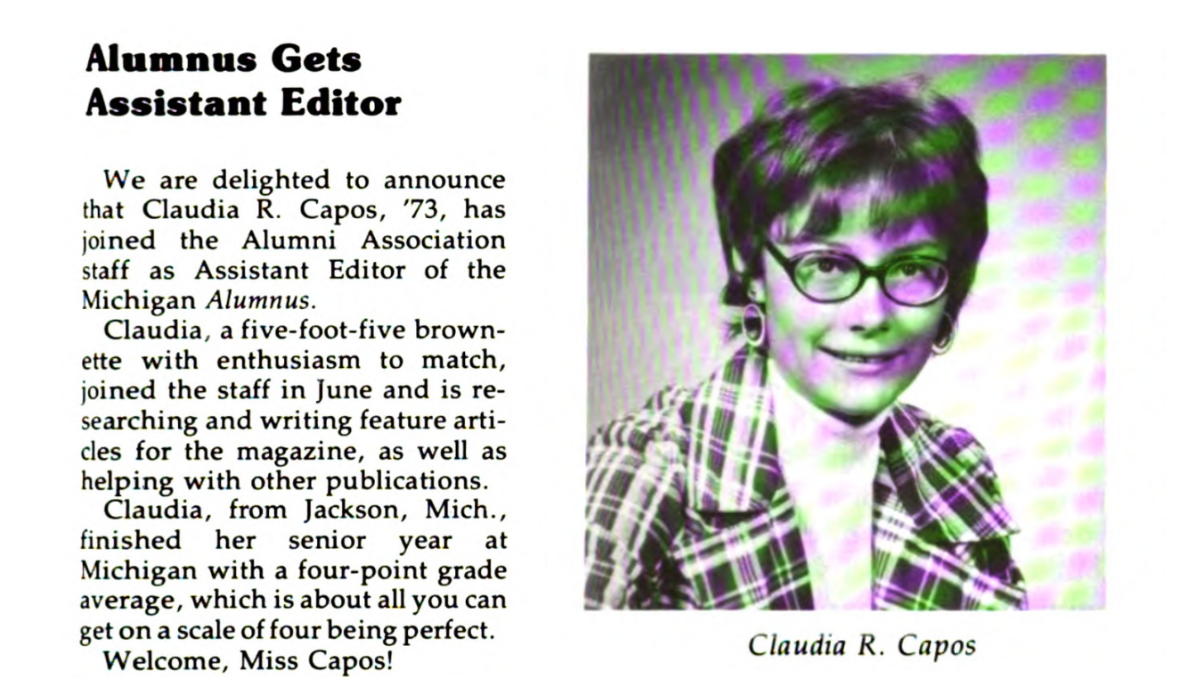
But U-M journalism professor William Porter came to my rescue by suggesting I talk with Dick Emmons, managing editor of the Michigan Alumnus, who was looking for an assistant editor. I knew nothing about the Alumni Association or the magazine, but I was game to give it my best shot.
I arrived at the Alumni Association office, then located in the basement of the Michigan Union, on a rainy day in June, wearing a navy-blue trench coat and wide-brimmed hat. Dick and I hit it off immediately, and he offered me the job. I accepted it without hesitation. This was a dream come true.
As soon as I settled into a desk outside Dick’s office with, yes, a manual typewriter and a stack of blank sheets of paper, I was ready to go. After all, there was plenty to do.
We had to produce a 36-page, full-size magazine every month (except in July and August when Dick was perfecting his golf swing at the Ann Arbor Golf & Outing Club), and we had no in-house photographer, graphic designer, layout artist, illustrator, copy editor, or proofreader to help us. Nada! I became a Jack/Jill of all trades.
From the get-go, I felt the magazine needed more visual pizazz and feature stories to elevate its appearance and appeal. Bill Stegath, ’42, MA’49, PhD’61, then director of field activities [and formerly the radio “Voice of the Wolverines,” who would be inducted into the Michigan Stadium Media Hall of Fame in 2016], showed me how to use the office’s trusty Pentax SLR film camera and off I went, shooting pictures of everything and everybody, everywhere.
I procured a U-M press pass, so I could capture the Wolverine gridiron action in the Big House from the sidelines. In one game, I nearly got trampled by running back Harlan Huckleby, who powered the Wolverines to three Rose Bowls from 1976-78.
I slipped backstage at Hill Auditorium and the Power Center to photograph the celebrities who performed on campus under the auspices of the University Musical Society. French pantomimist Marcel Marceau never uttered a word as I snapped frame after frame of his comic poses. Before one performance with the University Symphony Orchestra, Russian cellist Mstislav Rostropovich beckoned me to bring my camera into his dressing room. Then he closed the door, tightly. To my relief, he merely wanted my help in adjusting his tuxedo cummerbund.
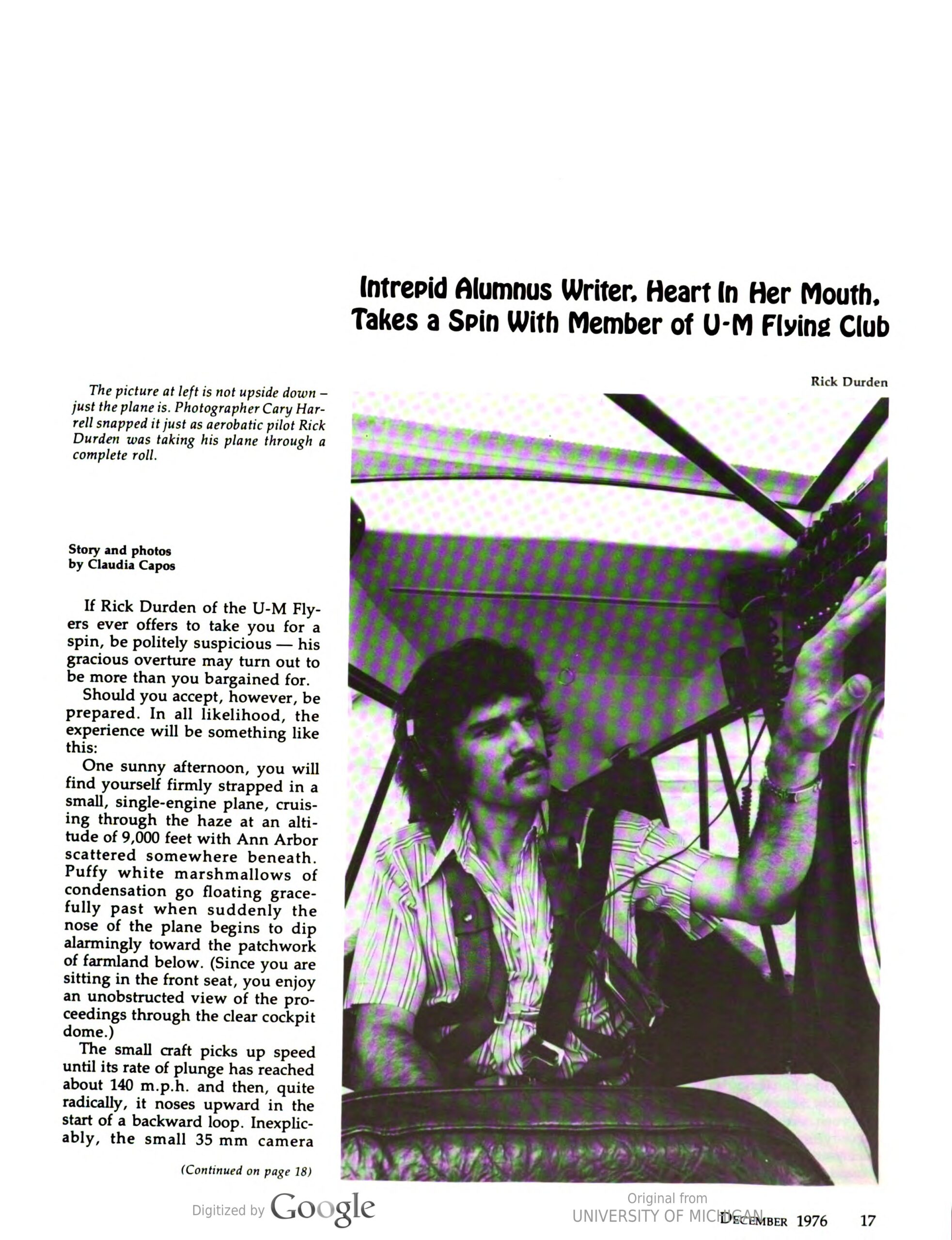
I even took to the skies in a Bellance Citabria aerobatic airplane piloted by a member of the U-M Flyers so I could photograph the world while flying upside down. After a local photo studio botched the film development, I went back up in the Citabria the next day to reshoot the stunt flying.
Soon Dick and I had a steady stream of black-and-white photographs to illustrate the magazine’s feature stories, news, and events. We introduced colored matte and glossy paper stock on the cover, experimented with different headline typefaces, and added visual drama to the layouts. We also commissioned illustrations by Milt Kemnitz and cartoons by Harley Schwadron.
The Michigan Alumnus was stepping up its game, and people were starting to notice. But in my mind, we were just getting started.
More than anything, I wanted to seek out the University’s most illustrious graduates and bring Alumnus readers along as I talked to these highly accomplished men and women about their lives, careers, and ties to Michigan.
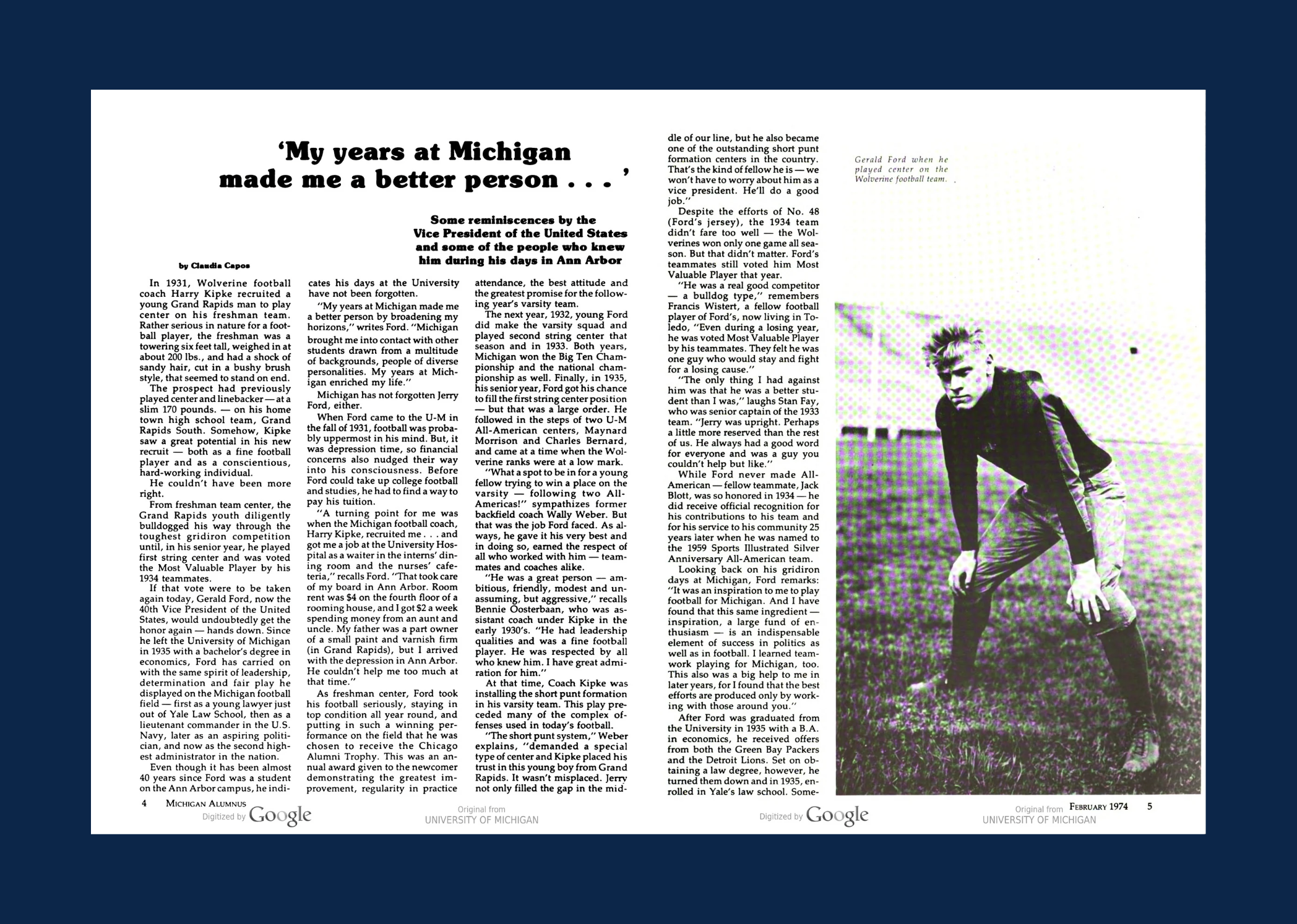
After Gerald Ford, ’35, HLLD’74, was appointed the 40th vice president of the U.S. in December 1973, I wrote a cover story detailing his reminiscences of playing football under U-M head coach Harry Kipke, 1924, and wove in anecdotes from former teammates. When Ford assumed the presidency in August 1974, following President Richard Nixon’s resignation, I headed to Washington, D.C., to interview a coterie of U-M alumni in the nation’s capital.
At the White House, I chatted with Ford’s college chum and former law partner, Philip Buchen, ’39, JD’41, who had been tapped to be presidential legal counsel. I also stopped in the office of the President’s personal physician, Navy Rear Admiral William M. Lukash, MD’56, who was charged with overseeing the First Family’s care. In Georgetown, I caught up with the President’s chief economic adviser, Bill Seidman, MBA’49, HLLD’94, and rode with him in his chauffeured limo to his White House office.
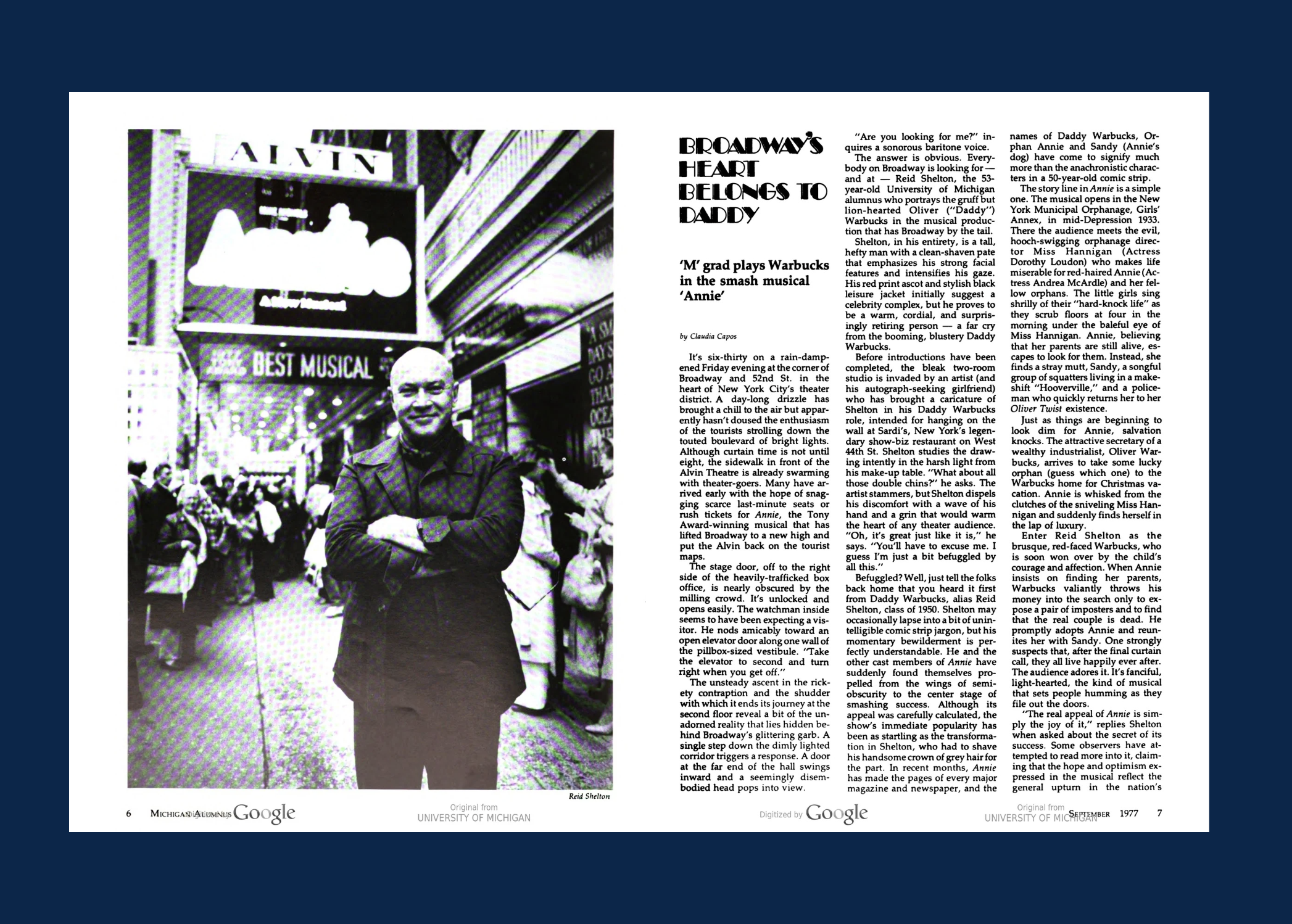
My quest for prominent alumni took me to the Big Apple, where, during a Monday dress rehearsal of Strauss’ “Adriadne Auf Naxos” at the Metropolitan Opera, I tracked down Russ Christopher, ’53, MMUS’54, who was dressed as a 17th-century German peasant. Later, I ducked through the stage door of the Alvin Theatre on West 52nd Street to interview actor Reid Shelton, MMUS’50, who was playing Oliver “Daddy” Warbucks in the Tony Award-winning musical “Annie.”
Novelist Gael Greene, ’55, the celebrated food critic for New York Magazine, invited me to her Standford-White apartment on 73rd Street to sip tea, nibble French chocolates, and recount the ups and downs of her literary career. At the offices of The New Yorker magazine on West 43rd Street, I was ushered into the inner sanctum of editor William Leonard Shawn, who spent several years at U-M. “Mister Shawn,” who refused to do interviews, made an exception for the Michigan Alumnus. However, when I pulled out my camera to take his picture, he tried to slip out of sight behind his desk.
My peripatetic travels eventually took me to Tinseltown where I followed up with television script writer Max Hodge, ’39, movie actress Marian Mercer, ’57, and television producer/director Hal Cooper, ’46.
As always, my Michigan Alumnus credentials opened doors and provided an entrée to remarkable U-M graduates who were eager to share their campus memories and career highlights.
I left the Alumnus in 1978 to continue my journalism career at the Detroit News, but I still look back fondly on my exciting days with the magazine.
Claudia Capos, ’73, is a writer based in Ann Arbor.